Nathanael Szobody

pollinator
+ Follow
since Apr 25, 2015
Merit badge: bb list bbv list
For More
Boudamasa, Chad
Apples and Likes
Apples
Total received
In last 30 days
8
Forums and Threads

Recent posts by Nathanael Szobody

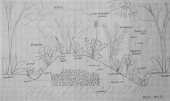
I'm skeptical. It's the whole "basket in the middle" thing. That stuff decomposes. How is this a permanent system? I do some keyhole-shaped beds, but i just put a standard "pile" in the middle.

In fact, I do lots of keyhole gardens,  arranged along paths in a branching pattern. But really,  the shape and layout could easily change from year to year. What's permanent about this?
5 minutes ago
Ranson,

I cannot tell you where to get split peas without rocks (except in my local market) but washing them out is not terribly difficult.

Put them in a very round bowl, and pour in water until they are covered. Pour quickly so the peas and rocks are all stirred up.
Pour the water back out and let some of the topmost peas flow out with it.
Pour only water back into the bowl and repeat: pour the water out and let the topmost peas flow out with it.
Continue until you are left with a small amount of peas and lots of rock/sand in the bottom.
Offer this last bit to the compost gods.
21 hours ago

(Photo credit to Nancy Reading)

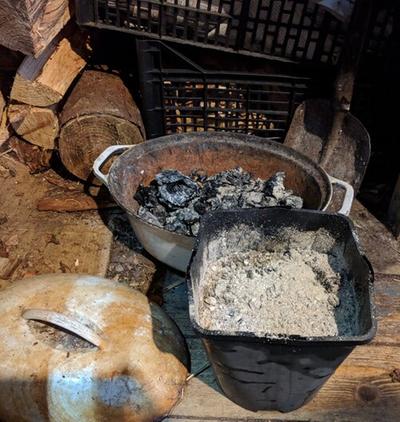
What is wood ash?

Wood ash is the residual material left over from the combustion process of burning wood. Wood ash is a fine black/grey powdery substance. Wood ash is primarily made up of calcium carbonate (Around 20%-50%) but also contains a variety of other mineral compounds. The combustion of wood creates roughly 10% ash as an end result. Hardwoods are reported to create more ash than softwood species. Branches and leaves produce more ash than heartwood. Wood ash is reported to increase the cation exchange capacity (CEC) of soils when applied.

As a general rule of thumb, most applications of wood ash for soil are recommended at an interval of once a year.

Uses
  • Liming Agent - Wood Ash is caustic (PH of around 10 to 12) and can be utilized to adjust soil PH.
  • Mineralization - Wood ash is a notable source of calcium and potassium. Wood ash contains many other minerals as well.
  • Nutrients - NPK 0-1-3
  • Traction Aid for Snow/Ice
  • Uses in textile dyeing.
  • Ingredient for Lye
  • Slug/Snail/Cutworm/Flea Beetle/Clubroot treatment option
  • Glass Cleaner/Metal Polish - Paste made of ash and water.
  • Deodorizer - Wood ash can help keep offensive odors down.
  • Nixtamalization
  • Ingredient for Pottery Glaze
  • Baking Leavener
  • Flavoring agent in stews and sauces
  • Annealing Agent for Metalworking


  • Considerations
  • Wood ash is a caustic material and can cause harm if not handled with respect. Consider using both skin and breathing protection when handling wood ash.
  • Wood ash mixed with high nitrogen materials can encourage volatilization of the nitrogen into the air.
  • Ensure the source of your wood ash is free of contaminates that could persist into the ash. Burning only firewood and natural materials is recommended to ensure good quality wood ash.
  • Wood ash can introduce salts to soil so care should be had to avoid overapplication.
  • Applying too much wood ash at once (especially in the rain) can lead to potassium runoff issues.


  • Related Threads
    Food Grade Lye
    Uses for Wood Ash
    What to do with Wet Wood Ash?
    Uses for Wood Ash (Paul's Thread)
    Wood Ash as a Cleaning Agent
    Ash vs Biochar
    1 day ago
    Post in the art forum??

    *deep breath*

    Ok....
    1 day ago
    That looks great!

    ... maybe I could do that...
    1 day ago
    Nancy,

    Do I hear you volunteering?

    1 day ago
    Wow it's been five years! I decided that I needed to practice more before I preached. So after five years I feel much more confident proceeding.

    I have written about 2/3 of the first draft and am having so much fund doing it. The book is a reference book for regenerative ag techniques in Africa.

    It has become quickly apparent to me that this is going to take LOADS of illustrations. It's a how-to book, it's got to show how it's done. Building a keyhole garden bed, for instance, needs to show the steps, one-by-one.

    The first challenge, of course, is finding illustrators. I think I need to raise funds to hire some, because hundreds of illustrations is no joke.

    The second challenge is distribution. How in the world (or Africa) do I get this thing to the people who need it all over an entire continent. Development orgs?

    Anyway, the writing is fun.
    1 day ago
    Adding synthetic materials to concrete has its environmental concerns.

    The Roman's did not do this. They mixed in sea salt,  sea shell powder and other additives that in effect are "self repairing". They are materials the do, in fact dissolve slightly with moisture but recrystalize to fill in cracks. It's a dynamic chemical response to moisture.

    Also, you have to understand the limits and appropriate use of your materials. The Roman's would not have installed a pool above structural concrete. Pools were in- ground and plastered with lime, which is easily repaired from season to season.

    Foundations in contact with moist soil were not poured  concrete but stone,  poured concrete being reserved for dry areas like roofs.

    Context context context. And maintenance.
    4 days ago

    Mike Barkley wrote:Do you have varroa mites, hive beetles, or any other bee pests or diseases common in your area? Any reason to think something might be wrong? Do you know how to deal with any of those potential problems? It's hard to give a good answer to your question from so far away & not knowing your particular situation. My guess is it's probably best to leave them alone.


    Alright, I'll go with leaving them alone for now. Honey bees here are native and ubiquitous. I doubt there's a problem.

    My one concern is the heat. Naturally they occupy hollow trees where temperatures are pretty stable. A plywood hive is not the same, and temps get really hot here in March-May. In this season temps are in the mere 90's F, and they already are pretty inactive midday. So I put a pile of corn stalks on top of the lid and covered that with a cloth. I think that will mitigate direct heating of the hive by the sun, but ambient temperature is still going to be a challenge I think. I know Europeans traditionally covered their woven hives in cow dung for insulation. I could try something like that eventually...Thoughts?

    3 weeks ago
    Well, Ambitious 28 Year Old, care for a trip to Africa? Cuz you'll learn skillz...
    3 weeks ago