George Yacus

pollinator
+ Follow
since Sep 27, 2018
Merit badge: bb list bbv list
Biography
I am a Navy veteran (former Search and Rescue helicopter pilot) turned farmsteader and Permaculture Designer at Revival Permaculture LLC.

https://www.revivalpermaculture.com

My latest project is milling lumber and building my farm business office from scratch, as well as tending 250 black locust trees and a young organic orchard.
I have my PDC from Shenandoah Permaculture Institute (Fall '23).

I am open to pro bono design work as I expand my permaculture portfolio. Purple Mooseage me at the link below if you would like to rent my imagination for a little bit!

https://permies.com/forums/pm/sendTo/258910
Apples and Likes
Apples
Total received
In last 30 days
2
Forums and Threads

Recent posts by George Yacus

I noticed there is a new version of Principles & Pathways available.  

I confess that I have not read the first version, but I am familiar with the 12 principles such that I can rattle them off at least.

Has anyone read both versions, and is the updated one worth it compared to the original? Is this a book worth buying  - or better borrowing?  How about the original?  Thanks for the insight!
1 week ago
A quick search shows bat guano (available for purchase) has an NPK ratio of 7-3-1.

Valuable stuff!  

There's so much value wildlife provides that we don't even think about.  For instance, I just learned a new word:

Chiropterophily.

It means pollination of plants by bats -- we're looking at you, bananas, mangoes, agave, guava and cacao!  So in addition to hunting mosquitoes and fertilizing plants with poop, we get... chocolate!?

Likewise, think about the nutrient cycling function of seabirds' guano or salmon swimming upstream, transferring all these trace elements and bits and bobs that washed into the ocean back up to the mountains.  Amazing.

So then, the question we begin to ask as permaculture designers is how best to provide for these animals' needs so as to best capture all these energy and nutrient flows?  That's a fun question to entertain.
1 week ago
I am constructing a multifunctional cabin-office to serve as my permaculture lair, and am at the point where I am considering electric.

I have adequate power supply for my expected loads in the form of:

✓ Portable battery+inverter power banks & solar panels. 120V & 12V & USB capable.
✓ Gas generator. 120V & 240V capable.
✓ Stand alone small solar for DC lighting systems and phone charging. Biolite Solarhome 620, USB capable.

Where I am wembling is whether to (A) jazz things up, or (B) keep things stupidly simple.  Elaboration to follow.

Option (A) Jazz it up.

Hard-wire outlets in the cabin office (120V and perhaps 12V later, too).  Nice outlet covers would be flush against home sawn wood paneling, and cables run behind finished walls or run within EMT if exposed.  Systematically in my head it looks like...

120V Power bank (or generator with shore power through a bulkhead) -> Transfer Kit -> Main breaker panel -> UF cabling -> Outlets -> Loads.  

If I did go jazzy, I expect only four to six circuits, 15A loads or less.  I.e:
1) Tool nook w/ battery chargers.
2) Grow nook w/ seed mats, task or overhead lighting, grow lamps.
3) Cooking nook.
4) Window AC || table saw || air compressor.  
5-6) Maybe in the future I run some UF outside to an organic pool bubble pump or fountain, or install some neat lighting, or a water heating circulation system, irrigation, etc.

vs.

Option (B)  KISS.

Just move the bank(s) or run an extension cord as needed.  Maybe later jazz it up.  Focus on getting the cabin dry and insulated and clean first.

120V Power bank -> Loads.  

Option (A) is nice and prevents rework, but takes time and $.  Studwork is  currently exposed.

Option (B) is speedy and inexpensive.  Time is precious.  Worst cast I just pull paneling off to run wiring later.

I could use a nudge either way.  Also, I am curious if there is an Option (C) that is somewhere between the two. It seems silly having a Transfer kit and a main breaker without a service entry connection.

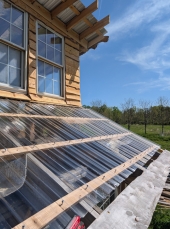
Picture attached as a sneak peak!

3 weeks ago
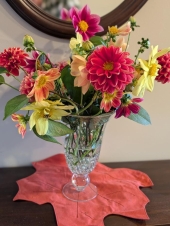
With winter's frosty approach, I decided yesterday to dig up maybe five or six Dahlia plants which I grew from seed this year — or perhaps two years ago, as this is only our third year growing Dahlias and several overwintered fine in USDA zone 7 last year.  

I decided to dig up only the yellow-flowered ones for now.

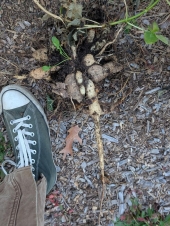
Now the younger plants only had a small handful of tubers each, but I was pleasantly surprised with the volume of tubers on one of our presumably older plants, shown below.  One of the tubers was a full cubic in length!  I'm digging them up to propagate and move to more advantageous locations come spring.

In the process, I removed a few of the non-viable tubers, and decided to take them upstairs to the kitchen.  Dahlia tubers have a rich history of edibility, and since I know my soil is free from ick, I peeled a golf ball sized tuber, sliced it and took my very first bite this morning.

Wow y'all!  

I would describe the flavor as a lovely floral mix between ginger and carrot.  

The texture was also very pleasant.  Not as dense or starchy as I was expecting, but rather lighter with good moisture.  I tried frying some briefly in olive oil, but decided it tasted way better fresh and cool.  I'm excited to grow and try some more!
3 weeks ago
Whoopsie Daisy Dahlia

As the sun sank lower today,
I sought to harvest the last remnant of summer's colors
to bring inside and brighten the mood a bit.
But what I did not seek to do,
was bumble a bee's final platter of pollen — a yellow Dahlia.
"Whoopsy daisy!  Didn't see you there."
I decided first to join my guest for an afternoon snack,
and promptly picked a fallen petal for a nibble.
"Hmm...tastes better than lettuce."
Then I scooped my little guest up
in a tiny plastic cup.
"Back to the garden, little friend."
1 month ago
I made orange chicken once.  That's gotta count for somethin'.
1 month ago
A nearby library has such a makerspace, mostly devoted to sewing and fiber crafts, but it also has a few 3D printers.  I don't make many trips there, but it doesn't seem especially well utilized any time I drop in.  

(A big part of that, I suspect, is that the surrounding suburban culture has more of a go-go-go working mentality.  And the space, while colorful, lacks that cozy "come and stay a while" welcome feeling.)

So I think the idea is fun, but the secret sauce would be really understanding the surrounding community needs and target audiences, and then crafting (pun intended) the space to their needs.

For example, designing a cozy and inviting space and events for...

1) Urban stay-at-home mom with kids in tow nearing nap time:
  - Need close social interaction with other parents
  - Need safe place for kids to play semi-supervised
  - Need quick projects, easy to pick up and start or finish

vs.

2) Suburban after-school teenager clique:
  - Need a comfortable place to hang out in small, private groups, or solo undisturbed
  - Need Wifi
  - Need right level of challenge / risk / reward in projects

vs.

3) Rural singles working on challenging long term projects late into the evening.
  - May need deeper instructional expertise from teachers (compared with newbie crafters)
  - May need more space or more advanced equipment
  - May need consistent offline marketing and communication to maintain buy-in to projects
  - Challenge to create connections among individuals of different skills and respecting introvert vs extrovert needs

1 month ago
If I were in the tropics as opposed to sub tropics, I would definitely test the fast growing Moringa tree to see if it reseeds easily.

An organization I recently had some training from (Equipping Farmers International) has heard of very good results with Moringa in the Global South.  It's a complete protein — especially good for nursing mothers.  I hear it can be grown as an annual, or brought inside.  I think I will try it out next spring.  Also a spectacular chicken feed I hear.

For a wider range, how about a native nitrogen fixer, Apios americana?  aka Groundnut.  I have not yet grown or purchased any, but I know some permies on here sell it.  

I bet Eric Toensmeier could rattle off a bunch more in his book...

https://permies.com/wiki/20163/Perennial-Vegetables-Eric-Toensmeier