• Post Reply Bookmark Topic Watch Topic
  • New Topic
permaculture forums growies critters building homesteading energy monies kitchen purity ungarbage community wilderness fiber arts art permaculture artisans regional education skip experiences global resources cider press projects digital market permies.com pie forums private forums all forums
this forum made possible by our volunteer staff, including ...
master stewards:
  • Carla Burke
  • Nancy Reading
  • r ransom
  • John F Dean
  • paul wheaton
  • Jay Angler
stewards:
  • Timothy Norton
  • Pearl Sutton
  • Tereza Okava
master gardeners:
  • Christopher Weeks
  • M Ljin
gardeners:
  • Jeremy VanGelder
  • Matt McSpadden
  • thomas rubino

Obsessed with these beautiful English hedges (1940s England)

 
pollinator
Posts: 3935
Location: Kent, UK - Zone 8
741
books composting toilet bee rocket stoves wood heat homestead
  • Likes 11
  • Mark post as helpful
  • send pies
    Number of slices to send:
    Optional 'thank-you' note:
  • Quote
  • Report post to moderator
This popped up on my facebook feed today. A lovely gentle video of the craft of hedge laying. I even learned a few tricks, and have my eye on a few new tools.

In particular:

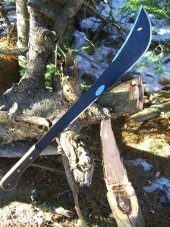
The slashing tool that they used first to remove brambles and the like. It makes so much sense to clean up the area properly before you start the detail work of laying. I have a decent billhook, but his axe looks like a useful addition.


pioneer
Posts: 66
Location: North Country New Hampshire
11
8
dog books solar
  • Likes 5
  • Mark post as helpful
  • send pies
    Number of slices to send:
    Optional 'thank-you' note:
  • Quote
  • Report post to moderator
So is the idea to force the hedge into thinking it needs to send roots out by first slashing it then laying it down near the ground so it can put out runners?

What types of trees make hedges like this ?

Had to look up billhook ... never saw one before (or a slasher for that matter) ... who knew there were so many !


Looks like they are till being made today in the UK :D
 
Michael Cox
pollinator
Posts: 3935
Location: Kent, UK - Zone 8
741
books composting toilet bee rocket stoves wood heat homestead
  • Likes 5
  • Mark post as helpful
  • send pies
    Number of slices to send:
    Optional 'thank-you' note:
  • Quote
  • Report post to moderator
Burton - There is a huge variety of hedging plants in the UK. Hazel, blackthorn, hawthorn, holly, ash etc...

You describe bending branches down to force them to root - which is definitely used when trying to encourage gaps to fill - but for the most part the bent branches just continue to grow in their new position, sending up vertical shoots. The weaving process, followed by the regrowth, makes for a dense stock proof barrier right down to ground level.
 
Michael Cox
pollinator
Posts: 3935
Location: Kent, UK - Zone 8
741
books composting toilet bee rocket stoves wood heat homestead
  • Likes 4
  • Mark post as helpful
  • send pies
    Number of slices to send:
    Optional 'thank-you' note:
  • Quote
  • Report post to moderator


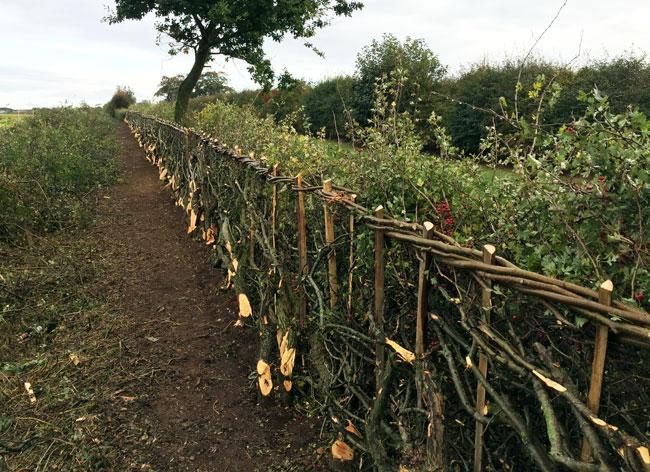
Here in the UK when we see hedge laying these days it tends to look more like the image above. It looks absolutely beautiful to look at, and is definitely stock proof... but the labour required to construct that level accurate detail is a step up again beyond what is required to build a functional stock proof barrier. Hedge laying has become essentially a status symbol for the wealthy, rather than a practical system of boundary management. Growing labour costs are certainly a part of it, and the number of skilled practitioners has fallen as well. But typically here we see hedges backed up by wire fences. The need to be stock proof is gone, so the desire to maintain the hedges properly is lost. The end result is tall windbreaks, but not a stock proof barrier - and massive gaps at ground level.
 
Posts: 8
  • Likes 1
  • Mark post as helpful
  • send pies
    Number of slices to send:
    Optional 'thank-you' note:
  • Quote
  • Report post to moderator
I come back to re-watch this video once in a while.  Thanks so much for sharing!  Definitely a skill I want to learn someday.
 
Posts: 50
Location: Eastern Ontario, Canada Zone 5b
8
  • Mark post as helpful
  • send pies
    Number of slices to send:
    Optional 'thank-you' note:
  • Quote
  • Report post to moderator
I was looking for information on hedging, and once again Permies delivers!

I currently have a broken down wire fence with a row of silver maples in front of it. My goal is to eventually have a stock-proof fence along this line, so my goal is to start growing some hedge-able plants between and start laying them down in a few years.
 
Posts: 75
13
  • Likes 2
  • Mark post as helpful
  • send pies
    Number of slices to send:
    Optional 'thank-you' note:
  • Quote
  • Report post to moderator
https://youtu.be/WoprVhpOKIk

I think I really like the idea of making natural fencing like the video shown. Can anyone tell me what plants to use for this purpose? These hedges don't have to be maintained but for once every couple to five years, I understand.

What kind of plants can make these hedges? Is there anything that can be used for another purpose besides just fencing?

I'm fine without the option, though. Can anyone point me toward more resources that I may more fully consider this technique? It's like beautiful art work to me. Thanks!
 
Posts: 35
Location: West Virginia
17
  • Likes 1
  • Mark post as helpful
  • send pies
    Number of slices to send:
    Optional 'thank-you' note:
  • Quote
  • Report post to moderator
I think hedgerows are great, and there seems to be no end to what you can put in them.

I like this combination myself: Autumn Olive, Willow, Hazelnut, Mulberry, Black Locust, Spicebush, and Blackberry. The Mulberry and Black Locust might need to be coppiced/pollarded. And how about Comfrey along the edges as a root barrier to help keep things in their place?

Acanthus grass is another option I've seen used as a living fence.

George Washington advocated the use of Honey Locust for a living wall and hedgerow, but that is one mean plant to tangle with.
 
out to pasture
Posts: 13090
Location: Portugal
4156
goat dog duck forest garden books wofati bee solar rocket stoves greening the desert
  • Likes 6
  • Mark post as helpful
  • send pies
    Number of slices to send:
    Optional 'thank-you' note:
  • Quote
  • Report post to moderator

A Northamptonshire hedger is ably assisted by a smiling land girl eager to learn the rural craft of hedge making and maintenance in this gentle instructional film, made by the Realist Film Unit for the Ministry of Agriculture.


https://www.youtube.com/watch?v=WoprVhpOKIk

Transcript...


England is a country of mixed farms and where cattle and corn grow side by side. You need hedges to keep stock from straying from one field to another and to give them shade in summer and a windbreak in winter. But hedges need looking after. This one is too bulky and wastes a lot of the field space. This one is too tall and its shadow will ruin any crops growing near it. The taller it grows the thinner it gets at the bottom and then you get a result like this where the hedge is useless for keeping stock out and the farmer has to use a wire fence as well. One of the best ways of filling in gaps and making up a thin and scraggly hedge is laying or flashing. For this job the hedger needs a stout slasher for cutting out the briars and dead branches, a billhook for making the actual cuts or preaches, a pair of leather mittens when handling the thorn and a good sharp axe for the heavy chopping.

This is Deighton, a Northamptonshire hedger who was well-known in the district and does many of the local hedges today. His assistant is a land girl who is learning the job. She works ahead on the first rough clearance and Deighton follows on with his slasher getting rid of the tangle of briar and dead sticks from the hedge. This will leave him with only the live wood which is what he wants for the layers. Layering is a job for the autumn. The sap has ceased to rise and besides the bare branches let you see what you're doing. After clearing a short stretch Deighton can begin on the actual layering. He uses his billhook to make a clean cut unique stem near the ground and then bends it down away from the cut. The cut must not go too deep into the stem. It must leave a good tongue of wood to carry the sap but quite a small cut. Most branches will bend down easily to discourage cattle from eating the young shoots when they begin to grow. Deighton puts the thorny ends on the side away from the ditch as that side will need more protection. After preaching the branches Deighton carefully trims off the lip of each cut and tidies off the stump from which the branches grow otherwise moisture and rotting leaves would collect there and cause die back, that is destroy or weaken the new shoots.

Meanwhile his assistant is working ahead, clearing away the brambles. Here Deighton has reached a place in the hedge which was layered years ago but as you can see the preachers were made far too high above the ground. As he continues he has to remove any dead stumps that get in the way of his layers. This one is another relic of badly done layering.

Now for the stakes and binders to hold firm the length of hedge he has layered. Deighton makes a point of binding each day's work as he goes along in case anything happens to it overnight, so he always sees that he has a bundle of stakes and binders ready. Often he can get them from the hedge he's working on.  Chestnut cut about five feet long makes good stakes. The binders are of hazel, elm or willow about seven or eight feet long. First he puts a good point on the bottom end of the stakes. Then he threads them in and out through the layers two or three feet apart to keep the thorn firm in position. The binders go at the top two at a time woven in and out of the stakes and twisted over each other to make a neat basket like finish. Then the stakes are driven in good and firm. The final touch is to level them off at the top and this is a neat way Deighton does it.

By now his assistant has finished her clearing and she's anxious to try her hand at the layering. As with any job the main thing is to get to know the tools and to learn how to handle them properly and not cut right through the thorn. Then she has to know where to make the cut - not too high but just above the ground level so the split runs right to the ground when the layer is bent over. Soon she'll be getting on quite nicely and be really useful in assisting Deighton in his job.

Layering certainly makes a good hedge and the finished job is a pleasure to look at. Next year shoots will have grown up from the stumps and all along the layered branches filling in the body of the hedge. This hedge will not need layering for another 15 or 20 years but it should however be trimmed. Before the first trimming the hedge should be allowed to grow for at least two years. A slasher is the best tool. Use the strong upward cuts as downward strokes would injure the plants where the cut is made.

Hedges are always trying to grow into trees. Trimming them each year helps to keep them bushy and make them grow at the bottom. A triangular shape is best sloping to a point at the top. It's easy to trim and stays stock proof at the base for a long time. At the end of the job the trimmings are collected into bonfires and make a good ash for the fields. If hedges are well layered and trimmed regularly they'll last for years and do their job properly. Their neat appearance is something a farmer can be proud of.

 
Burra Maluca
out to pasture
Posts: 13090
Location: Portugal
4156
goat dog duck forest garden books wofati bee solar rocket stoves greening the desert
  • Likes 5
  • Mark post as helpful
  • send pies
    Number of slices to send:
    Optional 'thank-you' note:
  • Quote
  • Report post to moderator
Hehe - spotted this in the comments to the video...

A stout slasher, a billhook, and a good sharp axe. I call that cutting-hedge technology.

 
Posts: 158
Location: Prairie Canada zone 2/3
70
  • Likes 5
  • Mark post as helpful
  • send pies
    Number of slices to send:
    Optional 'thank-you' note:
  • Quote
  • Report post to moderator
I came across this old video on hedge laying, and thought it might be useful to folks.  Here it is:

Content minimized. Click to view
 
pollinator
Posts: 185
Location: Haute Vienne, France
29
2
forest garden books woodworking
  • Likes 3
  • Mark post as helpful
  • send pies
    Number of slices to send:
    Optional 'thank-you' note:
  • Quote
  • Report post to moderator
This is a great video.  It tells you all you need to know. Layed hedges, especially those with a ditch and bank and using a lot of thorn species is a very solid barrier indeed. When I get on some land (hopefully REALLY soon) I'm planning on planting for this kind of hedge.
Apparently I'll need to plant on 20cm (9 inch) centers and wait until they are 2.5m (8ft) high before the first laying.
 
Posts: 31
2
  • Likes 4
  • Mark post as helpful
  • send pies
    Number of slices to send:
    Optional 'thank-you' note:
  • Quote
  • Report post to moderator
Do you think Osage Orange would work well for a layered hedge, or is it too vigorous/sucker too much? There are quite a few of these on my property I've been thinking about turning into deer proof "fortifications" (can you guess some of the depredation problems I've been facing?).
 
master gardener
Posts: 5872
Location: Carlton County, Minnesota, USA: 3b; Dfb; sandy loam; in the woods
3406
8
forest garden trees books chicken food preservation cooking fiber arts seed woodworking homestead ungarbage
  • Likes 2
  • Mark post as helpful
  • send pies
    Number of slices to send:
    Optional 'thank-you' note:
  • Quote
  • Report post to moderator
I don't have a source at this point, but I've read Osage Orange was a typical frontier hedge tree.
 
pollinator
Posts: 278
Location: Italian Alps, Zone 8
135
hugelkultur duck forest garden fungi foraging chicken food preservation homestead
  • Likes 21
  • Mark post as helpful
  • send pies
    Number of slices to send:
    Optional 'thank-you' note:
  • Quote
  • Report post to moderator
I came across this lovely retro video of a farmer couple building a live fence. I don’t know if it has been posted on the forum yet. Feel free to remove if it has.
I just enjoyed watching this, and those outfits are on point! I’m impressed by the level of skill applied at keeping his pipe in his mouth through all of that work!

I was wondering what kind of plants could be used for anything like this. I can imagine many shrubs not surviving such a rigorous chopping at their base. Seems like you would need some very hardy plants; Or do they not care if the plants die?

http://youtu.be/WoprVhpOKIk
 
gardener
Posts: 1268
Location: North Carolina zone 7
459
5
hugelkultur forest garden fungi foraging ungarbage
  • Likes 1
  • Mark post as helpful
  • send pies
    Number of slices to send:
    Optional 'thank-you' note:
  • Quote
  • Report post to moderator
Well that was about the coolest thing ever! My mind keeps coming back to mimosa trees as a decent start for a new hedge. Yes, I’m well aware of the issues with this tree but I still love them. Of course once you have the hedge going I’d want to use the entire thing as a trellis for climbing vegetables. The use my mimosa trees in this fashion often by planting cucumbers along a the bottom. You just have to be aware to keep that side of the tree free from too much growth. A couple years ago I made a small wattle fence from cedar post and fresh mimosa slashings. It was dry and brittle by this spring but may offer a fast growing, nitrogen fixer hedge. Scott
 
S. Bard
pollinator
Posts: 278
Location: Italian Alps, Zone 8
135
hugelkultur duck forest garden fungi foraging chicken food preservation homestead
  • Mark post as helpful
  • send pies
    Number of slices to send:
    Optional 'thank-you' note:
  • Quote
  • Report post to moderator

Scott Stiller wrote:Well that was about the coolest thing ever!. Scott


Isn’t it? I really like the look of the hedges too. And the farmers wide pants. I want me a pair of those!

What would be the issues regarding the mimosa trees?

I was thinking if black locust could be used for a hedge like this. They are certainly fast growing and will likely survive the rigorous cutting at the base. And the added thorns are a bonus to help keep intruders out, be they of the two legged or four legged kind.
Do you think that would work?
 
Scott Stiller
gardener
Posts: 1268
Location: North Carolina zone 7
459
5
hugelkultur forest garden fungi foraging ungarbage
  • Likes 1
  • Mark post as helpful
  • send pies
    Number of slices to send:
    Optional 'thank-you' note:
  • Quote
  • Report post to moderator
Locust trees don’t grow well where I live. I’m not sure I’ve ever seen one up close. They are nitrogen fixers and the thorns are definitely a plus.
Mimosa trees are also a nitrogen fixer but they do aggressively spread by seed. I don’t feel like they are an issue on the land I work though. The seedlings are very easy to spot and remove. They can take all the cutting and chopping you can throw at it and continue growing.
 
S. Bard
pollinator
Posts: 278
Location: Italian Alps, Zone 8
135
hugelkultur duck forest garden fungi foraging chicken food preservation homestead
  • Mark post as helpful
  • send pies
    Number of slices to send:
    Optional 'thank-you' note:
  • Quote
  • Report post to moderator

Scott Stiller wrote:Locust trees don’t grow well where I live. I’m not sure I’ve ever seen one up close. They are nitrogen fixers and the thorns are definitely a plus.
Mimosa trees are also a nitrogen fixer but they do aggressively spread by seed. I don’t feel like they are an issue on the land I work though. The seedlings are very easy to spot and remove. They can take all the cutting and chopping you can throw at it and continue growing.


I’m fortunate to have black locust growing wild on my property already. They do really well here.
I want to transplant a few of them that have sprouted on difficult spots and move them to create a hedge to border the property. Plus I love the flowers on them so tasty and they smell incredible.
I wonder how old your trees would need to be for you to bend them over into the hedge.
 
Scott Stiller
gardener
Posts: 1268
Location: North Carolina zone 7
459
5
hugelkultur forest garden fungi foraging ungarbage
  • Likes 1
  • Mark post as helpful
  • send pies
    Number of slices to send:
    Optional 'thank-you' note:
  • Quote
  • Report post to moderator
Maybe a year old. They are very flexible and grow like mad.
 
gardener
Posts: 570
Location: Central Texas
239
hugelkultur forest garden trees rabbit greening the desert homestead
  • Likes 2
  • Mark post as helpful
  • send pies
    Number of slices to send:
    Optional 'thank-you' note:
  • Quote
  • Report post to moderator
That was an excellent video! I've seen pictures of the layering process, but it was really helpful to actually see it in action. It's awesome how the trees only need a small sliver of bark/cambrium intact for the cut trunks to continue growing. I just wonder how many years he'd been doing it in order to be that fast/efficient...

This makes me want to go plant all of the willow whips and Osage orange seeds I have waiting to be planted to make a hedge.

I love mimosas, and could see them working for a hedge. The only negative I could see is they tend to be short-lived; but it would probably be easy to replace them as they died just from letting well-placed seedlings grow up beside the parent trees.

Thank you for sharing that very cool video!
 
Scott Stiller
gardener
Posts: 1268
Location: North Carolina zone 7
459
5
hugelkultur forest garden fungi foraging ungarbage
  • Likes 1
  • Mark post as helpful
  • send pies
    Number of slices to send:
    Optional 'thank-you' note:
  • Quote
  • Report post to moderator
They are very easy to replace, They’re everywhere!
They are such a great pioneer plant that I’m not even sure they could grow in a rich environment for long. They could give it a great start though. I’ve got some rock hard clay that I have no idea how it even found a crack to grow out of. But, it does.
 
Posts: 246
Location: Wales, UK
11
forest garden trees woodworking
  • Likes 5
  • Mark post as helpful
  • send pies
    Number of slices to send:
    Optional 'thank-you' note:
  • Quote
  • Report post to moderator
Hedge laying! The art is seeing a bit of a revival here in the UK, or so it seems when driving around the countryside. The hedging mixes for sale for the establishment of new hesges generally comprise of mostly hawthorn and blackthorn but can also include hazel, willow, cherry... Most of our native deciduous trees can be layed although elder isn't considered desireable. Not sure why but possibly just tradition/superstition.
 
gardener
Posts: 3491
Location: Fraser River Headwaters, Zone3, Lat: 53N, Altitude 2750', Boreal/Temperate Rainforest-transition
697
hugelkultur forest garden fungi trees books food preservation bike solar woodworking
  • Mark post as helpful
  • send pies
    Number of slices to send:
    Optional 'thank-you' note:
  • Quote
  • Report post to moderator
Any plant that would coppice or pollard well, should be able to handle this type of abuse.  

I can imagine many shrubs not surviving such a rigorous chopping at their base. Seems like you would need some very hardy plants; Or do they not care if the plants die?  

 Many plants would die if treated like this, true.  But many plants can and will shoot up from an established root.  The point is that you have to get an established root on your tree or shrub first.  In my area, willow, cottonwood, poplar, alder, birch, hazel, and maple would be good candidates.  It is important that the plants not die, as a completely dead hedge becomes brittle (which a cow could force its way through, if it was hungry at corn time), and in my opinion is far too much of a fire hazard to keep around.  There is a structure called a dead hedge, and you can search about it on this site, and some people advocate them as well.  
 
Michael Cox
pollinator
Posts: 3935
Location: Kent, UK - Zone 8
741
books composting toilet bee rocket stoves wood heat homestead
  • Mark post as helpful
  • send pies
    Number of slices to send:
    Optional 'thank-you' note:
  • Quote
  • Report post to moderator
I posted about this a few months ago. It is a lovely video :D

The term is hedge laying, and there are lots of regional styles and techniques. It is making a comeback it the cycle of cutting leads to a healthier and more vigorous hedge.

Hedge Laying
 
Michael Cox
pollinator
Posts: 3935
Location: Kent, UK - Zone 8
741
books composting toilet bee rocket stoves wood heat homestead
  • Likes 2
  • Mark post as helpful
  • send pies
    Number of slices to send:
    Optional 'thank-you' note:
  • Quote
  • Report post to moderator

Sam White wrote:Hedge laying! The art is seeing a bit of a revival here in the UK, or so it seems when driving around the countryside. The hedging mixes for sale for the establishment of new hesges generally comprise of mostly hawthorn and blackthorn but can also include hazel, willow, cherry... Most of our native deciduous trees can be layed although elder isn't considered desireable. Not sure why but possibly just tradition/superstition.


Elder - it grows faster than everything else, shading and smothering the plants around it. A hedge with elder left to grow ends up with gaps and won't be stock proof.
 
pollinator
Posts: 364
Location: East tn
99
hugelkultur foraging homestead
  • Likes 1
  • Mark post as helpful
  • send pies
    Number of slices to send:
    Optional 'thank-you' note:
  • Quote
  • Report post to moderator
Autumn olive (invasive) and rose of Sharon (bush hibiscus) can handle this type of "abuse".

Loved the video, thanks for posting.

 
pollinator
Posts: 181
Location: Zone 7a, 42", Fairfax VA Piedmont (clay, acidic, shady)
36
forest garden fungi urban chicken woodworking homestead
  • Likes 3
  • Mark post as helpful
  • send pies
    Number of slices to send:
    Optional 'thank-you' note:
  • Quote
  • Report post to moderator
I don't think Black Locust would work in this fashion, as it does not really coppice; it just root suckers.  But you could keep it pruned down to say 8 ft with a long hedge trimmer, and it would fill in and get denser.  Osage Orange is supposed to grow very dense and thorny in this fashion, along with hawthorn.  I think some crab apples get thorny too.

Helpful video on some hedging plants:
 
pollinator
Posts: 1610
Location: Root, New York
334
forest garden foraging trees fiber arts building medical herbs
  • Likes 6
  • Mark post as helpful
  • send pies
    Number of slices to send:
    Optional 'thank-you' note:
  • Quote
  • Report post to moderator
yeah i saw this when it was posted earlier. very cool little vid.

while everything about it is cool, watching them do this...one of my fave things about this video is the girl helper/intern.
now- it's more gender politics than i like to get into, but for the time and place i am happy to see sister helper there. and she kicks ass too =)

 
Kc Simmons
gardener
Posts: 570
Location: Central Texas
239
hugelkultur forest garden trees rabbit greening the desert homestead
  • Mark post as helpful
  • send pies
    Number of slices to send:
    Optional 'thank-you' note:
  • Quote
  • Report post to moderator

J Davis wrote:Autumn olive (invasive) and rose of Sharon (bush hibiscus) can handle this type of "abuse".

Loved the video, thanks for posting.


I wondered about Rose of Sharon (also called Althea around here). I sell a lot of them at the market, but typically have a bunch of cuttings/seedlings left over at the end of market season that I just plant in random places to free up the pot & space, so it might be worth some experimenting to use them in a hedge.
 
Scott Stiller
gardener
Posts: 1268
Location: North Carolina zone 7
459
5
hugelkultur forest garden fungi foraging ungarbage
  • Mark post as helpful
  • send pies
    Number of slices to send:
    Optional 'thank-you' note:
  • Quote
  • Report post to moderator
Rose of Sharon is a great idea! A mix of them and mimosa would be my pick for around here.
 
what if we put solar panels on top of the semi truck trailer? That could power this tiny ad:
Learn Permaculture through a little hard work
https://wheaton-labs.com/bootcamp
reply
    Bookmark Topic Watch Topic
  • New Topic