Richard Gorny

gardener
+ Follow
since Mar 08, 2013
Merit badge: bb list bbv list
Forum Moderator
Richard Gorny currently moderates these forums:
For More
Poland, zone 6, CfB
Apples and Likes
Apples
Total received
In last 30 days
12
Forums and Threads

Recent posts by Richard Gorny

Well, not exactly the trees alone, but an effect of their existence :)

My homestead's backyard. Fallen leaves mostly from TWO nearly 200 years old trees - linden and maple. I collect them with land mower and I put them shredded on garden beds. One spiral bed to the left has been already covered.
1 week ago
You are saying that you are in the urban area, what is the size of your garden, and what is its type?

The size determines amount of woodchips needed, and the type of a garden determines whether they need to be chopped, or perhaps you could use "chop and drop" method just with pruners.

I use RCW as a mulch in urban containers. I was experimenting with RCW mulch versus a typical Back to Eden style woodchips mulch and honestly I did not find any difference in case of my very poor, sandy soil.

For my forest gardens, I do not bother chipping, I just chop all prunings and drop under the trees.

As to the pedal-powered wood chipper, take a look here.
1 week ago
I'm afraid that the first few seconds of any video makes a difference these days.
Either you catch attention and people keep watching it, or they scroll away.
I think the beginning of this video is not attractive enough to keep people watching.
On the other hand, card show that starts around 0:38 is way more interesting. Perhaps starting with something like that is better option?
Well, such system is a nice addition to the house and allows to learn fish and plant growing, but the system is small. And in case of aquaria, the smaller system, the more difficult it is to maintain. 10 gallons of water with fish requires way more maintenance than 100 gallons. Take it into account.

I'm sorry to say that your wife said not to that project.

So you are going to revamp your plan? If yes, take one more thing into account: a permaculture perspective.

I am afraid, that many of indoor aquatic systems do not meet energy audit. They use more energy and resources than they produce. Power for the pump, filtration, lighting and heating cannot be easily compensated with let's say lettuce grown in them, in terms of energy.

Of course, joy of playing with such system is a yield too, but when planning such system I would have a permaculture principle of "Minimum resources, maximum yield" in mind.
2 weeks ago
It depends :)

In the kitchen garden composed of raised beds, I usually end up the season with covering the surface with an inch or two of compost. That is all what I do in terms of maintaining fertility of these beds.

In the main crop garden, I use heavy mulch (fallen leaves, spent strawbales) at the end of the season. In spring, I throw a handful of compost under each seedling I plant there.
2 weeks ago
It depends on a level of an angler :)
At the start, all bodies of water are pretty much the same, you cast into it whatever you've got, and hope for the best.
Then, you start differentiate - for current speed or lack thereof (the stronger the current, the heavier gear and lures)
For the depth, from surface lures to deep diving ones, etc.
So the difference can be none or enormous, depending how you approach fishing.
The species of fish is also important, it is entirely different way of fishing for let's say river brown trout and lake trout.
And season, weather, light, temperature, all play role on the advanced level.

If I had to point out just one difference between fishing lakes and rivers, that would be the way of planning your fishing. On rivers, you have to decide wheather you fish upstream or downstream and adjust your gear and tactics for that, while on lakes you do the same but for shallow or deep first :)
2 weeks ago

Douglas Alpenstock wrote:Perhaps the UK and EU have different systems also?


Well, yes and no. Mathematically EU and US are mostly identical, but in practical gardening, they are worlds apart. Here is a quick breakdown of what you need to know (I will use Poland as example).

The Similarity: The Thermometer Formula

On paper, the baseline is exactly the same. Both US Zone 6 and Polish Zone 6 are defined by the average annual minimum winter temperature:
• Zone 6a: -23.3°C to -20.6°C (-10°F to -5°F)
• Zone 6b: -20.6°C to -17.8°C (-5°F to 0°F)
If you are growing hardy herbaceous perennials (like Echinacea, Hostas, or Daylilies), they behave identically. As long as their roots don’t freeze past their genetic limit, they will pop back up in the spring whether they are in Ohio or Masovia, Poland, EU.

The Major Differences: Summer Heat & Latitude

The thermometer only measures the single coldest night of the year. It completely ignores what happens during the other 364 days.

"Wood Ripening" (The Summer Heat Factor): Summers in the US Zone 6 (Midwest/Northeast) are hot, humid, and consistently sit between 30°C and 35°C. This intense thermal energy cooks the plants, allowing new tree branches to "ripen"—meaning the soft green growth turns into hard, woody bark before winter. Central European summers are much milder. Without that intense summer baking, plant stems stay soft and green, making them highly vulnerable to freezing when winter hits.

The Latitude Illusion: Poland sits around 52°N latitude (parallel to central Canada). The US Zone 6 sits much further south, around 40°N latitude (parallel to Madrid, Spain). Because the US is further south, it gets much higher light intensity and stronger solar energy year-round, even though its winters drop to the same freezing temperatures as ours.

Real-World Examples

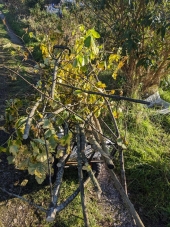
• Figs (e.g., Chicago Hardy): In the US Zone 6, this variety can grow into a large, productive woody shrub because the blazing American summer hardens the wood to withstand the winter. In Poland's Zone 6, that exact same fig tree will almost certainly die back to the ground every winter unless heavily wrapped, because our milder summers don't ripen the wood enough.

• Peaches and Grapes: US Zone 6 gardeners grow these with massive success. In Poland, even if the plant survives the winter cold, our lack of intense summer heatwaves can lead to poor sugar development in fruit, and sudden European spring frosts are notorious for wiping out buds much more aggressively. Only a few areas of Poland with specific microclimate are good for grapes.

So, we use US-adapted zones but we do not trust them blindly for woody shrubs, fruit trees, or Mediterranean plants.

A plant rated for "US Zone 6" might need a Zone 7 or 8 microclimate in Central Europe (like a south-facing brick wall or a greenhouse) to make up for the lack of summer heat.

As to the UK, (as far as I know) they have their own RHS system of zones, from H1 to H7.
• H1–H2: Tropical to frost-sensitive
• H3–H4: Half-hardy to hardy (H4 roughly matches USDA Zone 8)
• H5–H7: Very hardy down to continental European winters (H7 roughly matches USDA Zone 5 and below).

1 month ago
Small daily harvest on October 1st
1 month ago
Bill Mollison did not say: Gimme a million dollars and I will make it a paradise, he asked for a rock in the middle of the ocean :)

Anyway, I was referring to the described situation where frugal people amass millions in the bank. I am not sure if Gert cares at all about having those millions. Just that.

Anne Miller wrote:

If Gert had a million dollars maybe she would devote that monies to help others learn about permaculture.


These days you can learn about permaculture for free like it has never been before.

In the same time, even small marketing campaigns for the FMCG have multimillion dollar budgets...