
|

|

|

|

|

|
|
|
|
|
|
|
|
John Weiland wrote:Thanks, David! Can you tell me why this is not done routinely for LiFePO4 batteries? Granted, a bluetooth version would be able to give you an estimate based on the battery management system display, but wouldn't one want to be able to 'real-world' test that capacity. And even if the discharge curve for Li is flatter than that for legacy lead-acid tech, if one was detecting a 'fully discharged' status well before the amp-hour rating on the battery, this would indicate where power deficiencies may be located. Finally, it seems from some videos out there that comparing LiFePO4 battery specs often involves validating the advertised Ah rating and so this often is done, albeit with shop electrical control units that appear more expensive and sophisticated than I wanted to deal with. Thanks for insights here....
Kara Ann wrote:Hi All -
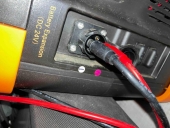
thanks for the encouragement to find a better connection to replace the banana plugs.
The friendly peeps at Pecron support tell me that the MJ32 does not connect with my E2000LFP model.
Maybe there are other options that someone knows of? For now, I have been checking the banana plugs, and the battery end fuse, ensuring they are not getting warm, the wires are safely snugged down, and I am really glad to have the larger energy pool to draw from! I was even able to bake cookies in the little toaster oven - a big treat for a glamping scenario.

Kara Ann wrote:Thanks, D for the clarification, and also the safety tips. The bolts on the expansion battery now have caps and the battery has a cover to prevent unexpected OOOPS connection disasters (EEEK!). The wiring between the Pecron unit and the expansion battery are threaded through adhesive clips that are attached along the pathway to prevent an unwanted tug. I appreciate the knowledge / experience you have in this subject area, and if I want to follow up on some of these suggestions later, I hope it will be ok with you if I reach out with questions.
Kara Ann wrote:
Hi Mike - thanks for joining in the conversation - your questions are just the thing that I value about Permies... all of us here sharing our experiences and skills to help eachother. I really like the Pecron, and have been using it as power source on my off grid farm over the past year. I researched and comparison shopped quite a bit before I purchased. I live here solo, and my electricity needs are pretty modest, so I chose a smaller unit. If I were doing it again, I would stretch to one of the E3000 or E3600 units you are considering. I have found it to be very reliable and easy to use. The lower watt solar panels (200W and 300W) are lightweight almost like very firm fabric and very portable. They actually seem to do pretty well with charging in overcast conditions (Pacific Northwest needs that), and they can be daisychained. Last month I purchased the 500W solar panel which is 4 folding panels that are hardframed - not the firm fabric. It works VERY WELL, both in sun and in cloud. I attached a pic of the solar panels by the trailer (the 4 panels on the R side, mounted temporarily on a pallet frame that is ground anchored beside the RV) where I am glamping til the tiny home is habitable. Anybody else using Pecron with some experience or opinions for Mike?
Kara Ann wrote:
Hi Daniel -
Why did you use the banana plugs instead of the correct plug for that port? I was able to buy a matching plug on amazon easily but I havent installed it yet.
Great question. If I could have found the correct cascade port cable for the E2000LFP unit, I definitely would have purchased it. You did not mention which specific Pecron model you have. For the E2000LFP, there is a EB3000 cascade cable listed on the Pecron website, but it is out of stock there, on Amazon, and anywhere else I could find. The banana plugs were not chosen because I like to innovate - it was because I could not buy the correct cable. Which model do you have?