josh ober

+ Follow
since Apr 15, 2017
Merit badge: bb list bbv list
For More
Apples and Likes
Apples
Total received
In last 30 days
0
Forums and Threads

Recent posts by josh ober

I got the leveling done for free, the guy is 70, and he didn’t really want to work on it for too long. I guess I just took what I could get.

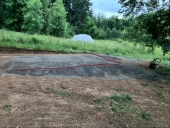
The area that the build will sit on (the level part of the pad) is the cut section , but the sloped gravel extends quite a ways beyond that.

I did make sure to leave 10’ between the two sides that were cut out of the slope. The other two sides are downhill.

I’m using 3/4 minus gravel, which is about half fines. It compacts exceptionally well. I’ve been using a plate compactor, and the end result almost looks like asphalt.

I’m building a stick frame tiny home out of salvaged materials.

Thanks for the response!

Cristobal Cristo wrote:Josh,

Why was the graded pad not level at least within 10cm (4") envelope? I do not think it's good that you had to add 16" in a spot.
When grading I would ONLY build on cut section and also leave at least 3 m (10') graded perimeter around the house, so you would have space for paving, protection from water (or adding some trenching).
How are you compacting it? Gravel does not really compact much, because it does not have finer fractions.
What structure do you want build?


3 months ago
So I got myself into kind of a pickle.. I’m working on a gravel pad foundation, and my build is on a slope. I’m using 3/4 minus and compacting it every 4”. The footprint of the house is 12’x16’, and I had someone do some grading for me. The area that was “leveled” extends only 1’ beyond the house footprint on two sides.

When I started dumping gravel, in one corner I had to build it up 16” to get the site actually level, then 4” of gravel on top of that. Instead of building a retaining wall, i decided to level an area 1’ wider than the footprint on all sides, then slope the gravel in hopes of creating a hill that would retain the level zone. Outside of the area that I had leveled, especially in the low corner, the slope is comewhat significant. So now I’ve ended up with 15 yards of 3/4 minus.. It’s been built up so much at this point that I’m worried about erosion. If I continue to add gravel to make the slope less steep, will that save me? Am I overthinking this? Any input or suggestions appreciated.

The red line in the picture is where the level turns to slope.
3 months ago

Ben Skiba wrote:No i haven't had to water it.

great. Thanks!
3 years ago

Ben Skiba wrote:I live in the high desert as well. elevation 6,000 feet. we personally just put our humanure between 4 pallets with a metal mesh on top.


Have you had to water it?
3 years ago

Anne Miller wrote: If I were in this situation I would have 2 wheelie bins with lids.


I’d definitely prefer this. Main concern is pathogens. Has is been verified that anaerobic composting will take care of pathogens? Most things I’ve read, outside of someone pitching a toilet idea, say that it won’t.

Does it not smell?

Considering the cold, wouldn’t it take a super long time to compost? The average low is below freezing 7 months of the year. Worried that I’ll have a mountain of bins.
3 years ago

John C Daley wrote:What are you actually trying to deal with?
- Food
- septic waste
You have 3 other issues to deal with
- absence
- dry climate
- wind that is fierce and relentless.
Can you alter any of those last factors?



I suppose the priority is septic waste. Absence is unlikely to change. I’m sure there’s solutions to the other two.
3 years ago
I live part time in the high desert of northern New Mexico. I’m about 2700’ higher in elevation than Denver, if that gives any perspective. It gets pretty damn cold. I’ve been looking into different options for how to deal with waste, and would love some suggestions! A big consideration, is the fact that I’m frequently gone, so anything that requires too much maintenance is out the window. I’m also looking for low cost, and preferably simple.

Initially I was leaning towards something along the lines of Geoff Lawtons wheelie bin composting system. I have some concerns about it’s ability to kill pathogens, the time it would take to compost (considering the cold), and the smell… am I missing something?

Someone later suggested I look into the omick barrel design. On the website, it states that it’s only suited for warm climates. Now I’m concerned that any form of cold composting won’t adequately eliminate pathogens in my climate.

The problem I see with hot composting…If I understand right, is that it likely requires watering in my climate. On top of the dry, the wind is fierce and relentless.

I’m open to options outside of composting, but that would be the preferred method. Thanks!
3 years ago
Hmm. I see the omick design isn’t well suited for cold climates, unless indoors. I’m at 8000ft in Northern New Mexico. Now I’m wondering if maybe cold composting isn’t the way to go. I was looking into Geoff lawtons wheelie bin system. I stumbled across the other design just searching around on google. I’d have to dig around to find it again. It appears that with the omick design, they only tested for salmonella. I wonder how capable it is of killing other pathogens. So far I haven’t stumbled across anything that suggests (by way of proper studies) that cold composting will eliminate all pathogens. Im now leaning towards the classic bucket to hot compost pile method. Not exactly excited to have to deal with the buckets. I’ve definitely got some more research to do. Thanks for the response!
3 years ago
Hi there! I’m looking to build an outhouse where the waste goes directly into a 55gal drum that I can remove once full, and leave to compost. I’ve seen two designs.. one (actually with a wheelie bin, not drum) that has half pvc pipes running vertically in the corners of the bin, with slits down the sides of the pipe for ventilation. The other is just a drum with a screen over the top, and no internal ventilation. Of course, I’d prefer the latter. Seems like a lot less work. Just concerned that there won’t be enough airflow. Any opinions? Thanks!
3 years ago

John C Daley wrote:What is" t1-11 siding" please?
I doubt the stick frame that size will move much, but is it braced?
What is the weather like?
Why 1 ft eaves, wider would be cooler?
Does the shack get hot?


T1-11 is essentially plywood with grooves. You see it a lot on sheds. The house is built on piers, and we get really high winds here, so it budges a little when the wind is bad. It’s about 15” off the ground. Bad design… I know. Everything is tied together pretty well. I’d say it’s rather overbuilt actually. I have noticed some nails popping slightly out of the siding, so there’s definitely some flex going on. I also hear things creaking when the sun comes up. Up here it gets down into the negatives in the winter, and 70’s-80’s in the summer. 40ish inches of snow and 14” of rain annually. Not sure why I went with 1’ eaves, it was kind of a spur of the moment design. It does get hot. It’s really well insulated, but I need to figure out some sort of ventilation for the summer. Thinking some vents in the floor (or lower wall) and at the high point of the roof, but that’s for another day. Think I’ve got some passive cooling science to learn.
4 years ago