Rich Rayburn

pollinator
+ Follow
since Dec 18, 2020
Merit badge: bb list bbv list
Biography
Homesteading in Minnesota, a wilderness style log cabin homestead.
Off grid and non-electric.
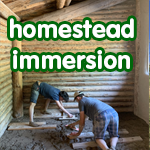
Homesteading for over 40 years, hand built log structures from native materials on site.
Also organic gardening, small scale grain raising, small scale haymaking, raising chickens,  and practicing all manner of homegrown food preservation.
Also proficient in woodworking, blacksmithing, and all manner of mechanical repair.
Living the dream of a nearly self-sufficient homestead.
Always happy to share information, feel free to PM me with questions or wanting to chat about homesteading.
For More
Apples and Likes
Apples
Total received
In last 30 days
0
Forums and Threads

Recent posts by Rich Rayburn

Is your ,homestead experiencing extreme weather this summer? It would appear that much of the country is experiencing whether that would make the homesteading lifestyle quite challenging, whether it be drought, extreme smoke, wildfires or floods.
It seems that this year the country is getting plenty of all of the above.
Where I am located in Minnesota we've had extreme smoke for a couple of weeks back in July, that really wasn't so much of a difficulty except for visibility and maybe a little runny nose.
The real problem that most of Minnesota is experiencing is drought, Central Minnesota is currently in what the Drought Monitor classifies as D2 drought or severe drought. Where we normally get about 4"  or more of rain per month we're getting little more than two or three and so far this month only a half an inch .
Because of the lack of rainfall the garden and apple trees must be watered regularly, that is merely more work, but what is concerning is the fact that the cistern which I draw water from is located in a water table that used to take one day to recharge to the full level after watering and now it takes 4 days to recharge and is still about 4 inches below the normal level. That means that at best I can only water every 4 days or so and with no rain in between that allows the garden to get somewhat dry between waterings.
Hopefully this area and much of Minnesota will get some rain before Wells start going dry due to dropping of the water tables.
The only bright side to all of this if there is one is that there have been almost no mosquitoes, horse flies and the other usual summer pests that can drive you crazy. You can be out a good bit of the day with only shorts on and  almost nothing will bother you as far as biting insects, even the ticks have disappeared.

Well that's pretty much what it looks like in Central Minnesota.  If you're getting some " interesting" extreme weather let us know what it is and what if anything you're doing to ameliorate the problem.

2 weeks ago

Douglas Alpenstock wrote: when you hit a sort of equilibrium, where the land is able to give you what you need -- and you are able to give the land what it needs. Ideally, there is a sense of partnership.


Beautifully written Douglas,
If the human species had followed that philosophy we might be living in Paradise! 🌴
2 months ago

Patrik Schumann wrote:Ever less land, more demand, higher prices, poorer condition, more work, less stability, higher risk, & that's if things don't go really bad.  The extinction crisis includes horticultural varieties, traditional/ historical/ heirloom cultivars, local land races; I started my work on that long before I had any land to call my own & I'm still collecting, learning, losing.  Self-sufficiency in biomass & nutrient cycling + water availability are additional constraints which took years to decades to secure, & the latter is diminishing for us again.


There's a saying, "The key to our future lies in our past"
People have been living simply, without technology or electricity since there have been humans. I don't believe that over analyzing a situation or adding high technology leads to a better solution, you could probably ask any peasant farmer from the Middle ages. Those people provided almost everything they needed including clothing for themselves.
Now that most of the worlds population is stacked up in large cities there is quite a bit of land available for those ambitious enough and resourceful enough.
In several Midwest states you can pick up land for one or $2,000 an acre, and that land may have heavy woods, some arable ground and even one or more water sources.
What most people lack is the information and the self-confidence to proceed. Personally for information and some self-confidence I would recommend Books over the internet, the internet often has too much information, and there is another old saying" Too many choices is like having no choices at all"
If you're trying to live in the California Central valley you might have a problem or if you want to try and live in the Rocky mountains, much of that major agricultural and "scenic" land is being brought up and in high demand and very expensive.
However in the state I live in a person can pick up 40 acres of land with a shallow water table and probably some swamp, but also plenty of woods and patches of high ground for building and gardening purposes.
All you have to do is a little research and I think you'll find that self-sufficiency or close to it is quite attainable for many people well into the future.
2 months ago

Patrik Schumann wrote: I am ever more concerned, somewhat less for us but very much for others.


Patrik, could you expand on what's your concerns are for others?.
Thanks.
2 months ago

Jay Angler wrote:
In the Province of British Columbia, we have very limited arable land (our mountains are very pointy and prolific). Wealthy people have been buying up huge swaths of farmland inflating the price and crowding out genuine farmers. .


Jay, the problem you describe has also happened in the United States in a lot of the mountainous areas or areas with high scenic value.
It's hard to tell what these corporations are planning with their land purchases and I see that some of them are actually developing the properties.
I also noticed that in Quebec they have land use laws that prohibit out of province ownership of certain types of land especially agricultural.
        Being that the original posting was how much land does the good life require I would again say buy as much as you can afford thereby having the ability to protect as much as possible. And the folks that we are talking about buying the land would be homesteaders and hopefully they would have only good land stewardship policies in mind.
2 months ago
How much land does a person need?
Well a person doesn't need much, even a small family. On a couple of acres you could probably provide most of your food. If you live in a colder climate and need to burn wood for heat probably 10 acres maybe 20 for wood and a little scenery.
Needs and wants are two different things, and wanting land sounds a little possessive to me.
This is my two cents worth:
Acquire as much land as you can afford, you can develop the small part you  NEED and then become the steward of all of the rest, you can keep it from being developed, clear cut and otherwise abused.
You can possess a thousand acres and it's no problem because you don't have to do anything with it the land will take care of itself.
If a person who is concerned about the land owns title to it that person can then protect the land .
And in my opinion protecting the land is the ultimate responsibility of those who can.
2 months ago

Christopher Weeks wrote:They start running around the time the maples stop. When it's 30 at night and 50+ during the day. And I think they last about two weeks.


Okay that's interesting because with those temperatures the maples should keep running, that is 30° at night and 50° during the day. It may be that your maples are "budding out", because when they begin to swell their buds they usually stop putting out sap. The term "buddy sap" refers to the brownish colored sap that is produced when the trees are swelling their buds, usually right before they stop running.
It may be that the birch trees put their buds out later and that's why they keep running when your maples have stopped.
I might have to tap a birch tree just to see what happens here.
4 months ago