Tim is a big dreamer working at a piddler's pace.
On a third of an acre in a village, living alongside his wife and trusty hound, Tim works towards living life within nature instead of at odds with it. Chickens, gardening, mushrooms and much more occupies Tim's mind as new projects appear and old projects complete. Tim is currently working towards renovating his 1850's home while turning lawn into edible space.
Amazon Wishlist
I utilize wood chips in my pathways, perennial gardens, orchard and near my grapes. The only place I do not use the chips are directly on my annual vegetable beds. I 'harvest' aged/composted chips from the bottom of my pathways and use that as a topdressing on those beds. With this system, I have not run into issues with diseases on my plants.
When I place fresh arborist chips, I layer it deep to levels near 12". The chips collapse down to around four inches with time which I have found loosens the soil and minimizes weed presence.
Did you know that wood chip mulch can hold anywhere between fifty to sixty percent of its total weight in moisture?
I understood the notion that arborist chip mulches assist soil to retain moisture but I didn't appreciate the fact that the material actually holds water itself. This sponge-like function of wood chips could be really beneficial in dry periods. For optimization, I have read that the finer the mulch, the better levels of moisture retention.
A root cellar is loosely defined as "an underground or earth-sheltered structure designed to store vegetables, fruits, and canned goods at low temperatures and high humidity to prevent spoiling and freezing."
[applepoll]
Photo credit to Christopher Weeks.
I will admit, I don't know a lot about root cellars. Please share your system in the comments for all of us to learn from!
Hello fellow upstate New Yorker! I'm over in Washington County dreaming of obtaining enough land to eventually make my own market garden.
I suppose my first question I would want to ask before giving a recommendation is what does your soil look like? If you are trying to grow on clay, I would definitely be trying to figure out how to move water without needing to worry about erosion. Sand is quite a bit more forgiving but I sit somewhere closer to a sandy loam in my neck of the woods.
I'd say you are planning on gardening on a rather moderate slope so I'd be worried about eventual erosion. Are you thinking of incorporating tillage into your gardening or something more on the no-till side?
This had been a weekend of mulch hauling and brush clearing. As I type this, I can feel a every so slight ache of a well worked day in my bones.
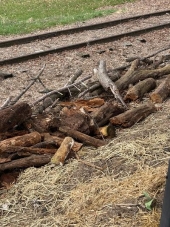
Right on the property line exists two large, unkempt apple trees that have been there over thirty years. Blackberry canes and bittersweet vines choke the ground and branches out. Some of the vines were two inches wide at the thickest part. The previous fall we cut the vines that were reaching up into the trees and by now they were dried out and brittle. A difficult part of clearing the brush was a pile of cut up applewood that was rotting with time right next to the trees providing cover for the undesirable plants to grow near. It took around six full wheelbarrow of material to get rid of the applewood but we deposited it to a low spot on a hillside.
Rotted Applewood
Many pieces of the log segments were starting to break apart by hand. We utilized a chainsaw to chunk up some large trunk segments and it just ripped straight through them like butter. I'm expecting all of this to turn into nice friable material that will hopefully mulch the hillside in place while benefiting the soil. My quest to restore this hillside continues and I am starting to see the results that I have hope for. My plum trees continue to expand their roots into the soil and perennials planted the prior year have successfully started to re-emerge!
Arborist chip, as previously mentioned, is made up of all of the parts of trees sent through some kind of machinery that turns it into chips. There are two types of implements that chippers utilize known as knives and hammers. The knives of a wood chipper slice wood into chips at a high speed against a stationary anvil. Wood chipper hammers smash materials in a chamber until it can pass through a screen of particular size. This renders a fine semi-consistent mulch material when utilized. Blades require periodic sharpening and hammers may require replacement with use. Depending on how a chipper is maintained, there could be partially intact branches or inconsistent sized mulch in the final product.
It is generally recommended, at a minimum, to have four inches of arborist chips to gain most of the benefits of their mulching effects. I have found weeds start to pop up when the mulching layer is under four inches thick. Luckily, the soil underneath is so nice that the weeds tend to pop right up when weeded.
To note, fresh wood chips lose size quickly and a person can expect whatever volume of fresh chip that they put down to reduce by around fifty percent in a months time. Personally, I put down around twelve inches of fresh wood chips in newly established areas in anticipation for it to mellow out to four to six inch future depth.
I've uncovered a pile of rotting apple tree chunks in varying stages of decay. I had to unearth a few that were buried into the ground! I have decided to toss these on a hillside that working on reducing erosion on to further break down and improve the soil.
These are especially 'punky' so I don't expect them to last very long in the elements.