oaktree Hatfield

+ Follow
since Jul 11, 2010
Merit badge: bb list bbv list
For More
Apples and Likes
Apples
Total received
In last 30 days
0
Forums and Threads

Recent posts by oaktree Hatfield

Hey there permies,

I currently live in santa cruz, CA in the mountains which are dominated by a redwood forest. This place has had a history of fires (mostly low intensity) in the redwood understory. I notice when I am wandering around the forest that i see old stumps that were previously cut down by loggers about 60-100 years ago. These stumps, however, are covered in what looks like biochar! So i had this crazy thought that I could simply harvest the biochar by scraping it off with my knife into a bag. This biochar is already infused with native micro-organisms as it has been immersed in the fungal and bacterial rich forest. I would like to do a couple tests on the biochar to learn more about it: PH test and bacterial/fungal inspection (with microscope). I will try to get photos in the near future...

What are your thoughts on this?
15 years ago
Some plants are less tolerant of salts than others. Your diet will determine how much salt is in your urine so if you and your housemates moderate your salt intake (which is a good idea anyways because these days everything seems to have salt in it) you should not have to worry about killing plants. if you are already concerned about the salinity of your soil you can take the extra effort to dilute it and spread it.
15 years ago
oh, and using a fan to increase air circulation will help in the long term maintenance.

and if you are really desperate like my mom then use a dehumidifier...but those generally use a whole lot of energy
15 years ago
To clean mildew without expose yourself to toxic chemicals you’ll need some distilled white vinegar, an empty spray bottle, baking soda, garlic, gloves, and an abrasive sponge. The vinegar and garlic will kill mildew, germ,s and bacteria. The baking soda and sponges help remove mildew stains and make a nice corroding reaction.

Recipe for garlic bomb: mince up 1-5 cloves of garlic (depending on size) and put it in a shot or two of water and let it sit for 5 minutes. this will let the juices out and create a really intense solution. I will down this shot whenever i feel like it, especially if have been exposed to a cold or if i feel low energy.

Fill the spray bottle with vinegar and add the garlic bomb. Shake the bottle a little. Sprinkle a little baking soda on the mildew you wish to eradicate. Liberally spray all the affected areas and be sure to make epic laser or blasting sound effects as you do it. Mildew is easily intimidated and confused. Let it sit for an hour or two to allow the vinegar, garlic, and baking soda to corrode and penetrate and kill the mildew.

Come back and hour or two later with a sponge and more baking soda. Scrub scrub scrub til its gone. Maybe spray a little more vinegar/garlic.

If you can or you really want to, leave a clove of garlic by the spot where the mildew formed. I havent actually done this last part but i think it may help in the long run. I break up garlic where i keep my fresh fruit and it definitely preserves the fruit longer.


Ultimately, if the site where you had mildew gets really moist again, doesnt have adequate air flow, and no sunlight then the mildew is more likely to come back. Oh and if you can put the object that has mildew on it in the sun or do the treatment while the sun is shining (on a window for example) it will work better.
15 years ago
I live in the berkeley hills in california where it is really foggy and my 90 year old house had mold/mildew problems for years. I have seen my mom try all different sorts of cleaning agents and bleach. three years ago we tried using vinegar, baking soda, and minced garlic and it has been the most effective means for controlling the fungus among us in our home. The mold comes back only occasionally and in little patches when the rains come but as soon as we use the vinegar, baking soda, and garlic (anti-fungal) its gone and doesnt come back throughout the foggy june/july.
15 years ago
i agree with joel and heres another idea you can experiment with:

fill a five gallon bucket 1/3 to 1/2 full with wood shavings (maybe add a little charcoal).
piss in it
when it looks as though the shavings are starting to reach 3/4 their saturation capacity or it gets too smelly mulch the shavings around a fruit tree.

using the shavings as mulch instead of directly peeing by the tree will slow down the rate of nutrient flow and the nitrogen will be released as the chips decompose rather than when the rain leeches the urine.
15 years ago
mild, not really any frost...i am in santa cruz, CA zone 9a/b
15 years ago
Generally, both a decaying mulch and a living mulch are going to positively benefit a productive tree.

The living mulch (plants) can serve many functions: shade the soil to reduce water evaporation, build soil with roots, fix nitrogen (legumes), produce biomass to later be used as dry mulch, bring up nutrients from subsoil (dynamic accumulators), fill up niche space (depending on the type of tree the rhizosphere will have open zones that can be tapped into), attract beneficial insects and pollinators, fumigate the soil of nematodes, provide habitat/shelter for invertebrate species, block out unwanted species, and more...

The decaying mulch (wood chips, leaves, etc.) will also serve many functions, especially in the short term: conserve moisture in soil, keep soil warm in winter, block out unwanted species, add organic matter to soil and build soil life, and more...

In the early stages of setting up a polyculture dominated by a productive tree it is worthwhile to bring in available dry mulch to get the system started. Ideally, once the polyculture is established you can just chop and drop mulch, always maintaining both living and decaying mulch.

Elan

15 years ago
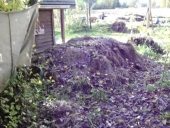
This is a thread intended for people to share their experiences building and observing compost piles that are used to heat water. I am curious about the specifics on how to build the most effective pile for heating water (lasagna method,chips/manure, etc.).  I have seen several examples of compost heated showers on youtube and in writing and i would like to hear peoples thoughts about how you have or would specifically design/construct the most efficient pile that:

1) produces very hot water
2) remains hot (functional) for a long period of time
3) gives the highest amount of hot water per extended use
4) has the fastest recharge
5) produces rich finished compost
6) stacks many functions and tie into other systems
7) provides other yields...

drawings of the design of the pile or system itself would be appreciated.
15 years ago
I think that presentations or modules should be dynamic and diverse so that people with varied learning styles can pick up on different ideas.

Like you paul, I enjoy presentations that offer strategies, techniques, experiments (data), and the like.
I think that poetry and pictures can be used as a hook or a short entry into a more rich presentation that inspires the learner with knowledge.

As we are entering this vortex of peak oil, peak soil, peak water, etc. it is crucial to create open environments where information and knowledge can be passed through a system. The act of teaching or giving a presentation is a system where the yield of inspired knowledge is only limited by the creativity of the presenter (mollisons principle).

We should not limit presentations to any one teaching style and, instead, be co-creative participants that lead a passionate, unique, and information rich presentation.