anuttama Hatfield

+ Follow
since Dec 26, 2010
Merit badge: bb list bbv list
For More
Apples and Likes
Apples
Total received
In last 30 days
0
Forums and Threads

Recent posts by anuttama Hatfield

From my experience and observation, people tend to form attachments to the objects of their labor.  I'm sure that if an aboriginal person chips an arrowhead from a piece of flint, most likely he thinks that it is his arrowhead.  Heck, even my dog thinks that it is his stick if he has gone to the trouble of fetching it!  This is so obvious that I'm surprised anyone would even suggest that people could possibly give up the concept of owning things.
15 years ago
I recently joked that Billy and I are endeavoring to become peasants, but we still have a lot to learn before we reach that status.  And we're finding that it's true that achieving a peasant's lifestyle is something worth striving for.  However the facts pointed out in the video show that there is a widespread push to limit the use of private property to the point that a peasant lifestyle will be all but impossible.  For instance in our county, Pierce County, WA,  just getting a permit to fence your property, build a greenhouse on the south side of your home or even just put a gate on your property is met with some serious financial barriers. 
15 years ago
Salamander, you need to watch the presentation.  It doesn't present a a collection of opinions and theories, but rather shows, with documentation what is being taught in schools and universities, what is being implemented within communities and what is happening within local, regional and state governments.  If you don't know the meaning of the word, "governance", this is a great video to watch.  Any conversation about permaculture should take place within the context of the information presented so well by Don Casey.
15 years ago
I recently watched a presentation that substantiated the theory that permaculture is being presented in order to make a more perfect way of life where people work for the common good and private property is phased out.  I posted a video of this presentation on my blog  http://billyandanuttama.wordpress.com/2011/03/06/glocalization-the-new-religion/   In fact after researching the United Nations' idea of "sustainability", I've decided to personally never use the word to mean the concept of living locally and in harmony with Creation.  Just as the word "gay" formerly meant happy and light-hearted, but now means something quite different, the word "sustainable" actually doesn't mean the lifestyle that I'm working to achieve. 

I'm also wondering if this forum might be a part of the "sustainable" movement as presented in the video.  When I posted a thread about the importance of developing an economy that was not dependent on the whims of the banksters, the owner of the forum moved the thread to "useless drivel".  Huh?  If you really want to be able to prosper when living locally, having a working economy where the members of the community can prosper by helping one another without feeling like they're being taken advantage of is very important.  Useless drivel?  Maybe for someone who thinks that private property is unsustainable.

15 years ago
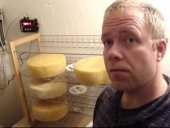
What a fantastic idea!  I've been looking into converting a fridge, but that involves a specially wired thermostat to get the temperature up.  This is a better idea.  I could possibly convert our well house into a cave! 

Right now I'm aging my cheese in my refrigerator, but sometimes I get so many cheeses that there isn't room for other things.  Our cow gives about 2.5 gallons/day so I'm making a 10lb cheese twice a week.  Right now most of the cheese is gone because of Christmas, but it is sad not to be able to sell it.  Our state, Washington loves to make examples of people who dare to have a family cow.    I do have a slide show about how to make a hard cheese, aged in the refrigerator:  http://billyandanuttama.wordpress.com/2010/11/27/how-to-make-an-aged-hard-cheese-in-the-refrigerator-using-easily-obtained-ingredients-and-equipment/
15 years ago
Regarding GMO, I doubt that any of the varieties offered are GMO.  They actually give you huge amounts of information about the varieties, at least for the grains that are the subject of my research.  They tell you where it was from originally, whether it is a landrace variety (developed naturally for that climate), whether it is spring or winter habit, which diseases and pests it resists and it even has pictures of many of the seeds as well as notes from researchers.  GMO varieties are proprietary and the owners of the patents on them always want a royalty so they'd be extremely unlikely to give them out with the possibility that they might be cross bred and they'd lose royalties.

And also I've gone to a class with the University of Washington about raising seeds as a crop.  The instructor talked at length about the isolation required for maintaining genetic purity.  However he conceded that sometimes it is impossible to have 100% isolation.  For instance corn pollen can travel hundreds of miles in the right conditions.  So if there is GMO corn grown anywhere near where the organically grown seeds that you  purchase are grown, they could potentially have the GMO genetics and the seed growers are unaware of it.  In Hawaii some papaya growers found that their crop was tainted with GMO and they had no recourse, as I recall reading.  GMO is here to stay.  All we can do it to avoid it to our best ability and choose to primarily grow and eat plants that pollinate close such as tomatoes, wheat and oats.
15 years ago
Seeds are actually plants, as opposed to the potential for a plant.  All of the parts of a plant are present in the seed.  So a non-organically grown seed probably doesn't have the same shakti (that is a Sanskrit word that translates roughly to mean energy, power or potency).  However if the non-organic seed is grown organically, the shakti will increase as the plant grows.

The problem with non-organically grown crops/seeds is that some varieties within a species thrive better when they are cultivated using chemicals and some varieties do better with organic methods.  For instance a plant variety with an insufficient root structure will do better with chemical fertilizer (think giving sugar to a child), while that same variety might not be the one you'd select to grow organically.

Sadly people who live near fields that have GMO corn and grow organic corn are probably eating GMO when they harvest their crop.  Corn pollinates freely and the corn you eat is actually the seed, meaning that if the GMO pollen happened to pollinate the corn, you're getting GMO.  It is sad.  Unfortunately the isolation distance for corn is over five miles.  So if you live within five miles of anyone growing GMO corn, you might not want to do corn.
15 years ago
To those who have expressed gratitude for the USDA lead:  you're welcome!  I'm happy that I could help people find this resource.
15 years ago
plantsnobin, no I haven't contacted Tim Peters, but thanks for the lead.  Even though I have some small quantities of durum wheat seeds, I haven't actually been able to purchase a quantity of the grain that I really want.  I love to make chapatis which are made from a naturally whitish yellow durum wheat.  I buy bags of the flour from Asian grocery stores and have contacted the millers in BC.  All I wanted was to be able to buy the unmilled wheat.  But no, our US government in their wisdom have banned sending such wheat from BC.  You can only get the flour.  So I'd love to plant a quarter acre or so of durum wheat for my own use, but may have to wait until I can grow out the tsps that I have.  The flour I get isn't organic and we really like to grow everything we eat.

My chapati video:  http://www.youtube.com/watch?v=TPOyGPB0zPE
15 years ago
In general I think that permaculture people are actually better researchers than the university people.  The university people are unable to think outside the box and because their research tends to be funded by corporate interests, their motive is geared towards profit.  With permaculture people, the motive is to create harmony, balance and to be able to feed people with ease and panache foods that can contribute to good health--physical, mental and spiritual good health.  This is something that the "scientists" I've been in contact with do not understand.  They want to breed a wheat variety that will generate profits, not one that can be harvested using animal drawn implements. 

The scientists can be a great resource, especially with information about isolation protocol for saving seeds.  Interestingly I was told that for wheat, 12 inches is all the isolation required!  One scientist that has been helping me, Dr. Drew, is a supporter of no-till farming practices, but he is unable to think of a way to have no-till without using herbicides.  He did suggest planting fodder turnips planted in the Fall after the wheat, and hope that the winter temps kill the turnips, providing food for the soil microbes.  These guys do have a lot of information.
15 years ago