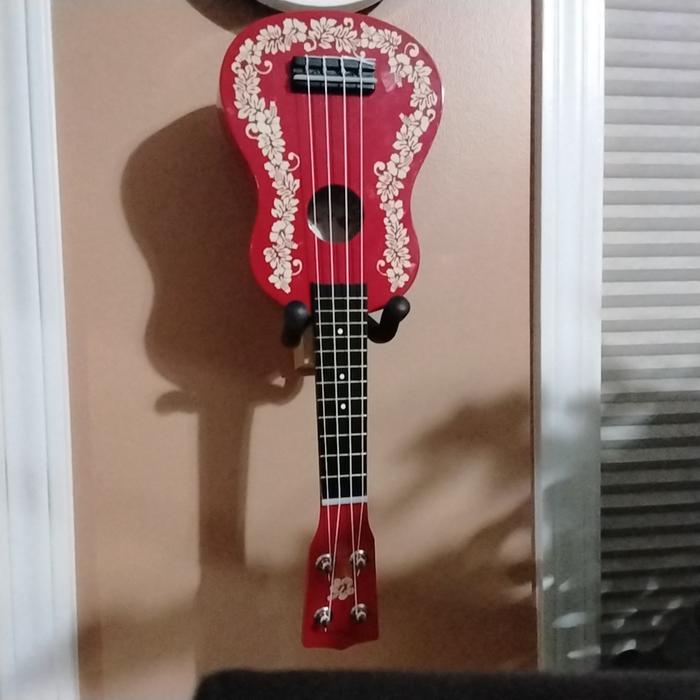
tiny ukulele won't hang from the hook right way up, it's so small
It didn't implode with string tension when i tuned it.
I can even play music on it. Not great music, but that's more a skill thing. The sound is pleasant and what I expected the $50 price range ukulele to sound like. The notes hang around for half a second or so after we pluck the strings. It's got a higher voice than my tenor.
Cheerful is the word that comes to mind. Like a kid hyper on sugar at a birthday party, but with a pleasant singing voice.
I think it would be fun when I learn George formby triple strum.
The tuning pegs....sigh.
How to describe this?
They stay exactly where I put them. No slipping or sliding. (Although the strings aren't settled in, I watched closely and the pegs are fine). In that way, they work amazingly well.
On the other hand...hmmm... you know how a circle has 360 degrees because math said so? I don't know if it is the short strings or because the tuning pegs don't have gears, but, but they are annoyingly sensitive. Two dgrees will take you from far too flat to far too sharp. Four degrees will take you to far too sharp on the next letter. It makes tuning painful as my hands don't do that small a movement.
If it was going to be more than a novelty instrument, I would upgrade to geared tuning pegs. This means drilling the hole bigger and somehow making the head big enough to fit the new mechanism. I don't think it sounds good enough for that.
intonation and set up
Filing the nut and the thing from the bridge (white things above) made a massive difference to how comfortable this ukulele is to play. Even with the tiny neck, not having to press down hard makes it easy to get clean notes.
I didn't expect set up would make this much difference. I didn't even go as far down as I should have. Instead, sticking to the maximum action (string to fret height) that is suggested.
The intonation, where the notes on the frets are what they claim to be, is almost spot on. The E string is a tiny bit sharp still, when on the 12th fret. But the others are nearly perfectly one octive higer. I think this is a big part of why I find the sound so pleased, the higer notes don't sound awkward.
I feel encouraged to try this setup on my tenor ukulele. Which, let's face it, is the entire reason I got this toy ukulele. To build courage and see if ukulele set up actually makes a difference. It does.
I have to give you a big A+ for patience.
I’ve had one in the past that came from my parents, not sure how they acquired it.
I was at a retreat leading music with my “real” ukulele.
The attendees made a skit using my toy ukulele. One of the older ladies, Mickey, pretended she was me and exaggerated all my moves. We all had a great laugh.
Those toy uses are fun, whether they play a tune or not.
Jay Angler wrote:... when you bring your own re-usable containers to the restaurant to bring home any left-overs. It's a double win, because it means we don't end up with dreaded Styrofoam containers that aren't very re-usable or recyclable where I am.
We bring our own pyrex glass containers in a little cooler bag to the restaurants all the time. One set for each car , and we eat out a lot and always have leftovers. 😋 Straight to the microwave for future meals.
It does look like a Dracaena. Do you have fluoride in your water?
When I had my plant care service, eons ago, flourish toxicity was very common with Dracaena.
I’ve been trying to remember the garden chemical we used to fix it, but for the life of me I can’t
remember it.
So I looked it up and this is what I found. Turned out it was Calcium.
One very useful practice plantscapers did was to leech out the chemicals in the soil at least once a year.
I would put the plant in the shower, washing off the leaves at the same time and give it lots of freshwater to leech out the chemicals in the soil. With your plant, you would want to add the calcium in the soil before you wash it.
Good point, Andrew.
I get pork, chicken and beef bones occasionally when my mom (They don’t compost) makes her bone broths. I dig a hole and bury them under the soil, about 6-12 inches, and put a rock, or brick on top, until it’s forgotten. I also bury the bones in the big, enclosed compost pile.
11 years later, I see dried up bone mulch all over the garden. Like you said, a 10 year slow-release of calcium and other nutrients.
I think the bones are also good for adding in the swales I’m digging, topped-off with wood chips.
Now BSF larvae, I wish I could find enough to feed the chickens. From what I read in the thread, the meat in the bones will attract them.
Lots of good ideas.
Andrew Co wrote:I understand that Tim is dealing with a lot of bones, but just to add a few comments here for the other "regular folk" like myself, there is no need to make this too complicated. Like most of us, I suspect, I have waaaaaaay to much to do to be spending my time and/or money grinding, cooking, charring, pulverizing, etc. bones that are going into the dirt to feed my veggies.
(1) Regardless of where you live, you CAN compost both meat and bones....provided you (a) keep the critters/dogs/racoons/rats/etc. from getting to them and (b) keep your ratio of bones to compost/wood chips reasonable; e.g., if you are composting an entire animal(s) [Salatin], you're going to need a lot of wood chips. If you're composting a pot full of chicken bones [after making stock ] once a week, you can dump into regular ole compost. I don't have rats - just dogs/cats/coons, so I just need to bury the meat/bones a few inches in the compost and cover my compost with wire mesh weighed down with bricks. If you have rats, you'll need to be more aggressive in your [metallic] protection because I think they will be happy to chew through, burrow, or do whatever is necessary to get to it. FYI I have been composting meat, bones, fat, used cooking oil, etc. for decades here in the burbs. My primary frustration these days is that BSF larvae will eat most of my compost and crawl away with the nutrients and organic material which I would prefer to end up in the dirt; I can fix that by making a BSF bin, capturing the larvae, and feeding them to chickens (but that's a different thread).
(2) As one of the other posters referenced, after a few months in a compost pile, animals will have no interest in the bones. The surface [and sub-surface] of my garden is littered with bones and pieces of bones. They break down very slowly, but WHO CARES??? (at least I don't). I like to think of them as a system of 10-year slow-release of calcium and other nutrients.
Thanks. I have seen this one. It looks more complicated than we can manage. We also don’t have the space. We have a suburban backyard. But we maybe able to get some useful information from it.
Anne Miller wrote:Maybe watching this video by David Pagan Butler, who is the author of Natural Swimming Pools will help explain the process and maybe a regular pool person could make these changes:
A step by step transformation of a conventional outdoor pool into an Organic Pool. This was a completed by the owners and friends with the intermittent help of David Pagan Butler. The pool has a relatively small planted zone so an Olive Bioflter (invented by David Pagan Butler), provides additional water cleansing
Does anybody have any experience on converting a traditional pool to a natural pool?
Our pool needs resurfacing, new tiles, and so forth. We’ve been getting quotes for the remodel, but we’ve also been interested in having a natural pool using plants for filters.
We’ve also contacted a natural pool builder, and we’re looking at about $50K for conversion, based on their pricing in Southern California. We’re in the San Francisco Bay Area, and it’s been really hard to find a pool builder/remodeler, much less a natural pool builder.
We are not young and able to tackle all that work.
So, in response to my own question, I served my girls some cooked fava beans and rice. They ate the rice and “tried” the fava beans, but left most of it uneaten.
Tina Lim wrote:
Ellendra Nauriel wrote:Mine will eat any type of legume, as long as it's cooked. They tend to turn up their noses at raw, dry split peas, or dry lentils. But, the guy at the feed store swears that most chickens love those, so who knows? Each flock seems to develop their own preferences.
Beans such as kidney, pinto, or lima definitely need to be cooked, soaked, or sprouted to get rid of the naturally-occurring toxin they contain. I have no idea if fermenting would render them safe.
Sunflower seeds might be another chicken-safe high-protein treat you could grow.
Does that include fava beans? I’ve never thought to cook favas and feed the chickens. I grow them for winter cover crop all over the garden. We eat some, give away some, and still have a lot left for the next winter.
Ellendra Nauriel wrote:Mine will eat any type of legume, as long as it's cooked. They tend to turn up their noses at raw, dry split peas, or dry lentils. But, the guy at the feed store swears that most chickens love those, so who knows? Each flock seems to develop their own preferences.
Beans such as kidney, pinto, or lima definitely need to be cooked, soaked, or sprouted to get rid of the naturally-occurring toxin they contain. I have no idea if fermenting would render them safe.
Sunflower seeds might be another chicken-safe high-protein treat you could grow.
Does that include fava beans? I’ve never thought to cook favas and feed the chickens. I grow them for winter cover crop all over the garden. We eat some, give away some, and still have a lot left for the next winter.





] once a week, you can dump into regular ole compost. I don't have rats - just dogs/cats/coons, so I just need to bury the meat/bones a few inches in the compost and cover my compost with wire mesh weighed down with bricks. If you have rats, you'll need to be more aggressive in your [metallic] protection because I think they will be happy to chew through, burrow, or do whatever is necessary to get to it. FYI I have been composting meat, bones, fat, used cooking oil, etc. for decades here in the burbs. My primary frustration these days is that BSF larvae will eat most of my compost and crawl away with the nutrients and organic material which I would prefer to end up in the dirt; I can fix that by making a BSF bin, capturing the larvae, and feeding them to chickens (but that's a different thread).