Nynke Muller

+ Follow
since Apr 09, 2019
Merit badge: bb list bbv list
Biography
We own a small plot outside the city, where we grow a lot of fruit in the most natural way we can. We like to experiment and try new things. We want more perennial food in our garden.
For More
Haarlem, The Netherlands
Apples and Likes
Apples
Total received
In last 30 days
14
Forums and Threads

Recent posts by Nynke Muller

Hi Jake,
Have you ever heard of Ernst Götch and syntropic farming? I love the concept and his work is fantastic!
The concept is based on natural succession of plants. It seems to me that nature might have done a lot of good in a 80 years of human neglect.
Honestly I don't have much experience with this method, but I would certainly look into it before destoying in a day what nature has been building underground fo 80 years.
I think it depends on the size of the trees that you are going to plant, and how easy it is to dig a hole for them. I think it would be possible to clear only small spaces for your trees, and manage their sunlight by cutting surrounding growt all year. It is something different, but I would give it a try.
3 days ago
Hi Richard,
You have already gained some confidence pruning most of the overcrowded shoots away. Well done!
I studied the pictures after pruning, and I would remove some more:
1. I would remove everything that grows vertically out of the branches, or redirect it in a more horizontal direction.
2. I would check the spacing of the latheral growt. Your tree looks pretty big to me, so i would want to grow a firm structure that would last for many years to come. I want each branch to look like a feather, with enough space for each side branch to grow out into a feather by itselves. Does that make sense to you?
3. I would cut one third off all long new shoots that I want to keep, to stimulate flowering.
4. At  the main trunk, you might want to grow a third and maybe fourth branch to fill the space, but creating a spot where water collects should be avoided at all cost. That would cause rot in the trunk and will be the beginning of the end of the tree. So imagine what happens when these new shoots at the trunk grow really big in 20 years or so. If it will cause a problem in 20 years, cut it off now and create space for something better to happen. If not, you continue with this main structure of two branches and work with that.
The goal you should prune towards is an open bowl shape, that catches lots of sunlight for flowers to fotm and fruit to ripen.
3 days ago
Hi John,

Like you, I want potato towers to work, but never really gave it a try. I did start a few times, but I never got past the first hilling. I have watched a lot of videos on this and learned something about the determined and indetermined varieties.
I think both video's you posted are verry interesting. The last one because it is so honest about failure.

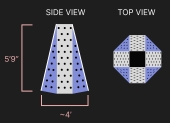
What I noticed when watching the first video, was a large discrepancy between the text and the images provided. The dimension and specifically ratio's between dimensions were really off, just like the numbers (tekst says:"plant 4 potatoes", picture shows 5).
When I just look at the pictures in the video, I notice that they tell a completely different story:
1. It looks like new potatoes are planted at each layer;
2. The stems are horizontal in stead of vertical.
I wonder if there is some clue in this?

Christoffer's article seems reliable. The second video confirms it, especially the dryness of the tower despite irrigation. Personally, I can confirm their positive experience with volunteer potatoes.

However if the dryness can be solved e.g. in a different climate, or a different type of tower; and new potatoes are placed at each layer, near the center; and the stems are trained horizontal, towards the outside of the tower, it might be a way to grow a more potatoes on a small footprint though. Because they grow above ground, they are easy to harvest. Maybe I will give it a try this year. If so, I will post the results here.
Hi John,
Interesting information, did you try it yourself? What are your results?

Alex Howell wrote:I follow <a href="https://www.youtube.com/@miki3333">this Japanese guy's (miki3333 on youtube)</a> pruning tips....


Hi Alex,
I love the japanese style of pruning. I have read some books on bonsai. I am really interested in what it is that makes a tree look beautiful. Japanese can explain that very well. Long before I ever heard about permaculture, I applied this bonsai style of looking at branches to my normal sized fruit trees. Now I have learned that it is the best way to grow nice stong, healty and beautiful trees. I can recommend reading a book on bonsai to everyone with a tree.

By the way, I apply some japanese garden style elements in my garden as well. I have 8 fruit trees planted in 2 perfectly straight rows, but by making a small mount in a special shape and place plants under trees in strategic locations, I created a romantically winding path to what feels like an open space in a forrest. It looks and feels perfectly natural. My garden will never look like a japanese garden, but with their help, it has become a beautiful natural garden.
1 week ago

Tim Mackson wrote:
... I was wondering about this.  So you winter pruned and plan on summer pruning the suckers that the winter pruning caused?  ...  Worst that I can do is kill the tree right?   :).  


Hi Tim,
That's right! That way I make smaller wounds, that calice over quickly. I keep the main shape of the tree, with all the branches in all the right places. At the same time that I cut the suckers off, I cut half of the new branches that I want to keep. This stimulates flowering buds for next year. I end up with some nice straight biomass. Pruning twice a year, might seem a lot of work, but if you do it right, it reduces the total amount of hard work and I am not even close to cutting off a third of the tree.

Killing a tree by pruning is not easy: My brother pruned his apply tree by sawing it back to the main trunk and  one main branch which are both over 15cm (6") in diameter. He does that every now and then. It has not killed the tree so far, but it definitely killed the shape forever. He started asking advice on a pest last year, so I do think he is weakening the tree. He still does not need my help pruning the tree...

Give it a try! Let us know how it turns out!
1 week ago
Hi Leland,

Everything starts with a good idea, and you just got started. It seems to me that only communicating about this, makes you write more cheerfully. You are writing "LOL".  Did you know that the english "LOL" is actually a Dutch word meaning "fun"?

I like Carla Burke's idea for the small pond. That would really add something to the total idea. This afternoon I made a quick sketch with a spiral around a small circular pond. You can add a small "beach" of pebbles or seashells in front of it.

I have googled "plants for evening scent" and found this:
https://youtu.be/rkIAunU_0Wo?si=HjVukrMFD2cJJNVJ
Most of these plants are not hardy in my climate. However, I will plant them on my balcony in pots. Than I can bring them in for winter.
For my garden, which is not at my home, I will figure out something perennial suitable for my climate. I already have some white flowers and cyclamen with sylvery patterns on their leaves (and a wildlife pond).

You really inspired me with the moon garden. I had never heard of it. I am definitely going to watch some video's. Last night the moon was full and I was seriously impressed by the amount of light! Normally I sleep at night, but now I know there is really something to enjoy. Thank you for your inspiration!

Leland, whatever you do, just get started and start enjoy the process. I wish you lots of "lol"
Hi Leland,

Gardening has always helped me get through difficult times. At regular days it helps me to unwind. Interacting with my plants always works.

I have never made a herb spiral yet. Good plants to enjoy in the evening are plants with white flowers or white in their leaves. They really light up in the evening.

For us to advice you on specific plants, it would be best to share some information about the location: soil type, rainfall, sun hours, climat in general.

To create a beautiful garden bed to watch, you need: a pillar; a filler and a spiller. So something high; something bushy, and a groundcover. Choose three different plants that you like. Select for different leaves and different plant structures. When suitable for your location, it will be an instant succes!

I will bet you will soon be adding more plants, or create a second garden bed.
Hugel pots! Thats new!
Definitly going to give this a try!
I have some pruning residue that needs processing anyway and I have some seedlings that need transplanting. So many solutions..!
I will experiment with bundles of branches with different thickness and maybe different freshness I think.
Thanks everyone for the inspiration!
By the way, does it matter whether branches are placed upside down? Or should they be applied upside up?
3 weeks ago
You are welcome Tim.

I am not familiar with your climate nor your area. Maybe someone else can step in.

I actually do most of my pruning in summer. I only cut young fresh shoots then, so the wounds are small. Actually I "correct" my trees all summer with small cuts, leaving small wounds that close quickely. My last pruning is in august, so there is still some slow growth afterwards.

For me, winterpruning is only for big corrections, which I try to avoid. During winterpruning I correct mistakes from the past, when I did not know what I was doing yet. The winterpruning causes much larger wounds that take much more time to close, and maybe never close at all.

Never the less, I pruned a large branche of one apple tree this year, because my tree becomes too big. Now I expect this tree to react with extra growth because of the small disbalance I have caused. I will keep an eye on this tree this summer and hope to restore the balance in the same year. Than next years will be only small cuts during summer.

I saw in one of your pictures, a branche entangled in the mess, that is not connected to a tree anymore. Such (dead) branches are more likely to cause disease than any clean cut in healthy tissue. You should remove such branches first. They help cleaning up  the mess. Clearing them, will give you a better view of the structure. These loose branches don't count for the "max one third" that you are allowed to remove.

Good luck with the pruning. It will be all right some day!
3 weeks ago