Jen Fulkerson

gardener
+ Follow
since Jul 09, 2019
Merit badge: bb list bbv list
Forum Moderator
Jen Fulkerson currently moderates these forums:
Biography
My name is Jennifer, I'm married to a wonderful man for 28 years and counting. We have four grown children. Two girls and two boys. Being a mom is my most important and favorite job. I love to garden, paint, crochet, read, go to the movies, upcycle/refinish furniture, and do just about any art or craft project. We have 3 dogs, 5 indoor cats, ? cats that live on our property, and 21 chickens. All but the chickens are strays that just showed up and demanded we love them, so we do.
For More
N. California
Apples and Likes
Apples
Total received
In last 30 days
16
Forums and Threads

Recent posts by Jen Fulkerson

Interesting comments, definitely something to think about. I just figured it was less piles of poop to draw the flies into the coop. Who knows, but it's nice to do what I need to do in the coop without having fly's all over me.
2 days ago
I predicted this was going to be a bad year for bugs because We had a super mild winter. I think we got one night that was 32. This spring I braced myself for a difficult year. To be honest it hasn't been as bad as I thought it would be. Aphids on the beans a lot earlier than usual, but not long after the aphid infestation came so many ladybugs. There was actually less damage to the beans then last year.
Then the Harlequin bugs started to show up. It's been quite the battle. Thankfully my son has been helping me. He has a very affective system. Unfortunately if he decides it's super bad he will defoliate the plant putting all the leaves in a bucket of soapy water. ( thank goodness my purple tree kale is such a tough plant, it's been naked twice this year) I don't use chemicals, even organic, and I understand there aren't really any predators for Harlequin bugs. That leaves hand picking. The only break is they are bright orange, and don't really try to escape. I find cutting them in half with my flower scissors works for me, and my son fills a bucket with soapy water and puts some of it in a cup. He puts the cup under the bugs and taps the leaves, and they fall into the cup. He says their defense is to drop to the ground, so he uses that to his advantage.
They haven't really done much damage, but it's been very frustrating, and a lot of work keeping them in check.  We will spend all this time removing all that we can, and for a few days it's great. Then one of us will spot one, which ends up being tons. I have even found them on my beans. They prefer brassica's, but will settle for beans if they have to.  
I keep hoping the hot weather will make them go away ( that's what happened with the stink bugs) But just the other day I noticed them in a little 3.5' X 3.5 bed with radish, melon, eggplant, nasturtium and onions. First I removed the radish, then we hand picked them. We got more than 100 bugs out of that bed. No we didn't count them, but when we had gotten a ton of bugs and didn't see any more I watered very well, and they climb up to get out of the water, and my son counted 25 more, so I know we removed way over 100 bugs. I'm lucky my son has been helping me, so we haven't lost anything that was super important, but I am worried about starting my winter veggies. For us winter is when we grow most of the brassica's. Last year, maybe the year before??  I had a rodent problem. I built wood frames covered in chicken wire that fit over several of my bed, like a lid. I should probably cover those with row cover, and put them over my garden beds. It may be the only way to be able to enjoy our brassica's.
Have any of you had to combat these prolific bugs? Do you have a better solution? I'm all ears. Thanks
4 days ago
I ferment grains for my chickens. In the summer this means 3 half gallon mason jars that hold a days grains. Ideally I feed for 2 days, and fill the 2 empty jars, so there's always fermented grains. More than 3 days in our heat starts to get risky.
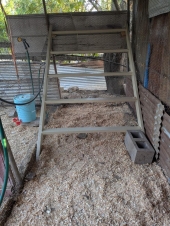
I add about 3 cups of grains in the jar and add about double the amount of water. The hose water comes out hot and stinky.  I try not to waist water, so when I fill the water, or grains first I spray down the roosting bars with the high pressure nozzle. The chickens don't seem to mind, but I just think it's gross to sleep in poop.
I started to notice when I am on task I can go about my business undisturbed. If I miss a few days I have to constantly swat flies. It was enough of a difference I noticed. I did a couple of very non scientific experiments where I didn't rinse the roosting bars for a few days, there was a lot more flies. I am convinced this makes a difference.
There's no getting rid of flies. Even though they are annoying disgusting creatures the world would be a very gross place without them. Also chickens poop everywhere all the time. I think because the only time chickens are still for any length of time is while they are sleeping. They even poop while they sleep from what I understand. So even though there's chicken poop everywhere, There's a larger concentration of it on and under the roosting bars. Removing most of the poop from the roosting bars, and now I spray off the poop stuck to the fence, and spray the larger piles of poop under the bars, seems to greatly reduce flies in the coop. This makes it so much nicer for me to do what needs to be done, and I imagine it is nicer for the chickens to not be constantly pestered by flies while they sleep.
I use the high pressure nozzle and quickly spray the bars down. Then I fill what needs to be filled.   Then I make one more quick pass over the bars fence and under the bars. This usually gets most of it, and makes a big difference. No chemicals, no sticky tape to get suck in my hair, no very stinky fly bag or trap. Just water that would be otherwise waisted.
4 days ago
Joao have you tried the board trick?  Put a wood board, next to the area you are experiencing slug pressure. wet the soil under it, and leave it be. During the day turn it over and dispose of the slugs on the board. This isn't a miracle cure, but it can help greatly reduce the slug population.
1 week ago
I built a bin, filled it with scraps that would be inappropriate for my worm bin, and the black soldier fly's came on their own. The only difficult part was that amount of food they go through, it's a lot.
I don't use my BSF bin. I just couldn't do it. adding scraps to the bin with all the maggots, it just totally grossed me out.  I thought I could handle it because they self harvest, and they do.  I didn't consider having to feed them, and see them pretty much every day.
I think it's a great concept, I love reducing my waist and producing a healthy chicken snack. more power to the people who can do it.
1 week ago
I call my garden style beyond organic because If I add, or use something in my garden, with the exception of seeds, ( I prefer organic seeds, but sometimes they are not readily available, or affordable) it's organic. I don't use any pesticides at all, not even the Organic options. This is harder than it sounds at times. When my beans are covered in aphids, or the kale is crawling with Harlequin bugs there's that human part of me that thinks I need to fix this and get the Neem oil, diatomaceous earth, or Castile soap, something to kill the evil bugs. Oh man there are times I want to so bad. Times I'm freaking out thinking all my hard work is going to be for nothing if I don't do something!!!  Then I get ahold of myself, take a breath and wait. I don't have the time or inclination to be mother nature. I know if I interfere even a little I compromise the whole system. So I wait. When the aphids were totally covering the yard long beans I did spray them off a few times with high pressure water, but only a few times. I thought about buying ladybugs, but then I started to see not only ladybugs, but their babies ( I can't think of what they are called at the moment, but you know what I mean). Then more, and more, the point where I'm seeing ladybugs, and not seeing aphids.  It's hard, but most of the time it works. I think it's important to mention I'm not a farmer, and I won't go hungry if my crops fail. I'm not judging people who can't do this.
The Harlequin bugs are another matter unfortunately. They have no natural predators ( according to Google) my chickens won't even eat them. Fortunately, and unfortunately if I'm being honest my son has decided to help me with them this year.  I'm lucky in this case anyway to have a lousy sense of smell, so it doesn't bother me to kill them. I usually cut them in half and dump them in a bucket of soapy water we are just keeping in the garden. The good thing about Harlequin bugs is they are bright orange and pretty easy to see. The bad thing is there seems to be massive amounts of them. My son defoliates the entire plant and putting the leaves in soapy water. Thanks goodness kale is so hardy. Mt purple tree kale was recovering nicely, only to be stripped bare again. I know he is helping, but wow, a bit extreme. I'm sure he has been on the Internet, and is convinced it must be done. I get it, but man it's a bummer. At one point we even had Harlequin bugs on the beans, I guess if they can't find brassica's, they will settle for beans. Even with the many Harlequin bugs we have battled, we haven't lost any plants because of them, some sad leaves, (which the chickens enjoy) but the plants survives. I do plan to make some insect netting covers to put over the brassica's I will start this fall.
If it won't interfere with your health, or wealth, leaving mother nature to do what she does best makes for a productive garden. Happy gardening everyone.
1 week ago
I've been struggling the few years to keep my worm alive and well during the summer. It seems like no matter where I put the bin it gets at least a little sun, and drys out very quickly.
This year I have been trying to be more attentive, and keep the worms alive and well. I used to put in ice packs on one side of the bin, and I haven't done that, but I need to this week because it's forecasted to be over 100 every day.  I did add straw ( I tested before I put it in there) to the top. My thoughts are it's another layer, but loose enough not to block the air vents. Most of my bedding is shredded cardboard, and before the straw it would dry out very fast. It wasn't unusual to only be damp in the bottom third of the bin.
I also put a cover I originally made for my seedling table over the bin and covered that with shade cloth.
So far so good. These small changes have made a huge difference. The goal is to check the worms once a week, in reality it's probably more like every 10 to 14 days, but still a lot better than the last few years. When I check it, I find dry straw, but a moist bedding underneath. The food is usually gone, and the bedding is quickly becoming more castings than shredded cardboard. I also see worms, I don't have to dig for them..
In the beginning with the exception of the learning curve, I was a pretty good worm keeper. Then I got super busy and I'm ashamed to say less interested, and I was a lousy worm keeper. I'm trying to get back to being a good worm keeper. Part because the castings are amazing, but more importantly if I'm caring for something, anything especially if I have a system that what I'm caring for can't get out or naturally care for them selves, then I owe it to them to do a good job.  Otherwise I just shouldn't do it.
1 week ago
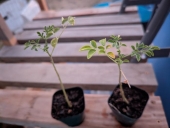
Some strange and interesting developments with my moringa. The moringa in the survivors pot looks healthy, but hasn't grown at all from what I can tell. Everything else is doing well.  The two Moringa in the large pot look good and are growing.  I have very slowly pulled back the shade cloth.   At this time the shade cloth is only on the west side protecting against the brutal afternoon sun. I plan to eventually remove the shade cloth, but watch closely to make sure everything is okay.

For some reason the moringa in the garden bed didn't come back.  One of the two I potted up grew a new stem.
Thanks to your great advice I think I can pot up, or transplant. I just have to be very careful not to disturb the roots, at all. but if I do, to treat it like it's still alive, and at least 50%of the time (this time anyway) it will grow a new stem/ Trunk.

I keep meaning to plan the seeds I bought, but just haven't managed it.
Thanks again everyone for helping me
1 week ago
I live in N. California zone 9B I tend to think of carrots as a cool season crop. I usually don't start carrots in the summer. I pulled the last of the carrots I had not long ago, and wished I had more. I decided to sow carrots in mid July, and see what happens, after all I had the seeds, and space.

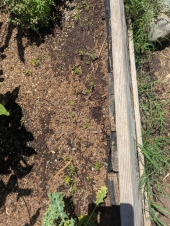
I watered the soil well, sprinkled the seeds in, sprinkled vermiculite on top and watered again, and placed a board on top.  I watered every day, and started to check for germination about a week in. As soon as I noticed growth I removed the board. (I'm pretty sure the first seedlings I saw were Johnson grass. I kept watering every day, and removed the Johnson grass when I realized what it was) I do water this bed every day, so it's definitely more work, but if the carrots taste good, I'll know I can grow carrots year round.
It's not free, but a less expensive nitrogen boost is Organic alfalfa pellets, It's animal feed, and works well.
Weed tea. Everyone has weeds, it's a good way to use troublesome weeds, and the diverse nutrients they have.
Compost extract (easier than tea, and can help make your compost go a lot farther)
Chop and drop.
Leaf mold
Seaweed
Algae
burying food scraps directly in the garden can be problematic. If it's the end of your growing season, and you aren't going to plant anything for a while, then it will probably benefit you. As the food scraps/compostables break down they rob nitrogen from the soil. Once they have broken down the nitrogen becomes available along with other nutrients. Some people who want to do this have a designated space for the scraps (like a buried wire basket with some kind of lid) they buy, or see if they attract composting worms. (I probably wouldn't plant veggies right next to the bin). The worms help the compost process and make castings that are beneficial.
There's a lot of great suggestions in this post. For me the focus is on building and maintaining the best soil I can using what I have as much as possible. Also it's important to remember $#&" is not the only thing that runs downhill. For  example If you treat aphids with an organic soap, or oil some of that is going to end up in the soil, and it will also kill the soil life we are working so hard to cultivate. So be mindful of all elements, even what's going on above the soil.
Good luck
3 weeks ago