

|

|

|

|

|

|
|
|
|
|
|
|
|
Dakota Miller wrote:TOO LONG DIDN'T READ: here's the basic setup. I'm certain I'm missing something. I expect to be corrected. Could you please explain why if you correct? I like to continue learning the why and how of what I'm doing. 😁
Raw rain water in Settle tank
--->Output for animal water.
10 micron washable
5 micron washable
---> Output for non-potable basic cleaning. Shower, mopping, etc (Everywhere but in the mouth or in the food)
1 micron washable
.5 - .1 micron
Aquatru undersink RO https://aquatruwater.com/product/under-sink-water-purifier
UV LAMP VIQUA VH150 UV System https://www.freshwatersystems.com/products/viqua-vh150-whole-home-uv-water-disinfection-system
clean potable water output
---> To small distiller for CPAP use.
Water finishers if I wish
Small water storage for in cabin use, sink, etc. (~5 gallons).
LONG STORY
I'll put the big filter set up ahead of the ro system to get the water as clean as possible for RO system. It feels to me more logical to invest in washable filters so I can reduce the wear and tear on the RO system as much as possible by back washing or swapping rinsed filters periodically. Makes it easier to keep the sensitive RO membrane in good condition.
I have decided on the Aquatru undersink RO for this setup.
I'm using the UV lamp to catch any escaping bacteria from the RO filter. The RO filter should do it's job just fine. The UV filter is a extra precaution. A thorough UV should be rated NSF/ANSI 55 Class A. But since I have so much filtering already done I figure a Class B at 30mj/cm2 won't be a problem. AND. If I can figure out how to run the water through the UV system aat 3.5 gpm it will effectively act as a Class A at 40mj/cm2.
I do have a solar set up. But my first goal is potable water. I'll figure out how to power it and make adjustments after I solve the water problem.
I couldn't find anything specifically about water treatment. So I hope rain catches is the correct forum area.
Steve Zoma wrote:
That is NOT correct.
I live on an island far out to sea where my well's are compromised by sea water and can be affected by red tides. None of that can be visually seen in the water.
I have looked into RO for seawater because of the sea water in my house-system, but what RO system I use for desalination is very different. If the water is over 2000 mg/liter it is considered sea water and takes a special robust filtration system, and if under that it takes another. As desalination is being carried out, it constantly has to be adjusted, and that is just for desalination. Too much pressure and it strips the water of minerals, not enough and you get salty water. This is a VERY real issue for me and I have conducted a lot of research on how I can get good water here. The quote I got from professionals has been the most expensive system they ever saw: $45,000 with (3) whole house RO systems to get out all the problems I have to go from undrinkable to drinkable.
If I just had sea water issues, I would distill, but sadly I also have incredibly high iron so distilling would actually make my water worse.
You do not have it quite that bad, but you can use the information that I have learned to set yourself up to be better off. Water is life and it pays to do things right.
My neighbors do not treat their well water because it is too expensive to filter so they instead have rain catchment systems. But they test their water. I am on the east coast so may be different than you, but the rate of cancer here is the highest in the nation per capita. I myself have cancer, and it is because of the topography and jet stream. In short, bad shit comes here when it rains.
Yes, water testing will change with every rainfall, but you get an average of what is in the water.
No one person on this forum is smarter than all of us put together, but you are indeed right. You do not have to justify your water filtration system to anyone. I am not affected by what you do with your water system, but when I hear of blanket statements like "you would see bad water", for the sake of others who might read this thread, I feel obligated to say in a kind manner, "I'm not sure that is the case". Myself and others can explain this in many different ways, but we cannot make you understand it. However, we can only hope that others who read this thread do and keep themselves safe.
Drinking water is the key of life. Best to do things right, not guess.
John C Daley wrote:
Does storage time get ride of the detritus somehow?
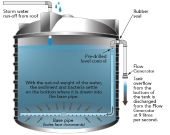
Detritus is the lumps, poo, leaves, nuts twigs etc, they are best removed with first flush diverters and or course filters such as leaf traps.
Water sitting in a sheltered tank with access to oxygen will clean itself.
Fine particles called fines, will simply settle to the bottom.
Most other issues just improve with time and oxygenisation.
John C Daley wrote:
How does that sailor get water from the ocean, because he can't always take enough water with them, or the stored water becomes sickly.
from google
Sailors in the 1700s primarily obtained water by filling large wooden casks at ports, supplementing this with collected rain, and rationing it strictly.
Distillation may be the only way that will work for you.
John C Daley wrote:Timothy, I am responsible for my drinking water supply and have been for over 50 years.
I also work in the field as a Civil Engineer.
I have never tested my water.
I allow air to circulate in the tanks.
I do not provide any form of chemical treatment, just time in a big tank!
John C Daley wrote:
I dont believe anybody is asking you to justify your quest.
In australia, water off metal rooves are generally not tested because of common prior knowledge.
Bird, rat and possum detritus is dealt with by the first flush and storage time in a big storage tank.
Hannah Shaw wrote:
Steve Zoma wrote:I am not seeing your water testing results.
A RO system that takes care of 12 mg/liter is great if you have 7 mg/liter, but if you have water that has 23 mg/liters you got contaminated water after you treat the water.
All the builder placard shows is the percentage that is removed at a certain level. I have no idea what your actual levels are: it may be higher, it may be lower?
You are putting the cart before the horse. You test your water to find out what you have for bad stuff in it. Then you obtain a water filtration system to take out what you don't want. You may not need any filtration system. You may need far more than you think. But if you overfilter then you end up drinking foul tasting water because the good minerals are not left in it and your own health suffers. Same thing for animals that you may have.
It is all just a guess unless you test and it costs just $150. There is zero reason not to test. It could save you tons of work and money, or even save your life.
You’re absolutely right — without actual water test results, everything else is just guessing.
A spec sheet showing “removes up to X% at Y mg/L” doesn’t tell you what’s really happening in someone’s home. If your source water is 7 mg/L, a system rated for 12 mg/L might be fine. If it’s 23 mg/L, that same system could leave you with levels you’re not comfortable with.
Testing first makes sense. It tells you:
What contaminants are actually present
At what concentration
Whether you even need treatment
And if so, what type and capacity
Overfiltering is a real issue too. Stripping out everything can impact taste and remove beneficial minerals, which affects both people and pets.
For ~$150, getting a proper water analysis seems like the smartest starting point. It removes assumptions and helps you choose a solution based on data — not marketing claims.
Test first. Then treat accordingly.
Hannah Shaw wrote:
Testing first makes sense. It tells you:
What contaminants are actually present
At what concentration
Whether you even need treatment
And if so, what type and capacity
Overfiltering is a real issue too. Stripping out everything can impact taste and remove beneficial minerals, which affects both people and pets.
For ~$150, getting a proper water analysis seems like the smartest starting point. It removes assumptions and helps you choose a solution based on data — not marketing claims.
Test first. Then treat accordingly.
John C Daley wrote:Dakota, Steve is making a very important point about testing the ground water.
- your 1800 Gallon tank sounds perfect for you at the moment.
- leaf traps are important
- Have a look here, this equipment is available in North America. https://rainharvesting.com.au/learn/
- A submersible pump will draw from the bottom, maybe an external small even 12V pump will work for yourself at the moment.
- Look at RV supplies they have very good expensive pumps.
- A small particle filter should be all you need.
- Rainwater will not have problems with these as Steve mentioned, "arsenic is hit or miss in drinking water sources, but so is radiation from uranium."
Can you load some pictures.