
Steve Marquis

+ Follow
since Apr 16, 2021
Merit badge: bb list bbv list
Biography
Ret'd Design Eng, SME Owner, Permaculture Mentor & Teacher, Climate Action Educator
For More
Apples and Likes
Apples
Total received
In last 30 days
1
Forums and Threads

Recent posts by Steve Marquis

Renting agricultural land (if it is) is a different ball game to accommodation rental, it should be less onerous (no pun intended 🤭).

If you get the land, it may open up the way for funding if you register it (it may be too small, I can't remember the limits). Ask at the local Rural Payments and Services office and check out their web site to get a BRN number.  We registered ours and they told us the
CPH number (every field is on their system). It opened up free training and grant funding for us.

Tidy people are generally neither permie or farmer 😁

You do need to look at the status of the land in any event, you might(?) find this helpful https://www.ros.gov.uk/scotlis

If I think of anything else I'll let you know.  
2 weeks ago
What you ask is not impossible, but there might be a hurdle or two to leap.  It's best to gently ask your neighbour if they're up for selling or renting the patch you're interested in.

Transfer of ownership and change of use from farmed/crofted land will have a financial penalty if it can be changed (you're unlikely to change crofted land). Farmed land is not so expensive as domestic land and your change of use, should you get it, effectively switches it to a premium land type where you should expect to recompense the owner for the difference.

You may be better off renting it and apart from some permanent shelterbelt planting (if needed) use it for annuals and maybe some pollinator attracting meadow planting so if the property changes hands your losses will be minimised if the new owner has other plans.  

Your shared track access might cause you problems, you'll need to let them move livestock, machines, etc to work the land, it may get messy in the running of their business. Shared access needs to be thoroughly defined and not limit business use, it'll need to be wide enough for modern equipment.

You need to do some research but to do that you need a little idea on references.

Is next door a croft? (Croft - an area of land surrounded by red tape).  https://www.gov.scot/policies/agricultural-holdings-crofting/crofting/
https://www.gov.scot/policies/agricultural-holdings-crofting/smallholdings/

Crofts, smallholdings and farms all have a number (it has a few names) Main Location Code (MLC) / Farm location / CPH (county / parish / holding) number formatted like this nn/nnn/nnnn.

There's a number for a croft formatted Cnnnn

Those same entities have a BRN (business reference number format nnnnnn. this allows you to keep and move livestock and access funding for farmed land, be it agricultural, horticultural, mixed usage, or something else like a type of croft.

The Crofting Commission regulates and promotes the interests of crofting in Scotland to secure the future of crofting and has publicly available information on specific crofts.

Rural Payments and Services is the .gov organisation that manages farming/crofting etc stuff and might be approachable for research.  You'll have a (roughly) local office. Not knowing where your talking about narrows the help I can give.

-----------------------------------------

As an aside, it sounds like you need a diversionary trench to take run-off from your neighbours down hill, around and away from your land.

Depending on prevailing wind direction, you might benefit from shelterbelt planting to soak up any airborne land / crop dosing (sprays, powders, muck spreading, etc).

The more you slow the wind with shelterbelts the larger the midge load. Make plenty of bat and bird boxes early on, ponds for dragonflies, frogs etc and plenty of predator attracting planting - nectar fueling stations like umbels.

Steve.
2 weeks ago
Sorry for the long read...

We have a kingspan steel insulated roof (we're in the far North of the UK) and find rock wool really dampens the sound of hail.  We too enjoy the sound of rain.  That said, we collected water off the roof for our off-grid water - not good!

The roof was installed in about 2010 and a water test on the system undertaken after the build was very good.  It worked for years, then we came along and purchased the self-build off-grid straw baled house.  

We wanted to increase the amount of water collected as we had observed that droughts were extending and downpours getting heavier/more prolonged, meaning a quick fill then run-off (there was no secondary use for the run-off at that stage).  I spotted a grant for an additional water store which required a water test.

We were shocked to see a pH of 3.4 where the rain fell at 6.5, worse, the acidification from the coating and UV had caused the coating to degrade further, leaking aluminium and lead amongst other things.  Apparently a kingspan roof is not designed for potable water collection. Kingspan as a company has been very supportive and we could have recoated the roof but we felt the problem would have only come up again.

We could have further treated the roof water and upped it's capability as it got worse, we felt it was not a good place to be.  Our confidence in the roof system was gone so we went the borehole route (£££s) and have now the ongoing water treatment cost of that instead.

The moral of the story is a regular annual water test for roof collected water (or Indeed any potable water system).  The acidification rotted our internal water systems which needed replacing and I imagine supping the stuff may well have had health impacts for those living with it too 😟
3 months ago
I need a coffee in the morning to wake me up.  Not sure the Cleavers will work for us as it gives mission control a fiery rash.  Cleavers, if you've a dog like ours grows all over the place (she distributes the seeds via her coat).

Rosebay Willowherb can be made into a palatable tea - it used to be the staple tea before Ceylon tea was taken and marketed by the Brits. I've attached an article I put together for permaculture magazine about Ivan's Tea.
3 months ago

paul wheaton wrote:I think it is good to note which things get chomped by deer, but I also think that getting chomped by deer does not excludesit from "the top 3".  

I have a fenced area.  And a lot of unfenced area.  And a LOT of deer pressure.  

The deer eventually chomp the kale and the sunchokes.  But I can still get a big kale harvest before they chomp it.  And the sunchokes tolerate some chomping late in the season.   So kale is mostly grown in the fenced area.  

The deer do not chomp the onions.  


Everybody is going to have different zones and challenges.  Some people have zero deer problems.  

There are thousands of gardening books where people talk about growing gardens and there is zero mention of deer.  

And thousands of gardening books growing stuff that will not grow in a tropical climate and they have zero mention of citrus, bananas, etc.  

I mention all this because I appreciate the discussion of challenges ("grow in a fenced area" or "the deer don't seem to want it") but some of the wording seems dark to me because it seems to discourage anybody trying due to challenges.


I think Matt Powers hid his edibles from deer with tall plants/ grasses to make a visual barrier.  Ohh, I've just found the piece he did...

paul wheaton wrote:

Anne Miller wrote:I have not grown sunchokes because some folks say they cause gas.


I have heard the same thing.  And I have learned three very important things:

THING-1:   I have eaten sunchokes about 50 times and had gas only once.  But it was sooooo good, I ate way, way, way more than i should have.  

THING-2:  my understanding is that you need to build up the ability to thoroughly digest sunchokes.  Start small.

THING-3:  apparently, if you harvest after the first hard frost, there will be less digestive issues.


Here's a thing?  Ferment sunchokes so they're partially digested prior to consumption to reduce gas.  
How to Ferment Jerusalem Artichokes - The Backyard Larder https://backyardlarder.co.uk/2020/12/how-to-ferment-jerusalem-artichokes/
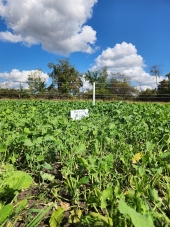
Be aware of the Diamondback Moth!
https://share.google/0GLCAfFIqacp3k6tq

Encourage insectivorous birds, predatory wasps into growing areas if possible.  We encouraged spiders, beetles, lizards, frogs and toads into our tunnel after a surprise infestation in the far North of Scotland.  
Bird boxes are a good move or pollard some willow (also useful for livestock forage and making char and/or compost) for wren nests.  
https://www.growveg.co.uk/pests/uk-and-europe/diamondback-moth/
1 year ago
Home made plant pots

Plant pots for starting seed that will become organic matter in the ground https://www.edenproject.com/learn/eden-at-home/make-your-own-newspaper-seed-pots

and here's a video https://youtu.be/9dkseng3MgE?si=7UZejL05C4mDcHbJ

Here's another… https://www.youtube.com/watch?v=9_QAZICSsWU

And there's more…
https://youtu.be/7dlGQP81yfo

Homemade Seed Packets

How to make free Homemade Seed Packets from Junk Mail without using Scissors or Glue. Click this link https://www.tinyurl.com/SeedTemplate ​for an easy and free Template printout. How to use it here https://youtu.be/I183eqdMoqw

There's a different way here called a Samurai Seed Saver Improvised Seed Packet http://openpollinated.blogspot.com/?m=1

The Brifka packs diamond dealers make to transport their gems in Hatton Garden would do the job too https://youtu.be/VILMMFu-rk4

https://turkeysong.wordpress.com/2014/03/30/origami-seed-pocket/
1 year ago

Jordan Johnston wrote:looking for anyone in canada with meader persimmon and or any other 90 chromosome species and is willing to give the seeds for cash please let me know i would love to grow these incredibly cold hardy persimmins and get new genetics.


Hi Jordan, did you manage to get a meader or similar persimmon?  I'm looking for something that would survive in the far North of Scotland (58.5°N) albeit with a mild climate (zone 8/9).

Seeds or scions (although I'm not sure what I'd graft to and I believe I need male and female.)

Many thanks
Steve
1 year ago

Sergio Cunha wrote:I don't think there's a synonym for permaculture because of its holistical aproach. I don't know of any other system that sees elements and their connections as a whole as permaculture does.


Only slightly off topic...

You might be interested in exploring Carol Sanford’s Living Systems Thinking work in the regenerative systems world. The late Dan Palmer utilised her work in his Holistic Decision Making or HDM method. HDM is a blend of Allan Savoury’s Holistic Management, Clinton Callaghan’s Possibility Management and Carol Sanford’s Living Systems Thinking work, re-packaged and re-purposed by permaculturist Dan Palmer.

Here's Dan in conversation with Carol Sandford in his podcast episode 19 with Carol Sanford discussing Living Systems Thinking and Permaculture, https://makingpermaculturestronger.net/living-systems-thinking-and-permaculture-e19/ he has a further conversation in episode 33 exploring her work in more detail,
https://makingpermaculturestronger.net/living-systems-thinking-and-permaculture-e33/
1 year ago