Jeff Peter

+ Follow
since Dec 21, 2021
Merit badge: bb list bbv list
For More
USA, Illinois/Wisconsin line
Apples and Likes
Apples
Total received
In last 30 days
0
Forums and Threads

Recent posts by Jeff Peter

~ separate the cloves, trying to leave the papery layers which protect them.
~ I stab my trowel in to open the soil, and push them in. About four inches deep.
~ shoot for planting about a month before first frost, and they'll get a head start.
~ to get big bulbs, they need room. I plant mine about ten inches apart, in rows about a foot and a half apart. You will be glad for wider rows when you go in to cut scapes, and later to harvest.
~ sort them by size. I save the biggest for the next crop, which over several seasons, increases the size of your stock.
~ don't be in a rush to dig them out. They're still bulking up even after the tops have dried. Just do it before winter sets in.
~ to avoid having to get in there and weed, I lay cardboard between the rows leaving an inch for the garlic to grow through. Bury the cardboard with mulch - grass clippings, leaves, old straw, etc.
1 week ago
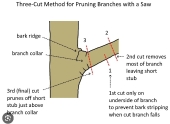
What's happening is that when your top cut gets to a certain point, the limb splits. The cut portion then straightens out, actually lifts back up, pinching your bar. The uncut portion bends down with the weight of the limb, leaving the chain spinning in air with the bar pinched.

You really need to start with that undercut, no matter how difficult, or angled. Then it will break away clean when the top cut gets deep enough.

Pole chain saws are quite a bit safer in my mind since that spinning chain is well away from your body parts. Something I would never do is get up on a ladder with a regular chainsaw. But it is quite safe with a pole chainsaw. As long as your legs are strong enough to be safe on a stepladder, of course. Getting up higher ~ careful not to be in line with where the limb will fall! ~ will allow you to make your two cuts closer to horizontal which will make the limb fall straight down and not twist on you.
2 weeks ago
Bare root is all I do anymore, except for a granny smith apple I bought in a pot.

My tree tree planting is simply moving squirrel planted seedlings. Black walnut trees that I grew from seed 40 years ago now produce wagon loads of nuts that the tree rats love to plant in my vegetable gardens.

I also developed the habit of heading out in the fall to collect Shagbark Hickory nuts and Red and White Oak acorns. I long ago gave up the time consuming work of actually planting them one by one in favor of simply throwing handfulls where I'd like them to be. The tree rats eat some, plant a lot for winter food, and the ones they cannot find under the snow will sprout in the spring.
Birds also "help" by sitting on my garden fences pooping out mulberry, gray dogwood, and black raspbery seeds under the fence. I try to get at those mulberry seedlngs in the first year, because they send deep taproots that are a bear to get rid of. With all of my existing trees, I need to keep sunlight for my garden beds.
Sorry if I missed it, but do you already own the land you'd need to start and grow ~ pun intended~ a nursey business? That factors in cost wise.

I am in the "Make money the best way you know how to fund what you love" camp.

As a consumer, when we have to replace an appliance, free haulaway of the old one is a big deal. As mentioned above, rehabbing and reselling appliances you got for free sounds like a great deal. And a repair and sales shop could easily phase into part time as your nursery business gets off the ground.
2 weeks ago
Oh boy. I thought having to pick fun size Snickers wrappers out of donated bags of leaves that a town dwelling friend gifted me with after raking at Halloween time was bad.
2 weeks ago
Sorry for not reading the whole thread, but I nominate pole beans. Specifically, Southern Appalachian Greasy Beans, and some of the beans grown by the Cherokee and SW USA tribes.
No hybrids, only open pollinated heirloom varieties.
All they need is support ~ sections of fencing on tee posts, tripods made out of long poles, anything sturdy. Pick and eat or freeze/can them green after the pods swell out with the seeds (protein), and leave a bunch on the vines to dry for dry bean eating and seeds for next year.

Literally just plant and pick.

I see a lot of mentions of the brassicas, and they are indeed easy and healthy to eat. Unfortunately, mine became magnets for cabbage moths. Those little white and yellow moths lay egg pods on the underside of the leaves, and within days, the green worms can skeletonize an entire plant. I am in the second year of planting no brassicas to try and break their cycle.
Happily, I have random kale and rapini plants self seeded which not being in a convenient row, seem to get overlooked being among plants the cabbage moths ignore.
I could be wrong, but I think the seed co. I bought my fennel seeds from said that most fennel is an annual, but it's the bronze fennel that's perennial. That's what I bought. Of course all varieties self seed heavily, so there's that. My original plant is a beautiful plant, growing five or six feet tall and almost as broad. That did change my original plans for my "herb bed".

Like cilantro, I end up with at least a gallon bag of seeds, which are not only good in cooking (a little goes a long way), but great for sharing.

I've also had luck with just stabbing a spade straight down into the base to get roots to share, much as one would do in dividing other perennials. Ironically, the volunteers that came from seed seem to sink their root deep before much top growth, so are harder to get out. If they are in an inconvenient spot, I just chop them off knowing I'll have to do it again. Heavy mulch helps.
I have not noticed alliopathic symptoms. They seem happy with cilantro, tomatoes, and hollyhocks ~ three other reliable self seeders. They are spreading though, so I will keep an eye on my spinach and lettuces.

4 weeks ago
Couple things:

Garlic, when naturalized as you want to do, are going to crowd in on each other so much that they'll resemble clumps of chives. They scape, which are edible, but the bulbs will be useless.
Garlic needs spacing to make the big bulbs and cloves.

Have you thought about perennial onions, also known as egyptian walking onions? Dig and eat as young green onions, or later as bulbing green onions. Reliable self sower/ spreader, but not annoyingly so.

Quite attractive plants, and you will never need to buy onions again. Well, except during winter.
4 weeks ago
If you can't get a local arborist to dump a load of woodchips on your property, maybe a town nearby has their own forestry guys in the maintenance crews, and have a chip pile free for the taking.

My wild black raspberries do well with thick woodchip mulch. My chips get inoculated by the soil. So I miss out on a crop of edible fungus as well as many varieties of raspberries. However, I am learning to value the varieties that are native to my soil. They are proven survivors in my garden. I re-learned this lesson again this year when the volunteer tomatoes, kale, cilantro, lettuces, peppers, etc thrived in spite of the conditions that made my intentionally started garden struggle.
The volunteers all come from spoiled fruit, and from the plants I couldn't eat fast enough and went to seed.

Free black raspberries (enough in the freezer for a full year), free wood chips, free fungus ~ those all fit my budget.
8 months ago
Hi Bert,
Have you thought about using the manure in the way farmers have been doing since the beginning of agriculture?

Spreading it/just throwing forkfulls?
You'd be emulating the way grazing herds fertilized the prairies. Without chickens to scratch it up, and spread it, I've used a mower to do that.
You also get a good layer of clippings over the manure to help reduce nitrogen loss to the atmosphere.

I did create a very good compost by making a five ft. diameter circle of old 4' fencing. I just layered on a few forkfulls of horse manure for each 8 or 10 inches of woodchips. Downside is it takes a year or more to break down the chips, but it came out rich, black, and crumbly.
1 year ago