Gordon Blair

+ Follow
since Sep 21, 2022
Merit badge: bb list bbv list
For More
Apples and Likes
Apples
Total received
In last 30 days
1
Forums and Threads

Recent posts by Gordon Blair

Hullo, permie Fraggles, permie Doozers and everything in between!

I fantasise about the buildings I might construct if my wife and I ever manage to acquire some land. We would likely be growing somewhere in Zones 8-10, so a greenhouse would greatly open up our possibilities.

They're expensive and fragile things, and I have this dream of building a gigantic one that is cheap and rugged and incorporates ideas like insulating air gaps, heat-sinks, an integrated rocket-mass heater and the wallipini concept. Cheap materials, easy to repair.

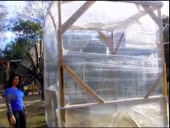
An element of this concept is replaceable panels made of cheap sticks, maybe bamboo, enclosed in pallet wrap with an air pocket in the middle. I've had thoughts about how the panels would be connected up and what would be involved in patching or replacing damaged/degraded panels. I don't have all the answers there yet.

One super-important answer would be regarding how worthwhile it could be to use pallet wrap, knowing it has a limited lifespan. The potential advantages are obvious: it's cheap and ultra light. If a section is damaged, you can just stick a new layer on top. If it degrades in a matter of weeks, no good. If it all needs to be replaced every few years, might still be worth it compared wth putting together a heavy & expensive structure based on polycarbonate or glass... especially if I manage to figure out a good modular system.

The wonderful and underappreciated GREENPOWERSCIENCE channel played with the pallet-wrap greenhouse concept years ago.  
 Two years later, it was still holding together in strong, direct sunlight. I see others have experimented with it too.

Has anyone here experimented with this material?

Best wishes

Gordon
2 days ago
You mean me? I'm asking for speculative future plans, not an existing site.  

I want to know things like does pallet wrap last; what were her assembly methods... If she's not active on the forums any more or never got round to the project, I'll start a new post rather than piggyback on this one.

Rico Loma wrote:What is elevation, climate, soil conditions,  hours of direct sun on your site? That can influence any advice , I think

2 days ago
Hi Evelynn

I was about to write a new post asking if others had experimented with pallet-wrap panels for this purpose (I was thinking of using bamboo for the poles), and when I decided to search for previous mentions first, yours was the only post that came up. I would love to hear about any subsequent experiences with this approach.

Gordon

Evelynn Renee wrote:Hi. I am researching to design a couple small greenhouses for my property. One of them will mainly be used for starting seeds and to create a heated space for my chickens during winter, the other a sunken greenhouse for year round more permanent plants.  So far I'm looking at lots of ideas on design elements but like others inputs especially if I've missed something that might be useful as far as uses, utility, heating/cooling, water harvesting, etc. I have a HUGE pile of arborist wood chips (FINALLY the wood chip god has favored me and I have so many wood chips I can literally build a house inside the pile. NO JOKE!)

I plan to do a jean pain style heating system with a water tank inside a greenhouse and the pile outside butted up to my chickens coop. So it can serve dual purpose of heating the greenhouse through hoses of water and providing a heated space for my chickens. I'm toying with the idea of cover that area to hold the heat a little more, kind of similar to what edible acres does with their heated high tunnel for their chickens. I think I will also build a bin along the greenhouses back northern wall and create a long compost bed their for heating and use that to put my seed trays on for germination, as well as a grate on top of my water tank connected to the hoses for starting seeds on top.

For the permanent greenhouse I plan to sink it with a French drain (I live in Tennessee and worried about possible flooding of it. I don't think I would need geo thermal in it because it's sunk? I like the design element of the trench that Paul uses in his greenhouse model. I didn't know if I should plan to put a rocket mass heater in this one for the winter? Was thinking the mass should run on the north wall and could be best used for seed starting like the compost wall in the other one.

So so far I've looked into sunken greenhouses, compost heating systems, some geo thermal... not sure how deep in TN though, I don't think our frost line is much lower then 2.5 feet? And using a heated water tank to heat the greenhouse and or also running heated water tubes in my in ground beds. As well as rocket mass heaters.

I would like to implement systems that don't require lots of input and are fairly simple and low cost to run and not a terrible amount of work and maintenance. Have I overlooked anything? Am I missing anything cool I might be able to utilize?

Thanks in advance for any and all help and assistance.

I have windows to up cycle and clear tin for my permanent greenhouse and like the idea of maybe using cob?  The seed starting GH, I am planning to construct using self harvested cedar or other poles and pallet wrap on individual panels and then screwed together and attached to in ground set posts. How do I calculate the best angle for my roof to capture and reflect the most sun? My site unfortunately isn't the best so I need to reflect fr where it will be sitting.

2 days ago
That's quite a story, Cécile! Lends anecdotal credence to the idea that sunchokes can provide serious human-available calories without breaking up the inulin into sugar first.

I have tried to acclimate to them, but perhaps it would need to be done more consistently and built up gradually.
1 month ago
Yeah, for me, that's the big question here. I understand that this is what cows do? There is also evidence that inulin-consuming bacteria release short-chain fatty acids that are digested by the human for energy. So there are two potential means to extract calories from indigestible inulin. Maybe that process is turbocharged for Paul.

I love onions and have eaten an almost inordinate amount of them for many years. They are considered relatively high in inulin, but this has not conferred Paul's superpowers upon me.

Les Frijo wrote:

Christopher Weeks wrote:
If bacteria inside your body do the digesting for you is that still you digesting or is it more like farming the bacteria and consuming them without having to slaughter and store the pig so to speak?

1 month ago
Hey Paul

I watch David's channel sometimes, but his situation isn't always applicable to mine, as I am growing in Scotland. No shortage of frost here...

It's not sufficient to make even moderate amounts tolerable for me and my wife. We do have to process them for digestibility.

From what I've read, humans can't digest inulin, period. Would building up a tolerance just mean happier and more gastric bugs, but not calories for the human..?

paul wheaton wrote:At this moment, I think there are two big things to get past the sunchoke comedy:


      - harvest after a hard frost


      - build your gut biome to digest this new thing


That's it.  

David the good (one of the staff here at permies.com) just posted  a video bashing sunchokes


Note that david is in alabama.  Warmer climate.  Does he ever get a hard frost?  I also wonder if he goes easy on getting started each year?  


1 month ago
I get the impression Paul is super keen on folks growing sunchokes as a main survival crop. I've found that I can eat a limited amount without side effects only IF I lacto-ferment it first.

So this entails a workstep that crops like potatoes don't have to go through. If I'm treating sunchokes as a main calorie-source, the fermentation would have to be done in big batches. The process can go wrong (mould) and I would expect it results in a rather high-sodium vegetable to consume as a main calorie source?

And could I really get serious calories (without side effects) eating it as a potato substitute? The inulin conversion would never be close to 100% (I may be wrong about this?) and while some people may adapt to tolerate inulin more with exposure, it's the gastro-bugs that reap most of the calories, right? Maybe some of it is released in a human-digestible form, but it can't compare with eating potatoes and directly getting the starch, I would think..?

If I have a good source of acid (lemon juice is generally said to be ideal) to cook the sunchokes in, that can help, but in a survival situation, I would need to come up with a LOT of it if sunchokes are my main staple?

I'm not here to blow raspberries at the concept; I like growing them and the taste of them! I would love for this to work out somehow!
1 month ago

Anne Miller wrote:By the way, acting as a career choice is going away ...


https://en.wikipedia.org/wiki/Tilly_Norwood


Kill it with digital fire...

This thing can only be viable because the mainstream alternative has become THAT generic and vapid.
So vibrant and elegant!
7 months ago

Anne Miller wrote:Have you ever wondered what it is like being a raven or crow?

https://theconversation.com/whats-it-like-being-a-raven-or-a-crow-257171?utm_source=firefox-newtab-en-us


There was a very philosophical movie all about this, starring Brandon Lee...
7 months ago