

Josh Wolf

+ Follow
since Jul 11, 2024
Merit badge: bb list bbv list
For More
Apples and Likes
Apples
Total received
In last 30 days
0
Forums and Threads

Recent posts by Josh Wolf

Rick Valley wrote: "Note that Australia generally is a pretty old continent without a lot of mountains, volcanos, and big rivers". " I learned to plant with watering tubes of bamboo (biodegradeable and the drip line puts moisture right in at the root zone)".

I know, I live there! The kind of area I am thinking of are low hills and rises with gritty clay, which are foothills of a granite range. The area receives 600-700mm of rain a year and is roughly zone 9. Not that I have any land, I am just making the hypothetical relevant to my region.
I like the idea about watering trees to the roots with bamboo tubes.

1 month ago
Reading more about keyline, and I realise that the aims of keyline do not fully match up with a complete permaculture/polyculture, but is more directed towards increasing arable pasture :
"According to Yeomans (the originator of the keyline concept), swampy bottomland results from mismanaging the water upstream.  To correct the problem, you dig a swale (an on-contour ditch) along the keyline so that water doesn't whoosh right down into the swampy bottom, but instead flows gently (along a 1% downhill slope) to drier areas to the side.  This is known as a spreader swale, and it's what folks mean when they talk about moving water from the valleys to the ridges --- you're not technically bringing water uphill, but you are moving it from a wetter area to a drier area.  The result is a more productive, damper area to the side of the keyline, and a more productive, drier area in the flat zone directly downhill" (https://www.waldeneffect.org/blog/Keylines/).

A permaculture might actually look to accentuate the swampiness of a certain area to increase the edge effect and create more niches. Keyline farming would likely look to move that water away and soak it into the soil of the adjacent ridge. Both look to increase soil water retention, but keyline farming is more focused on uniform hydration.

I still think the geographical basis of keyline is useful in judging the placement of permaculture earthworks. My amended questions are;
Is the keypoint (usually) the optimal place for dams?
Do earthworks above the keyline that allow for filtration of water into the soil negatively or positively impact water levels of dams below?
1 month ago
If one was building ponds/dams (on the keypoint of a valley) for aquaculture or habitat, I would assume you would try to drain water towards the dam, and that water retention techniques such as swales, rock/ brush dams. and keyline ploughing would reduce the amount of water reaching the dam. But increasing runoff, and 'draining' areas to a dam couldn't be good for the land (at least not in the Australian climate). Overall, would swales and check dams in the gully above the keyline raise the water table, benefitting the dam more overall? Is water quality better in a primarily groundwater fed dam compared to a runoff and rain fed dam? Would keyline ploughing would be better below the dam, as it actively moves water to the primary ridge, away from the gully, to benefit vegetation? From an ecosystem point of view, it is good to have as many niches as possible, so it is important to rehydrate soil while balancing that with the creation of waterbodies.
1 month ago
If I had read the thread properly I would have noticed it has already been mentioned. But it would be different to keyline plowing as it would be on contour.
1 month ago
What about chisel/yeoman plowing on contour to let the water seep in? Since it isn't turning soil layers it would be fairly easy to mow over afterwards.
1 month ago

Paul Young wrote:The post did say they were rubber trees (Hevea in the Euphorbiaceae - euphorb family) which is not closely related to Banyans (Moraceae - fig family), BUT it seems Banyans do seem like excellent candidates…


Hey, there seems to be a lot of confusion on this thread. The “rubber tree” they talk of is Ficus Elastica, which is a banyan. Also the roots they use are the specialised aerial roots that grow off the branches in hot and humid climates. Other than ficus and the wisterias, grapes and other lianas, a great candidate would be the New Zealand pōhutukawa tree. A myrtle tree that is often the first tree to grow on basalt fields there. They produce prolific aerial roots.
1 year ago

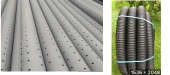
Anthony Breaks wrote:On the topic of "wood" ollas:  I was just researching using bamboo as an olla.

My research suggests that bamboo is very good at holding water, too good in fact.  Some processing is needed for the bamboo to slowly pass water like low fired clay.  But.....

There are treatments to help bamboo take water based stain for things like furniture, so it is possible.

The shape of bamboo is so perfectly suited to irrigation, I am surprised it isn't already a thing.


Sounds like deep pipe irrigation, but no pvc needed!
Drilling holes in the side of the bamboo seems to get around the issue of it not wanting to seep naturally, although it means it functions on a different principle to Ollas.  
An article on deep pipe irrigation: https://www.echocommunity.org/en/resources/c9b0359d-0adf-4485-af08-7f746c44514e
1 year ago

John C Daley wrote:What are Ollas?


An unglazed clay pot with large surface area and volume, but a small opening. They are buried in the ground, fill with water through thre small spout, and the water in the pots slowly seeps into the surrounding soil through the porous clay walls.
1 year ago

Vitor Bosshard wrote:To get the ball rolling... what are the material properties required for an olla? Fired clay is expensive at large scales and cracks under frost.

For example, why not build them out of pallet wood? I imagine a square tunnel that looks like an inverted "T" shape made of boards. Over a few years, this would break down and provide all the benefits of a hugelbed, and in the meantime you can water directly into deep soil layers.

Another idea would be to dig a trench, clad it with clay, then do a big charcoal burn, which as a side effect turns your trench into a semi-permeable irrigation canal.

Just some ideas off the top of my head, I would totally experiment with this if I had the land.


One thing with low fired, non glazed, non vitrified clays is that they are very porous, but don't 'leak' that much unless the surrounding area is dry enough to kind of 'pull' the water from the pot. If the dirt surrounding the Olla is wet already, there is no force of osmosis and it won't continue to empty until the plants need it. I think that is the issue with most of the Olla experiments and alternatives is they don't function under the same principle.
About ground frosts; I never thought about them that much though I knew that they do crack and get destroyed in cold areas. My I live in Aus and my area is humid subtropical turning cool semi arid. Only minor frosts. We can grow broad beans, lettuce, brassicas ect through the winter, and its getting to warm for that to viable in future. It is still to cold for proper tropicals here unless pampered. I have bananas in my backyard that have successfully overwinted near the north face of the house. They just came of dormancy the last few weeks. I live above the flood zone in a big valley full of natural clay. I have the perfect climate for Ollas. I think that Ollas aren't feasible in cold climates other than very small gardens where they are dug up in winter.
1 year ago

Gray Henon wrote:Insulation.  Put it in place, properly, and it does its job for decades.  

Roof overhangs.  Keeps water away from the foundation and summer sun out of the windows while letting winter sun in.  Simple and effective.


I'll second that
1 year ago