Mark Reynolds

+ Follow
since Jul 21, 2024
Merit badge: bb list bbv list
For More
Apples and Likes
Apples
Total received
In last 30 days
1
Forums and Threads

Recent posts by Mark Reynolds

Serenity Prayer.

That in itself instructs you how to handle what you have no control over.

Beyond that, when engaged in the moment from something that triggered the stress, you have to disengage from it. I think this is what the original topic might be getting at, although the statement seems a little broader than that making 'Serenity Prayer' an appropriate solution also.

To 'disengage', you have to pause or disrupt the flow of information or trigger of the stress in some manner. Close your eyes and envision a safe place. Turn off the TV (a huge stresser), Turn off the cell phone (social media. I know what you are doing), go for a run (or a walk), go outside and scream at the top of your lungs (not recommended if you are in a highly populated area), splash your face with the coldest water you can get out of a sink or ice water or take a shower (just get in and get out) with the coldest water you can set the shower to, jump in a very cold pool or lake (polar bear swim), read a book (doesn't tend to have an instant effect, but can/does after a few pages if its an interesting book), clean house, work on a hobby. The point is, disrupt the stressor and fill the resulting void with something else immediately.
2 days ago
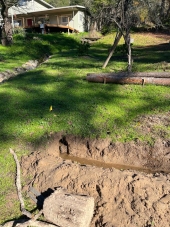
I'm wondering if you are getting any where on your drainage problem. Before I speculate or make any more comments, I want to ask a few questions.

First, how dry does the current soil get if the swales were not there? I'm talking : "Does it get unseasonably dry regularly?" Can you crumble it to a fine powder that just simply will blow away? Does the soil get excessively wet at times of the year and "turn into modeling clay"?

How long does the water stand in the dug swales before it seeps into the soil, and how far does the water actually seep into the soil where there isn't a crack in the soil or an animal hole?  

If the water sits in the swales for two days and has only soaked into the soil an inch or so, the swales will be totally ineffective at providing water to your trees

You have got to get the soil to the point it will absorb the water so that it is holding the water so that the plants (trees) can actually absorb something. Your swales might as well not exist if the water can't get through the soil in the swales.

If the above is your case, (and it is starting to look that way) the soil must be changed to be able to absorb and release water. Otherwise, your fruit trees will ALWAYS be either 'drowning' or 'baking'. Your soil needs softened to be useful.

Initially, my though was a 'claypan'. Now it seems all the soil is this. That being the case, ther3e really isn't a hardpan for a radish to break up. Instead, The soil needs a whole lot more organic matter. It might take tilling in some organic matter (I don't typically recommend, but the soil might need 'jump started'. Once this is done, start planting fiberous rooted plants/grasses and get some roots to have some action in balancing the clay effects. Keep planting anbnbual fiberous rooted plant seed with minimal soil disturbance from here on out and do work to encourage earthworms, insects, and soil microflora/fana. The soil will absorb more water that is available for plants, and stay wetter for a longer period, decreasing the need for swales, which I doubt help much at all right now.
1 year ago

Kim Wills wrote:

Mark Reynolds wrote:
I'd look at planting some deep rooted plants that CAN break up the compaction. Forage radish, possibly alfalfa, turnips. The radishes will also collect nutrients and make them available to other plants when they die and decompose.


Daikon! "Daikon radish" can be up to a foot long and up to 3-4" thick. I have searched this topic to death because the spot where my kitchen garden will be has a sub layer of nearly solid clay; like, you could mold an ashtray out of it. I'll be ordering 3000 seeds for $8. The reviews complain it's more like 2000, lol, but that's still the best bargain I found. From what I hear, I'm supposed to plant the daikon all over, let it grow as long as possible, then chop & drop the greens and leave the daikon in the ground to decompose. This will add the biggest possible pockets of organic matter. I can't wait til spring to try it!


Kim, as for your Daikon radish (that is the most commonly known one), go to a feed store and inquire about purchasing the radish seed. You'll buy it by the pound, not the number of seeds. 3,000 radish seeds sounds like highway robbery to me for $8.00!

I didn't find radish seed yet, but check out these numbers of seed per pound and the cost. You will quickly understand my reaction and what I mean by 'highway robbery'.

Here are my figures for this year.  K500 alfalfa, 227,000 seeds per lb., $2.58 dollars per lb., equals 87,984 seeds per dollar.  Climax timothy, 1,152,000 seeds per lb., $1.06 dollars per lb., equals 1,086,792 seeds per dollar.  Baraula orchardgrass, 416,000 seeds per lb., $2.44 dollars per lb., equals 170,492 seeds per dollar.  Seed seems less expensive now.
1 year ago

Leah Sattler wrote:hmm. I don't understand how the taproot thing could be true?? wouldn't you graft a desirable apple onto another apple tree? wouldn't all apple trees have or not have a tap root? just curious.


Apple varieties, (the trees are what I'm referring to here) are propagated from bud and stem (scion) grafts onto 'rootstock'. The rootstock comes from an apple tree that has good root structure, (a root cutting), although not necessarily great fruit. In other words, the commercial apple tees you see do not originate from seed. They are literally a "Frankenstein" (I don't mean that in a bad way) of a tree. They are composed of parts from other trees to create a new tree, that was not propagated from a seed. As such, this new tree will not/does not have a taproot that originates from a seed. However, because it is created from 'superior' root cuttings, I would suspect that a tree grown in this manner would likely be superior to a tree propagated from seed in terms of the root structure. Taproot notwithstanding.
1 year ago

Carla Burke wrote:I'm not sure why, but the 'neither' option isn't working for me. I choose neither, not because I don't do them, but because where my preference is depends on my purpose. I shower to get clean, but use baths medicinally, for both mental/ emotional and physical healing, with epsom salts, oils, herbs, and essential oils, with or without the jets.


There was a Sultan at one time in Turkey that did both, but he took a shower first. His reasoning: "If you take a bath, you are marinating in your own filth." He took a shower first, to remove the filth, and then a bath to relax in. It was during the Ottoman Empire.
1 year ago
Hello!
I think I see a few things going on.  Yes, it appears you have a high clay component with a degree of compaction, but that isn't the only thing that I see. I'm not sure when the pictures were taken, but it appears there is a lot of tree canopy. That in itself isn't necessarily a bad thing, but to grow most things under that, my guess they will need more light than what they will get there.

Have you done a soil test? In looking at the current vegetation, I'd also guess the plants that are there aren't getting the nutrition they need. This could be the pH of the soil. Maybe the nutrients the plants need aren't there. Maybe both? You need to be able to get something into the soil somehow in order to add lime? or nutrients. Subsoiler as suggested?

I don't care for equipment myself as it's expensive and tends to have a short term effect. To break up your compaction - long term - organic matter would be what I'd add. The best way to add OM is through roots of grasses. Of course, the grasses have to be able to grow which means nutrients, and the roots also have to be able to overcome the compaction. The earthworms would be nice to incorporate surface added OM, but the soil is too compacted.

You have a bit of a vicious cycle or circle here. Roots to address the compaction, om to address the compaction, nutrients to feed the plants but can't get in the soil because of the compaction, etc.

I'd look at planting some deep rooted plants that CAN break up the compaction. Forage radish, possibly alfalfa, turnips. The radishes will also collect nutrients and make them available to other plants when they die and decompose.

The long term increase in OM will help with compaction as well as help with water retention.  I bet the area dries out completely and turns into a 'brick' during the summer. Getting the soil to absorb some of that water will assist with the ponding, but it will also decrease the long term dryness I'm sure you have encountered, or will encounter.
1 year ago
Are the ducks getting a 'wobble' in their 'wattle"?
1 year ago
It did have a smell though? In my experience, the prunus is going to have a stronger smell than the beech. Maybe a bit 'pungent'? Someone give me a hand here with what the prunus/cherry smells like...... possibly somewhat like bitter almonds. That would be the cyanide within the tree. (It's not going to harm you unless you are going to eat the bark, which I don't imagine you have any intentions of doing).
1 year ago

greg mosser wrote:smooth, gray, relatively thin bark could say beech around here. do you have european beech in your area?


I get what you are saying about beech. This bark is smooth and unfurrowed, I don't think its quite smooth enough for a beech, although I honestly wouldn't put money on my guess.
1 year ago
Truly the wrong continent for me, let alone the country. However, in looking at the bark, that is giving me some ideas. It is smooth, gray, relatively thin (especially for the diameter). Also note the horizontal lenticels on the bark.

Add to your description any smell that may be present on the bark and/or the freshly split wood.

There are some indications to me that the tree may have been some kind of Prunus species, or a cherry/peach/apricot/almond in other words.

https://www.bing.com/ck/a?!&&p=0a179fb36889e67d66b3a164290b2c02e331bce6985c1b5f9f4093b8b0e433b1JmltdHM9MTczNTYwMzIwMA&ptn=3&ver=2&hsh=4&fclid=35303032-f811-6b77-0999-2568f99f6ae1&u=a1L2ltYWdlcy9zZWFyY2g_cT10cmVlK2JhcmslMmMrY2hlcnJ5JmlkPUQ5MkQ4QjhDM0RGREM1NjIwNTBGNjhGOUM2MTEwRjM1MEUwOEE2NTAmRk9STT1JUUZSQkE&ntb=1
1 year ago