sara ventura

+ Follow
since Feb 12, 2025
Merit badge: bb list bbv list
Biography
Leathercrafter and now on the path to build my two first BBRMH.
For More
Barcelona
Apples and Likes
Apples
Total received
In last 30 days
9
Forums and Threads

Recent posts by sara ventura

That's good news, indeed! IFB are 1€ plus per piece than Firebrick😅

I am unsure what type of insulating firebricks you have there. Better to use just hard firebricks for the entire core. The riser is the part that's heat stressed most of all, especially the liner in the lower half. Thin strips of insulating firebrick, I feel scary about its durability.


I have located a high temp materials factory that offers:

Insulating firebrick G-26 -
Dimensions: 230 x 114 x 64 mm
Maximum temperature: 1430ºC
Alumina: 56%
Characteristics:
Excellent insulating qualities.
Mechanical and temperature resistance superior to group 23 bricks.
High purity.
Thermal shock resistance.

Firebrick AL40-
Dimensions: 230 x 114 x 64 / 76 / 20 / 30 / 40 mm
Maximum temperature: 1420ºC
Alumina: 39-41%
Characteristics:
High purity.
Low iron content.
Good mechanical resistance.
Excellent resistance to thermal shock.

I'm trying to avoid ceramic wool as much as possible, I was going with the insulated firebrick for the riser, so I don't have to add extra insulation outside. Keeping the ceramic blanket at minimum when directly exposed to gases.

I"ve had a look at your drawing of the core, and question arose. The depth of the firebox, is that a fixed figure because of the bell depth?


I've drawn 50 cm because the depth is the lenght that has more tolerance, and I'm thinking in the type of wood I'll be using.
Most of the times the horitzontal cuts of the wood are at an angle, length is always irregular. So extra depth to make sure I can fit any kind of cuts in the box load.


3 days ago
Hello, it's not the same but it has reminded me of something called in spain Churrasquera.

I can't find info in english, only this https://www.gastronomiaycia.com/que-es-una-churrasquera-y-como-se-utiliza-en-la-cocina-domestica/

In short, it's a stove barbecue, we use it to cook on open flame indoors. It's placed straight on top of the flame, no heat diffuser.
Maybe you could source a round inox grid from these for your oven, they always have the hole in the center.

Or if you ever come across a churrasquera, it's a great cooking tool to have.

4 days ago

What I usually do with this size (150 mm) of core is this: I'll take the width of the bricks, in your case 114 mm, and use that as the Base figure.

Don't worry too much about it, I'll draw you a core that is the right size and proportions, based on the bricks that are available to you.  


Thanks Peter, that's so generous! and life-saving, I've tried to do the math with Base figure, but my brain switches off at some point and I get lost. 😅
No rush at all. From my drawing, I can do an overall estimation of the bricks I need already.

I've read somewhere that a 20% increase is the usual to add to the amount needed of bricks, is that correct?

Also, I've realized while drawing I forgot there are 2 types of brick, not sure that I can lay both between them as I've done? Different expansion rates, perhaps?

Yes, this is right direction and yes, there are some crucial mistakes.
Namely: the liner opposite the port shouldn't be there, the top half of the riser box should be square, sides equal to 2B.


No wonder, I was trying to copy from the .skp Sidewinder shorty from your site combined with the dimensions from the shorty chart, but doing the riser I felt a bit lost. Never used sketchup before.


I've drawn the top's firebox using the refractory slab G-23, which leaves three joints on the top. Would it be better to have a single piece instead?

And the single piece that doubles as top exit riser's port and base of the riser's top, should be from the same material as the rest of the riser? Can I use a cut from the G-23 slab?

thanks for your guidance!

4 days ago

Best to shape it with cob and lots of straw. Th render is just for looks then.


That's convenient because we can use this extra thickness to try and make the bench a bit more comfortable. A 90º angle seat it's not good for the back.


I've finally managed to draw something that makes sense with sketchup.

Firebrick - 230x114x64 mm

IFB - 230x114x64 & 230x114x30 mm

I'm I going in the right direction? Are there any crucial mistakes?  
5 days ago

In short: it may be so that at the start of the heating season the heat seem to disappear, until all the walls and part of the mountain that is behind one of the walls is finally warmed up.


I can imagine 😊
Something similar happens in summer, when all this mass keeps the heat outside for a while, until it doesn't.  
Winter gives me an easy way to regulate inside, the heat in summer is becoming dreadful...

It might be a good idea to shape the seat's back wall with a generous layer of plaster, this will make the transfer and the top temperatures flatten out somewhat.


Can the thickness be done with clay / sand render or better to shape it with cob and render on top?


1 week ago
Side note about house cork insulation

When this house had a ceiling made of  4 cm High density poliurethane panel 80 kg/m3 and MDF panels, I was consuming 75 kg / 165 lb. of pellet a week.
That was a compromise between getting cold or broke... The house was chilly, and the rides to load pellet bags with the car, a constant hustle.

Previous to that the house had no ceiling insulation and a cast iron fireplace insert, without the fireplace around. That was a cold pit, didn't matter the hours you burnt the stove, you could feel the heat of the stove going up through the roof. I used to wrap myself up warm WHEN I entered the house...

Last spring, the ceiling was covered by a single layer of 6 cm / 2.36 in. expanded cork.
Now, the past week with average temp. outside of 15ºC / 59ºF day and 8ºC / 46ºF night, the house has kept steady between 18 - 19ºC / 64 - 66ºF.
No heat input, except opening windows 15 min to ventilate during sun hours on the south facade.

This gives me high hopes of real comfort when the Shorty is finished and the floor installed again 😊

Plus, now I have a material that's oblivious to moisture, mold and critters, breathable and 100% biodegradable!

Go cork!!

PS. I was planing to paint it white, but in the end I felt in love with the dark color and thanks to the height of the house it doesn't weights down the ceiling.

1 week ago
Duly noted, thanks for the clarifications!

On to the next phase, I'm gathering suppliers and sources for the build materials. I've resumed what I have so far, see below.

Supplier for the high temps stuff is https://www.labelan.net/en/
They're open to give advice on the optimal material from their catalogue for every need. I want to go the extra mile to ensure longevity of the build, but I don't want to over spend either.

Red clay brick https://lacoma.com/
Red clay brick is easy to source, I just want tot make sure it's local production.

Questions:

- I've found this product, would it be suitable for tiling top bench and bell? https://www.unistara.com/en/product-/
I'd prefer to avoid high temp silicones as I imagine in case of repairs it's more difficult to get rid of.

-The bell wall facing the riser's port exit - It will also be the face of the exterior bell that will serve as back support when sitting on the bench.
With a double skin of firebrick and red brick, what can be expected temperatures outside? Too much to rest your back on?

Most grateful for your time and inputs, thanks!
1 week ago
It feels like I've got a building plan, Peter, thank you so much for your time and patience!
Thanks permies for all the knowledge and kindness poured here!


Minimum distance would be 8.5 cm from the floor in this configuration. The scheduled bench is 40 cm high, I would go for 12 cm as optimum.


Would it make sense to help gases flow through the exit pipe to cut the last section of the funnel? Like in the picture below

IFB is insulating firebricks, yes? For the firebox you'll need hard firebricks, no escaping from that. The riser/afterburner could be built out of hard firebricks as well. If you want to use IFB's, those should be the same size as the hard firebricks.


Yes, I have located Hard firebricks for the firebox and IBF's for the riser and heat shield.

The heat will go through the insulation, conduction will be slowed down, that's all. So some heat will go into the walls around the heater, which isn't a bad thing at all, especially when those walls are internal in the house.


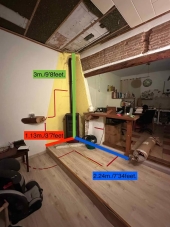
That's good to hear. The left wall it's underground but it must be well drained and insulated because it has no moisture issues at all, the back wall is open to the kitchen and the floor it's a slab on top of the lower floor, wild guess it's probably more than a meter of concrete foundation underneath.

If you use the red bricks on edge, there will be more mass on the hot face.


Given the size and height the top of the bell will have, I'm considering making it also sitting place like the bench.
Would it make sense to extend the heat shield of IFB to the first layer of the top? If it's two layers of red brick, it will get hotter than IBF and red brick on top?

Now that I can move forward, a whole new range of questions arise : )

Haven't touched my basic technical drawing skills since high school, but it helps me to go through details and figure out how to proceed. It's helpful to imagine better how it will fit into the space. And can wait to see it!


1 week ago

This is coming from a person that used to think hand saw was the only way to cut small branches.  


Same here, but we've got one of this, and it's really a game changer to do maintenance on the garden.

Cutting wood with this is bliss! You can cut easily soft wood branches  up to 20 cm, 15 if it's hard wood.  
1 week ago