Gordon Longfoot

+ Follow
since Oct 14, 2025
Merit badge: bb list bbv list
For More
Arizona
Apples and Likes
Apples
Total received
In last 30 days
4
Forums and Threads

Recent posts by Gordon Longfoot

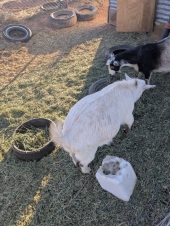
Our white goat had triplets today. It took all day, she was having contractions this morning and I spent a couple hours keeping an eye on here. Of course when I go back to working on my other project my wife hears the baby doing it's first little baby goat sounds. This time we got two girls that will stay on the homestead and one boy that will be sold off.

So she was exposed in October and took a few weeks to go into heat.
3 days ago

Lif Strand wrote:

Gordon Longfoot wrote:
There were prairie dogs in our front field before we moved to our farm. This was out in Springerville.


Are you still in Springerville? If so, that would explain why your conditions seem so similar to mine, because I live in NM 30 miles east of Springerville! And if you are still there and that's what all your posts are about, your experiences will be super valuable for me and the tough growing conditions of this area!


We're an hour away now. In Snowflake but outside of city limits. It's my understanding that this area was the sheep capital of the country. But going further back there was wars over cattle land. The early sheep herders would be run out of town or murdered, but eventually all the land around Holbrook was sheep. I was told they would eat all the grass then pull it up by the roots.

There was a Hatfields McCoys type feud out here. You can look up the Pleasant Valley War.

So it should be good grazing land all around here. I haven't had time to get pictures because we were selling eggs yesterday then today I took some time to search for rocks out in my field. I came in with a wheel barrow full of petrified wood and what looks like ancient stone tools. There's some interesting Pueblo ruins out at Lyman lake, but some of them might have been living here on my land at some point.
4 days ago

Lif Strand wrote:

Jeremy Baker wrote:Our neighbors use trench gardening in the southern AZ. They love it for plants that are not “desert” plants. They dig down about a foot then toss a bunch of weeds, grass, and organic matter in the bottom. Then they replace some of the topsoil and plant herbs, vegetables, or berries.


Anything I plant in the ground has to have the hole lined with metal screen for critter protection (gophers, moles, even prairie dogs). Everything is so hungry around here because of the drought that even the rusty water troughs I used to plant in won't work - the critters somehow get through the rust places. This year I'm going to try planting in straw bales that are on top of metal roofing panels PLUS will have metal screen on the sides. I can't even get angry about the loss of my garden knowing that starvation desperation is driving them.

Climate change changes everything.


There were prairie dogs in our front field before we moved to our farm. This was out in Springerville. The first year we were there they must have had cows in that field because we could see the little critters really well. The last year the grass was too tall.

I see it as over grazing or poor farming practices. Soil has microbes and bacteria in it, so some grazing is good but too much will destroy a field. Turning the soil is also dangerous. It's my understanding that the dust bowl was caused by new farming methods pushed by the Federal Government around the turn of the century. They worked just fine until the drought hit in the 30's. But there was no dust bowl before the grass was plowed under. Plowed under to plant crops that the government would destroy to control the price.

Anyway, I went out in my field yesterday and found grass growing in the shade of a Juniper tree. This is leading me to believe my strawberry idea will work.
5 days ago

Cécile Stelzer Johnson wrote:

Gordon Longfoot wrote:

We're an hour or two from the NM border depending on which way we go. It's a little over 5,000 ft elevation, but there's pine forest within a 20 minute drive. The soil is red clay and sand, so water runs off. But there's a pond that collected some of that water. I'm somewhat concerned with water rights and grazing my livestock, so swales aren't going to be happening. I built a few half moons out in the field and have been adding manure filled bedding to the small wash that runs across the 40 acres. It's mostly experimental right now. My main goal is to get better soil that holds water instead of trying to block water from leaving the property.


It sounds like you have your work cut out for you. You have a lot or irons in the fire. Be careful  to not tackle too many things at a time. Getting better soil will also happen in blocking water from leaving the property.
Those half moons you dug are, in fact swales. You could make more, or make them deeper? I don't know your laws in AZ, but if the pond is entirely on your property, there shouldn't be problems with your water rights, although reading that you have "a small wash that runs through the property" could cause problems if you prevent *that* water from going to your neighbors. You should also be able to make a few more swales and keep doing what you are doing: Putting spent litter and manure will make them really fertile, so good job, and good luck, Gordon.


I broke ground earlier this week. Will get pictures of it later, I'm off to the hardware store to get plumbing and some garden hoses.

It's going to be dirt mounds on the north and south sides of about an acre, then I'll plant my honey locusts on that once the dirt settles. The interior of the acre had junipers and elevated mounts that occured naturally, so I'm digging swales that follow the contour. This will give me mounds for planting strawberries. I can afford 500 plants, which gives me a bulk discount. If these do well I will hopefully get runners in the August heat, which will be cut off from the host plant once they establish roots. So spacing will be 36" between plants.

There's dead trees, which look like they would hold my cantelope's as a natural trellis. And I can get some raspberries and blackberries in the same acre.

Water comes in from the property boundary during monsoons, so I've started establishing pathways for it to fill the swales. We're kinda near the top of a hill with dips and ridges throughout the property, but not completely at the top. Water runs pretty swiftly through where our existing pond is, so I imagine the swales will get a good flow that could fill another pond. That pond will be used to attract birds and dragonflys. The problem with the existing pond is ducks and chickens, it's fine for other birds but I want dragonflys laying eggs in an undisturbed area.

Kinda rambling here, but ground has been broken.
1 week ago

Nancy Reading wrote:It sounds exciting Gordon, both the strawberries and raspberries should do better next year once they are established, so observing them the first year makes a lot of sense. I find raspberries have quite a short season, but are very prolific whilst they are ripening. I have plenty for the birds to share as well as me, but I haven't time to pick every day, so they likely get more than I think! I've heard that birds sometimes go after berries if they are thirsty, so having a sorce of drinking water for them a little way away from the berries to distract them may work - maybe with some bird berries there as well.
I'm wondering if both raspberries and strawberries might like a little sunshade in your climate too? Having an overstory might disguise them from the birds...or may just make the birds happy to have more shelter!


I'm actually leaning towards growing them through a patch of Junipers. The well in nearby and the tree's provide a good wind block.
1 week ago

Lif Strand wrote:

Gordon Longfoot wrote:Petty much everywhere you look there's dead bushes or a mix of red dirt and sand.


Looks like you're over 5000' altitude, more like where I live in NM - 7000' and near the NM/AZ border. I recognize that red sandy soil!  

I've had so much gardening failure over the years that if I was way more rational than I am, I'd have given up years ago. One frustration is that the gardening solutions for even low desert don't apply here. The altitude changes so much, meaning that it's not just wind to deal with, but also extreme temperature fluctuations on a daily basis, poor soil, severe water shortages, and a short growing season.

There are some amazing solutions, though, and for that I look at high desert solutions elsewhere in the world, and also historical gardening solutions that are specific to these very specific conditions. The greatest success seems to come from creating microclimate zones and historically this has included terracing (which,  when there weren't any slopes to terrace, were created by digging deep pits and terracing the sides); irrigation systems, crops that were adapted to high altitude extremes, and intense soil management.  

Check out trench gardens, African Zai pit gardening, sunken beds, and traditional  Zuni waffle gardening. Ancient Incan pit gardens were hundreds of feet deep for community gardening, but 1-2 foot deep pits will work just fine for individual farms, too.  

Also, check out rock gardening - where rocks are thermal balancers and mulch all at once!

Finally, check out high prairie gardening as well if your area isn't as extreme as mine, e.g. https://www.theprairiehomestead.com/2015/05/desert-gardening.html


We find Anastasi pottery shards all over after rain. This lead me to buying Hopi blue corn. It might grow good here. I can dig holes easily with my tractor so I build a couple little experiments out in the field. But we have a good working well so I'll experiment with low water crops and still have a berry patch to make the farmers market money.
1 week ago

Cécile Stelzer Johnson wrote:

Gordon Longfoot wrote:This year I'd like to grow strawberries and raspberries to sell. The problem is we get big wind storms that blow dust around. We're planning to start planting wind blocking trees but that will take a few years to be effective. What are my options for a temporary wind block around a 1/2 acre berry patch?
For the tree's I'm planning to start with 40 low thorn Honey Locusts around the 40 acre perimeter. These will be 2-3' trees and more will be propagated as time goes on. I was also thinking of using a hedge but this is a dry climate with sand and clay in the soil. The monsoon season dumps a good amount of rain on the land then it all drains off. There's been destructive sheep ranching out here since the 19th century. The land is over grazed but I have six months worth of goat, pig, chicken, and rabbit manure piled up.
There's already established Juniper trees. One cluster seems to block the brunt of wind, you still feel a breeze but it's not blowing you around. Long term I want to thin them out but as a temporary wind block I could plant berries around them, if they don't interfere with growth.
The birds and other critters can be a problem. Last year we had all our tomatoes robbed by something. I was thinking a scare crow, because bird netting over 1/2 acre would be expensive and time consuming.
I'm willing to experiment and maybe loose this years crop if it means later on down the road I can make it work.


You have been wise in collecting manure from all your critters. Jay is 100% correct about not *blocking* the wind, just slowing it down. You will get a plus from that : My neighbor doesn't believe in winter crops, so when a strong wind blows, we get an inch or two of his topsoil! If I could block it completely, the wind would go around my property.
You do not indicate how many inches of precipitation you get, but I will assume it's dry. Can you make swales? This way, you would make the most of whatever rain you get.. Your clay would keep that moisture high enough and long enough for your plants to use it, perhaps. You may want to put manure & animal bedding in them to help even more to retain moisture.
As far as birds, have you thought about a sacrificial crop? I was thinking of Sea berry  (Hippophae Rahmnoides) 3-10 ft high, zones 3-8, full of thorns. The fruit are extremely high in vitamin C, A & E. In Europe, the fruit is cultivated. Around here, not so much They come in male and female. Here, they want too much money for them. (Maybe that's why you are thinking of the thorny honey locust)
What is the Ph of your soil?. You may want to think of a bush that grows really well in AZ for the bulk of your perimeter, and will fit your zone and precipitation...
I asked AI about your situation. Here is the answer:
Best bushes for Arizona include drought-tolerant, heat-loving options like Texas Sage, Bougainvillea, Yellow Bells, Hopbush, and Baja Fairy Duster. These, along with Arizona Rosewood and Red Yucca, thrive in full sun, require little water once established, and are excellent for privacy screens or colorful accents.
Top Performing Bushes for Arizona
Evergreen/Screening: Arizona Rosewood (non-poisonous alternative to Oleander), Hopbush (very fast-growing), Creosote (drought-tolerant native), and Jojoba.
Flowering/Color: Texas Sage (blooms after rain), Yellow Bells (trumpet-shaped flowers), Red Bird of Paradise (vibrant summer color), Bougainvillea (vines/shrubs for heat), and Baja Fairy Duster.
Small/Accent: Autumn Sage, Chuparosa (hummingbird favorite), Desert Marigold, and Valentine Bush.
Succulents/Structural: Agave, Yucca, and Ocotillo.
Tips for Success
Planting Season: Fall and winter are the best times to plant to allow roots to establish before summer heat.
Watering: While drought-tolerant, these plants need regular water during their first year and occasional deep watering during summer for maximum growth.
Soil: Ensure well-draining soil to prevent root rot.
Reflected Heat: Choose plants that can handle intense, reflected heat from walls or pavement, such as Natal Plum or Bougainvillea".
(Oh, you can grow agave and Bougainvillea. I'm jealous!). I hope this helps to give you a few ideas


We're an hour or two from the NM border depending on which way we go. It's a little over 5,000 ft elevation, but there's pine forest within a 20 minute drive. The soil is red clay and sand, so water runs off. But there's a pond that collected some of that water. I'm somewhat concerned with water rights and grazing my livestock, so swales aren't going to be happening. I built a few half moons out in the field and have been adding manure filled bedding to the small wash that runs across the 40 acres. It's mostly experimental right now. My main goal is to get better soil that holds water instead of trying to block water from leaving the property.

For the crops we're doing a farmers market this year with pork and eggs, so if I get food out of the garden I have a way to sell it. But if I don't there's other products. This is a full time job for my wife and I but we have enough savings to survive until we're profitable. That being said I wan't something people will recognize and want to buy. The strawberries and black berries seem to always be in demand. Pinions are very popular here but you can't drive down the road without seeing a car pulled over selling some. Too much competition for me. I would rather change the land to work, not try to fit in something that works with what we have. But that doesn't mean I won't try certain things in other areas of the land. It would be great to see more wildlife out here and cut down on the fly's.

The PH from untouched, over grazed desert is around 7.5, but into the Junipers it goes down, and in an area with irrigation that our birds pick though it's 6.5. We have 8 hens with full access to the land, 2 laying ducks and six more juvenile ducks. We have 20 layers in total and some roosters, but at the moment there's 14 chicks in the brooder cheeping at me. And I've got the incubator going with 9 eggs. The chicks are for eggs but the 9 potential would be an experiment with meat chickens on pasture. Because of the elevation cornish X might not do well, so I have a couple Rhoad Island Red roosters with a mix of mostly red based hens. If it all works the soil improvements will come with the bird tractor moving down the field.

We don't have that many rocks out here unless we dig or come out after the rain. It's mostly petrified wood. But, someone built a cinder brick building on the property so I've seen first hand how thermal mass works. Last August when the temperature was in the 90's that little building stayed cool. It's not usable yet but I'm thinking it will be a semi-root cellar with traditional refrigeration to keep my pork safe.
1 week ago

Pearl Sutton wrote:

Gordon Longfoot wrote:This year I'd like to grow strawberries and raspberries to sell.


Out of curiosity, will those grow in your area? The pH of the soil might be a problem.  


I went around with a pH meter and if the thing is still working right, it's reading 6.5-7.5 in the different areas I tested. The 6.5 was an area our chickens and ducks frequent, it also gets water overflow when we're filling buckets. We have winter rye growing there, and spread aged chicken manure on it last year.

I do have a good amount of pig manure built up in their pens, I could always go in there with a wheel barrow and start scooping it out. Doing a full 1/2 acre might not be feasible right now but I can try a few plants to develop a plan for next year. My compost pile is a good size but I don't think it would be enough for more than a 20x30' patch.

We're pulling a wheel barrow or two of straw/manure from the various livestock. The 6 ducklings made quite a mess when we had them in the brooder. Our doe goats just got a fresh bed of hay on Sunday. I've started to take the wheel barrows out to different areas of our field and strategically place it where it will wash down during rain storms. Letting nature distribute it.
2 weeks ago

Jay Angler wrote:There are a few factors here.
First - wind,  in a funny way, follows the rules of "liquids". You can change where water goes, so long as it still goes with gravity, but you can't *stop* it .

I have read reliable sources which suggest you are better to "slow" the wind by multiple layers with gaps than try to eliminate it. I don't know what resources you have, but my first thought was this fence idea: https://permies.com/t/8617/fence-pallets .
The idea is to upcycle pallets from a free or cheap source, but the video makes it look easier than it is from my experience. It either needs really flat land, or you will need to dig to level each of the skids horizontally.

The side benefit is that the pallet fence would protect the young trees from excessive wind, which will help them get started.


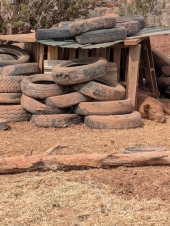
The pallet idea got me thinking, so I took a walk around the land. I'm already using pallets for one of my hog houses. These were free, and I reinforced the pallet with lumber and tires I already had. The property came with about 1,000 tires. There's one big pile then various small piles scattered around the property. Some people call these a nuisance but they also might be useful. So I could build wind breaks using pallets and tires. Then there's a good amount of dead Juniper trees. Some are fairly tall.

The only issue I'm concerned with is tires leaking rust or toxic substances into my berry patch.


I have a mini excavator for digging, it can scrape and push with the dozer blade but there's limited capability.

For seeds I have:

Sorghum
Hopi Blue Corn
Sweet Corn
Pole Beans
Black Seed Sunflower
Oats
Alfalfa
Winter Butternut Squash
Cantelope
Watermelon
Pie Pumpkin
Tamatillo
Onions

There's also tomato seeds I've collected over the years.

I have a few cactus's growing out in the field but it's mostly buffalo or other drought tolerant grass. But only small patches. Petty much everywhere you look there's dead bushes or a mix of red dirt and sand.
2 weeks ago
This year I'd like to grow strawberries and raspberries to sell. The problem is we get big wind storms that blow dust around. We're planning to start planting wind blocking trees but that will take a few years to be effective. What are my options for a temporary wind block around a 1/2 acre berry patch?

For the tree's I'm planning to start with 40 low thorn Honey Locusts around the 40 acre perimeter. These will be 2-3' trees and more will be propagated as time goes on. I was also thinking of using a hedge but this is a dry climate with sand and clay in the soil. The monsoon season dumps a good amount of rain on the land then it all drains off. There's been destructive sheep ranching out here since the 19th century. The land is over grazed but I have six months worth of goat, pig, chicken, and rabbit manure piled up.

There's already established Juniper trees. One cluster seems to block the brunt of wind, you still feel a breeze but it's not blowing you around. Long term I want to thin them out but as a temporary wind block I could plant berries around them, if they don't interfere with growth.

The birds and other critters can be a problem. Last year we had all our tomatoes robbed by something. I was thinking a scare crow, because bird netting over 1/2 acre would be expensive and time consuming.

I'm willing to experiment and maybe loose this years crop if it means later on down the road I can make it work.
2 weeks ago