Daniel Andy

+ Follow
since Mar 06, 2026
Merit badge: bb list bbv list
For More
Apples and Likes
Apples
Total received
In last 30 days
7
Forums and Threads

Recent posts by Daniel Andy

Douglas Alpenstock wrote:Personally I'm leery of anything that would stay plugged in to the battery pack. If the thermostat fails it might cause damage.

Can you describe your larger system? How are you charging the battery pack? If it's solar with a controller, could it power a small 12V incandescent bulb directly?


It's charged with 200w portable solar, and yes I could put a 12v DC bulb on it, but then it's drawing that amount nonstop forever.

I could protect against thermostat failure by running two thermostats in series to the heater. Then it would only turn on when both agree and a single failure wouldnt cause an issue.
1 week ago
I have one of those 2.5kwh portable battery packs with built in inverters.  its LiFePo4 so it handles cold relatively well but I'd like to be able to keep it above freezing in the winter. I was going to add a DC heater to one of the USB ports for that purpose.

However i am struggling to find one. Should be a USB cable to a combined heater/thermostat, that will generate heat when below a certain temp.  All my searches get drowned out with USB hand warmers and USB chair heaters which aren't what I need and lack the thermostat.
1 week ago
Left field idea: cast PLA pipes. Poly l
LactIc Acid (PLA) is the plastic used for 3d printing. It does compost but only with sunlight or municipal composting conditions, so long as your pipes stay in a cool dry place with clean water it seems unlikely they wouldnt last you a half century. I wouldnt recommend 3d printing it because thay creates lots of little gaps and holes that bacteria would live in, but if you pour or slush cast them it could work great.  Relatively low temperatures mean a reusable casting wouldnt be too hard to make, even maybe out of wood.

Then, when you replace a pipe...wood chip it and send it to your local municipal composter. Fully renewable.

I dont have answers for how thick the pipe would be or whether it would make sense in materials cost compared to alternatives but I see no reason it wouldnt work. Could be $5-10 a foot in materials though.  If you can find a 3d printing shop they may give you their scrap PLA for free.

Heres a link to a discussion on PLA casting. https://www.reddit.com/r/3Dprinting/comments/4l0fla/what_do_you_do_with_all_of_your_scrap_plastic/
2 weeks ago
Hi Matthew!

I need an easy system to tune heat flows in a passive solar home. Earth berm on one side, greenhouse on the other.  

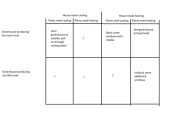
The problem is that the system will almost never been in ideal thermal balance. The greenhouse is always producing too much or too little, and the house always needs either cooling or heating, and the plants in the greenhouse may need something else.

So you end up with a 4x2 grid of possibilities. See the attached image.
 To meet those needs, there are cooling tubes through the berm, greenhouse vents, and you can drop some greenhouse window shades to reduce incoming sun...are those enough to fill out the whole chart?  Am I overthinking this?
3 weeks ago
Sort of a lost custom but from a much older time... donating time to help neighbors.

I was thinking about how modern life allows us to be so independent from each other that we have no need to interact with our neighbors. In times past, your neighbors would help roof your house, or clean your stable when you had a new baby, or build your barn with you.

It occurred to me that this wasn't just being generous to each other. Of course, you needed the whole village to build roofs and barns back then, but it also built community ties. In my readings about traditional tribal communities what stood out to me was the extent to which tribal existence was held together not by law but by *reciprocal obligation*. It was the debt you owed to people helping you out which bound you as an individual to the tribe, and which made you help out in turn. Over a lifetime these repeated debts tied everyone together and made sure everyone was acquainted with each other's strengths. People would avoid breaking laws not because there were police but because it would cause trouble for the whole group you were part of. A person who caused trouble, caused it for their whole extended group, so people would avoid causing trouble to avoid inconveniencing their extended kin, the people they owed a lot to and didnt want to disappoint.

In short, I think our modern independence is simultaneously the destruction of our community bonds. We don't need each other, and that makes us not know each other, and that makes a neighborhood group weak, barely less than strangers.  We don't get to know our neighbors because we don't have to.

So if we want to build real community, we have to get back to doing things for our neighbors, *even if we don't need to* because doing things for each other is where community comes from. A tradition of helping each other out with some project each year might do that.
3 weeks ago
This is great, i was just working on a cold climate earthship and the greenhouse was a key concern
1 month ago
We have a copy of (I think ) back to basics, by Abigail Ghering. Its been pretty good.

Theres been a lot of advertising about "rebuilding civilization" as a book lately.

I'd like a book that goes into addition detail on complex projects and skills that might be beyond the ordinary: like basic diy welding, saltpeter production, leather tanning, biodiesel and ethanol, electrical circuit reading and repair, and small scale machining.

Is there a go-to reference you choose for complex topics or do you find a separate book or 5 for each topic is necessary?

I bought a copy of Moving Heavy Things for my reference library already. Been looking at "
   An Elementary Treatise on the Mechanics of Machinery: With Special Reference to the Mechanics of the Steam-Engine " just because its valuable knowledge but I lack the machining knowledge even if I understood steam engine principles!

In person book recommendations are more necessary than ever in today's world of AI books.

1 month ago

Daniel Andy wrote:Even though you can run an electric vehicle from solar more readily, there is still some niche value in storing electricity in ethanol. For one thing it doesn't go bad the way gasoline does or discharge the way batteries do.

A tank of ethanol can be kept essentially forever. It's the tank's durability that matters, not the ethanol: https://www.laballey.com/blog/storage-and-shelf-life-of-ethanol

This makes it a suitable backup fuel for generators for when the PV system can't function, or perhaps for longer duration vehicle trips, although a pure ethanol vehicle is a bigger project than most will contemplate.

I think the last time I looked, though, biodiesel seemed simpler than ethanol due to the aforementioned difficulty getting engines designed for pure ethanol.


Just adding to this, that anyone interested in ethanol production should also seriously consider methanol instead. As a related alchohol it functions similarly (albeit 20% less stored energy per unit weight vs ethanol) but production is simpler and can be done generally from *any* biological feedstock instead of just the raw carbohydrates needed for ethanol. Methanol you can get by distilling grass clippings, or wood chips.

So if someone is considering an offgrid fuel system based on alcohols, they should consider methanol if they don't have an easy way to produce ethanol feedstock. You get less energy out, but you also don't need to do *any* work growing feed, which is a serious time savings.

I think an offgrid electric vehicle with a methanol engine range extender has enormous potential, and methanol could be used to drive pressurized sterling generators such as the one I've linked elsewhere for extra energy production.

It's always worth mentioning that pure methanol fires are invisible, but offgrid methanol is unlikely to be that pure, and you can always add something (including trace ethanol) to give it color.

1 month ago
People might be interested in the Soviet era maps produced of the world (including the USA) in secret during the cold war.

Im told many were lost in a warehouse fire but you can still buy them for many cities and areas.

https://redatlasbook.com/northamerica
1 month ago