Rémy LaCabaneFieutée

+ Follow
since Mar 25, 2026
Merit badge: bb list bbv list
Biography
Offgrid living, container home and tiny stoves enthousiast !
For More
Auvergne/France
Apples and Likes
Apples
Total received
In last 30 days
10
Forums and Threads

Recent posts by Rémy LaCabaneFieutée

Hi, I very quickly encountered the problem of lack of thermal mass in my converted shipping container. I could have built a masonry heater, but I had the following issue: when I come back in the middle of winter after being away for several days, the temperature is often around 0°C. I can’t wait hours for the mass of a stove to heat up.
I built a high-radiation stove, known as a “DEOM Turbo” stove in France.


I then covered two sides with bread oven bricks, 20 in total. This gives me immediate radiant heat for quick warming, reaching up to +19°C in one hour inside the container. I typically burn fires for about 1 hour 30 minutes, once in the morning and once in the evening. After the fire goes out, the 20 bricks continue to release heat for about 6 hours. Each morning before lighting the stove, I gain about +5°C inside the container, and my humidity level has decreased by 10%.

My feedback / experience in 2 years of use :
- It is important to keep two sides of the stove exposed if you want to heat the space quickly.
- The best stoves to modify are simple, high-radiation models.
- The bricks must be in direct contact with the stove.
- If the bricks are placed inside the stove, the heat will primarily go up through the chimney flue.
- You should monitor the stove body at first, as the bricks can cause the steel temperature to rise more than usual.
3 hours ago
Hi Juan, The cabin is actually a wagon built by my friend, who customized the stove.


I’m including a link to a blog article that shows the full construction process : wagon building

Hi Michael, as for me, I’ve greatly shortened my story. It took no less than five years of work and more than 150 stoves to reach this result. I built my first stove for my converted shipping container; people saw it on my blog and asked if I could make one for them, and everything followed from there.
My first attempt here and the original tutorial : Mini stove DIY


Hi Cristobal, you're right, there is kind of Jean Pierre Jeunet aesthetics on this stove.


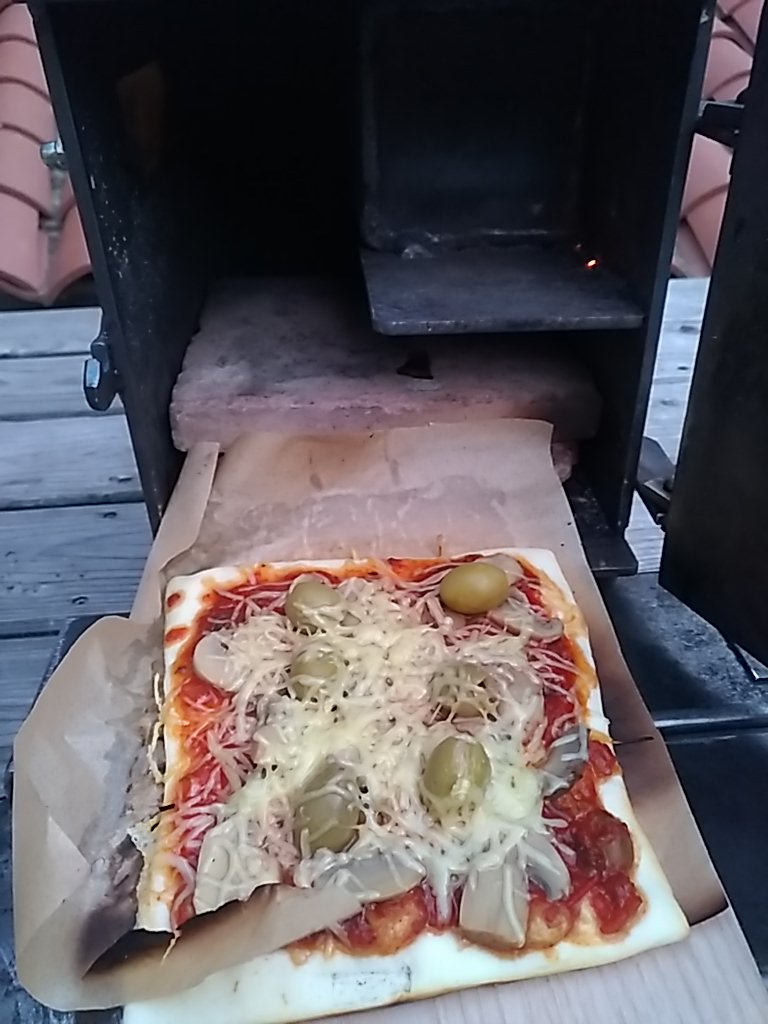
The last picture is from an another similar stove without customizing. For an efficient oven you need a thick terracotta, this one is 30x30x5cm and about 10kg. And The height of the oven should not be too great.
I made a short Youtube video of the last stove but it's only in french :


I also made this one with this sort of design :


5 hours ago
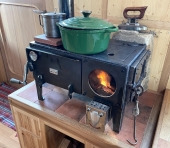
Hello, there are two things that really motivate me about cabin living: the cabin itself and the wood stove that goes inside it.
I live in France, and there are no manufacturers of mini wood-burning cookstoves here. So I had to learn how to weld and build many prototypes to design this stove.


The customization work and the installation of the side viewing window were carried out by a friend.


The main challenge was to reduce the size of the cookstove while maintaining its cooking capabilities. For the firebox, I drew inspiration from workshop sawdust stoves, with an air intake from the top. A primary air supply also comes through the ash drawer. The stove’s output is around 4 to 6 kW.

To achieve an efficient oven with flue gases passing only over the top, I installed a terracotta bread oven floor in the lower section. It stores heat after about 30 minutes, and the oven can reach temperatures of up to 300°C.

Thanks you for reading
22 hours ago
Hi Rico, I sometimes use a hand saw and an axe alongside my reciprocating saw. I don’t recommend a bow saw, as it will be less efficient than a reciprocating saw. As a manual alternative, I would go for the Silky Katanaboy.
I’ve shared some feedback on these different techniques, with plenty of photos :chainsaws alternatives

That said, I find the reciprocating saw to be a very valuable tool for off-grid living. Very few tools can cut such a wide range of materials: metal, wood, and even bricks. One of my friends even uses the saw’s vibrations to help vibrate concrete in small formworks. It’s also possible to find scraper attachments that can be fitted in place of the blade. One of the best techniques when using a reciprocating saw is to be familiar with as many compatible blades and accessories as possible.
1 day ago
I use my reciprocating saw extensively as part of my off-grid lifestyle in the wilderness. Along with my drill, it’s one of only two power tools I own.
I have a battery-powered Makita model, which I mainly use for cutting firewood. For proper use, I recommend an 18V model with batteries of at least 5 Ah.
I use it for felling trees up to 30 cm in diameter, as well as for limbing and cutting logs to size.
To extend battery life, it’s very practical to cut one or two sections of the trunk, then switch to splitting and stacking the wood. This break between cuts allows the machine to cool down and helps save battery power.
Blade choice plays a major role in vibration levels and cutting efficiency. I particularly like IZAR blades.

1 day ago