James Po

+ Follow
since Sep 05, 2026
Merit badge: bb list bbv list
For More
Apples and Likes
Apples
Total received
In last 30 days
0
Forums and Threads

Recent posts by James Po

Chris McClellan wrote:

Michael Blum wrote:I am also curious about this.  We are in central Kentucky  and have a Liberator, but no mass attached yet.  I had a similar experience in that we needed to feed it about every 30 minutes or so, and without the mass it quickly cooled off during our chillier nights here when it reached 0 to 10 F.  I was also planning on adding a mass this summer/fall, but am having doubts as to whether or not it will have a big enough impact. Have any experienced rocket mass folks besides Uncle Mud used the Liberator?  Will adding a mass make a big enough difference with a stove this size?

I am considering pulling it out and adding a traditional wood stove or attempting to build a custom RMH.  Any thoughts or feedback would be appreciated!


Michael,
The Liberator produces about 30,000 btu per hour burning kindling, and 20,000 more or less on pellets. I strongly recommend the best, tallest insulated chimney you can get, blast gates on the 4" air intakes to control the burn, and a 6 to 12 foot mass with 12 feet of heat exchange pipe in it for a good balance between mass heat storage and draft. I like a cob mass around 18" tall, 18" to 24" wide, insulated or isolated from the floor with thermosiphoned air movement,  with the pipe no more than 4" from the top and front surfaces of the mass. If the mass is any bigger the Liberator never quite gets it warm and you get condensate and poor draft. The Liberator didnt draft as well with stratification masses unless you have a really tall insulated chimney. --Mud


Hi Chris,
I am trying to decide if I really need to purchase a double wall pipe liner for my Liberator installation or if it makes more sense (and saves on extra work with extra costs)  for me to use a single wall pipe installed professionally into my existing brick chimney which appears to be lined with typical clay flue liners. When I read online posts on the Liberator installation or on pellet heaters there is often talk of a double wall insulated pipe being superior (or highly recommended) for getting a good draft. I'm not seeing comprehensive conclusions though when it comes to making this choice where the install site already has a brick chimney lined with typical clay flue tiles. Understanding there are variables to consider such as inside diameter and clearance or condition (damaged tiles, globs of refractory mortar etc.). Maybe it is a good, better, best situation with clay, single or double wall retrofit then it comes down to inside diameter and condition of my clay liner coupled with my budget.

I may have misunderstood all the reading I've done including the manual where I now believe the diameter and insulation of the flue is paramount to achieving proper draft.

Page 7 of the Liberator manual paragraph 2 states "Use a solid insulated listed factory built chimney length..." so I think after reading this a few times now I am understanding this insulated length is only the short pipe that mounts at the top of a brick chimney up on my roof. So now I'm unsure if a steel liner retrofit should be used at all. Googles AI result on topic "clay flues are often much larger than 6 inches. An oversized flue causes sluggish drafts, poor combustion, and heavy creosote accumulation for a high-efficiency stove". This is inline with what I thought about the need for strict adherence to the 6" pipe recommendation.

I sincerely wish I could just trust the installers but there are few in my area of Annapolis Valley Nova Scotia and I have good vibes from only 1 out of 4 contacted so far.

Thank you,
James
53 minutes ago

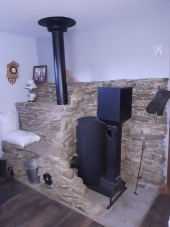
Mikael Korhonen wrote:Hi James. In my experience a cob-and-rock mass roughly the size shown takes a good 4-6 hours of steady burning to fully charge, and then it will comfortably radiate warmth for 12-24 hours depending on insulation and how cold it is outside. One thing to watch in a basement: the concrete slab and foundation walls will drink up heat, so I would put insulation between the mass and any concrete or exterior wall to make sure the warmth goes into your living space instead of into the ground.


Definitely yes on the insulation between stove/mass and a bare concrete slab. The mass shown above does not cover any of the manifold. My logical assumption is the 4-6 hours burn to fully charge a cob-and-rock mass roughly the size shown may be reduced by ##:## (no overfiring just following general manufacturer specs). Again being mindful of how much of the manifold area can be safely covered without risk of spalling or operating outside any manufacturer recommended parameters. Input from anyone with such experience is appreciated. Maybe Uncle Mud has something to say here.

What dimensions is your mass?
What material is your mass?
How long to fully charge (or heat up) to what you feel is the max capacity of your mass?
How long roughly would you say that mass radiates heat after fully charged and the burn has finished?
4 days ago
Hello, How long does it take to fully load this mass with heat and how long does the mass continue to radiate heat after the burn?
Looks nice!

I have seen some videos but having a hard time finding more specific details regarding the best mass materials and how to use them in building a mass around the exhaust pipe and partly around the manifold area without risk of spalling as per manufacturer guide in the manual.

I have to decide what to do in my basement as winter comes in Nova Scotia. I have a concrete slab basement with an existing chimney and old cleanout hatch door access through a masonry brick wall. If I can't get settled on a plan for mass using materials I have access to then I will end up having to spend my first winter without a mass at all and my backup heat is electric baseboards and an aging heat pump... not sure how hard that will hit my wallet!

Thanks, James
6 days ago