gift
How To Preserve Eggs by Leigh Tate
will be released to subscribers in: soon!

HMMMM. . . .

+ Follow
since Nov 03, 2010
Merit badge: bb list bbv list
For More
Apples and Likes
Apples
Total received
In last 30 days
0
Forums and Threads

Recent posts by HMMMM. . . .

Ive been exchanging rmh info for fish info with a tillapia farmer that is interested in using an rmh to keep his tank room at 70 degrees.  Anything much less than this and the fish die..  I want to make sure I give him good advice..    The space were talking about is a 24x28 double layered hoop and plastic greenhouse soon to be expanded to 88' long.  Being in mid florida, the temps are pretty mild but still gets to freezing fairly regularly.  Taking into acct the water heat retention, the thermal loss of the plastic and an 8" rmh, does anyone else feel it possible to keep a constant MINIMUM 70 degrees?  Seems to me that the early hours of the morning would need a supplemental heat source.  A few recent posts of using wvo as a constant feed come to mind as a way to keep the fire going unattended but this is his family income, not too keen on an untested system.  Possibly screw fed wood chips or wood stove pellets?  Any thoughts anyone?  maybe other heaters? 
14 years ago
In my limited experience the frost is not a friend of Cassava, 
14 years ago
Finally some real experience!  Can you tell us more about the safe preparation of the leaves for human and animal food?  In my reading I saw something about tests in texas but dont remember specifics.  I also ran into a guy that was part of a test crop at the university of florida in Gainesville.  Its deftinatly been researched here but is not widley known as a food source.  Id like to know more about the change in starch over a period of time if you have time.  Thanks!  Randall
14 years ago
Good to hear from you Cassava farmer.  It seems as though this amazingly diverse crop hasn't caught on in the US yet.  Are you growing in Panama now?  How big is your production to be able to provide livestock forage? Im interested in finding out more about the drying and grinding process for use as flour.  As far as cyanid, the bitter casava has substantial levels and needs to be handled with caution if being eaten.  The sweet version is reported to have 50 times less the levels as the bitter and is the type recomended for human consumption.  Ive not seen the bitter cassava but have read that the two types can be differentiated by the colour of the stems.  Bitter is blue, sweet is red.  Either way 20 minutes of boiling and discarding the water is enought to fix any concerns of digestability.  Im sure you know all this but feel like it needs to be said when ever the cyanid is brought up.  Hope to hear more from you soon. 
14 years ago
Hi Ludi,  seems like surf and turf type stews are the popular thing.  Palm oil and peanut butter.. cant go wrong with that. 

Thanks for your recipes
15 years ago
According to the "phillipine root crop information guide" cassava LEAVES contain per 100 g of edible mass, 70 g of protein and 311 mg of calcium.  These numbers seem pretty incredible and I a little dubious of them.  What I am sure of is that the leaves (boiled) have a texture of lightly cooked collards, are a prolific grower and are nutritious.  Theres got to be somone out there in permie world that knows about these as well...
15 years ago
Dried. Boiled. Baked. Yum, Sweet, Awsome, leaves, roots, stems,  people food, animal food, grows in good or crappy soil, wet or dry..  

This is such an easy to grow and versatile plant Im hoping there is someone willing to share their experience cooking or drying and using the leaves.

15 years ago
Lima beans would be ok.  Thanks Jen.
15 years ago
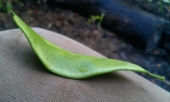
I bought these seeds as "asian winged beans" and planted them in the spring.  They are big happy vines and fruiting as I was told they would when the days grew shorter.  The problem is that yhe beans are decidely not "winged".  Does any one know if these hard flat beans will mature into the asian winged beans or is this something different?
15 years ago