Lydia S.

+ Follow
since Jan 09, 2011
Merit badge: bb list bbv list
For More
Apples and Likes
Apples
Total received
In last 30 days
0
Forums and Threads

Recent posts by Lydia S.

When is the best time of year to harvest the dandelion roots for tea? My guess would be the fall, after the plant has spent the season growing and is about to go dormant. Also, does anyone have any tips for drying the roots? I don't have a food dehydrator,
thanks!
14 years ago
Hi!  a note on the bee balm--they are known to get quite large and can spread out over four feet, so keep in mind the space you have as well as how you will get in there to harvest the trees.
Also, I've always heard that fennel may inhibit the growth of nearby plants. I found this online when I googled 'fennel alleopathy'

"A good example of an allelopathic species is production of inhibitory chemicals by fennel. The roots of fennel plants produce a suite of chemicals which can reduce the root elongation, root hair growth and germination of neighbouring plants, like lettuce. This is an example of allelopathic exudation. "

Just go easy with it, try one plant and see how it affects the others.

I would also suggest narrowing your list a little bit so it is easier to keep track of the guild and see how the plants are interacting.
Good Luck!
14 years ago
Hi,

I think the key thing is to mulch with weed free materials. This would include weed-free compost, salt marsh hay, quality straw (not hay). If you add weedy things like manure I would put another layer of cardboard then mulch on top with weed free stuff. Make sure you have some nitrogen rich material in there to keep the balance if you are using straw.
14 years ago
Thank you for posting the link, the lectures are great!
14 years ago
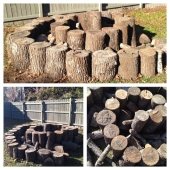
I think it's a great idea, and it would be interesting to compare the performance of a hugelkultur herb spiral with a more traditional one. The thing that I would try to solve would be that the herb spiral is highest in the center, so the roots of those plants may take a few season to get down to the wood below. A possible solution would be to build up the wood so that it forms a mound and is higher in the center. The first year especially the water needs are greater while the plants are getting established.
14 years ago
Thank you for starting this thread, Does anyone have experience growing perennial vegetables from seed?

I want to start some perennial veggie beds this year, but it is difficult to find plants, so I thought I would look into which ones could be started from seed.

I've seen a video about sea kale (Crambe maritima) that looks easy to start from seed.

Any others that you know of??
thanks!
14 years ago
I think I understand what you mean, it's really interesting-Try mulching in the areas you are currently planting trees and perennials--that will help the decomposition process along and hold in moisture in the layer of unprocessed biomatter.
Definitely keep us posted on how the cherry trees and plants are doing, best of luck!
14 years ago
What you decide to do really depends on your goals for the forest garden--you said you wanted a "diverse forest garden" --what does that mean to you? What kinds of things do you want from the garden?
Once you have decided on your goals, you can direct succession towards those goals. Your first objective should be improving the soil. Compaction will be a problem down the road if you don't try to remedy it now. You may want to till and plant a cover crop first, (include some fast growing deep rooted plants like daikon radish to break up the deeper layers) then look into using a subsoiler instead of tilling the next year. This device cuts and lifts the soil to allow water to penetrate without destroying the soil texture.
Once your soil has improved, create habitat for your desired species and reduce competition from unwanted species. This can be done in many ways, but I would like to know more about what your goals are first....
14 years ago
Sounds like you have quite a challenge on your hands!

How large of an area is affected by the hydrophobic soil? If it is not too big, you might want to try sheet mulching right over it and planting it with a cover crop. It will take a few seasons, but mulch will most likely improve the soil quality and ability to hold water. Try to mulch with what is already growing there so that you don't have to transport the mulch.

Also, I think that podsol better characterizes the soil you describe, "duff" is a general term: from dictionary.com:

duff
–noun
1.
organic matter in various stages of decomposition on the floor of the forest.
2.
fine, dry coal, esp. anthracite.

Best of luck! Let us know what you find out in your research!
14 years ago
Are you able to get your soil tested? That would be the best way to see which minerals are missing. If calcium is low, you could try plants that accumulate calcium (dynamic accumulators). The following plants take up calcium and store it in their leaves:
German Chamomile (C. nobile) (also accumulates K and P)
Silverweed (P. anserina) also accumulates K and Cu
Comfrey (Symphytum spp.) (one of the best, accumulates Ca, K, P, Cu, Fe, Mg
Nettle (U. dioica) (Ca, K, S, Cu, Fe, Na)
(info from Edible Forest Gardens by Dave Jacke)

when the plants die down for the winter, or you cut them back as mulch, you keep the calcium cycling through your soil. Holding the calcium in plant tissue prevents it from leaching out of the soil. If you want an all purpose plant to keep fertility high, comfrey is my choice, but do your research, as it is dispersive and opportunistic. The russian comfrey has been reported to be less feisty.
Best of luck!

14 years ago