Harmon McCoy

+ Follow
since Apr 03, 2011
Merit badge: bb list bbv list
For More
Apples and Likes
Apples
Total received
In last 30 days
0
Forums and Threads

Recent posts by Harmon McCoy

    I don't think their are any companies making animal feed from black locust. Just lots of small farmers around the world using it to feed their livestock, with apparently no bad effects.
14 years ago
    What I found with filing the ripping chain by hand was that I would sometimes get a ripple effect along the board -- that is, that the board surface was not nearly as smooth as with a new chain. Once I got the electric sharpener that precisely locked the chain in place while it ground the tooth, each one exactly the same, that went away. Also I found it was important to keep a close eye on the bar gap, closing it down regularly with a tool I got from Baileys.
      Rip sawing all day like that is quite a bit different from logging or cutting firewood. I almost never had to sharpen a chain during the day when logging, unless I did something dumb like hitting the dirt. Sawing lumber, however, it's more like 3 chains a day, or at least two. I guess if all the logging was done in the Winter and all the skidding done in the snow, it wouldn't be so bad, but having mud on the logs and in the bark is almost inevitable otherwise, and as much as you try to scrape or brush it off, it really dulls the chain pretty quickly. And with those long bars needed for sawmilling, that's a lot of work to do them by hand.
14 years ago
Huh, the more I look at this, the more mysterious it seems. If you google on "black locust toxic" you get a lot of hits with warnings of toxicity, but if you google "black locust fodder" you get a whole lot of hits with personal reports from people who have fed it to their rabbits, their chickens, goats, etc for years with no problems. And university papers like this:
"The leaves are used for livestock feed in the Republic of Korea and in Bulgaria (Keresztesi 1983, 1988). In the highlands of Nepal and northern India, where black locust is naturalized, it is an important fodder tree. Branches above the reach of livestock are cut when other green for-ages are scarce, and the wood is used later for fuel.

Ground black locust tops including woody stems, from first and second harvests, were found to be comparable to alfalfa (Medicago sativa L.) with 23-24% crude protein, 7% lignin, and 4.2 kcal/g. Ruminal digestion by cattle was also equivalent (Baertsche et al. 1986). When planted at close spacings, the new growth can be harvested with conventional farm machinery for silage or hay (Fig. 2, 3). The compound leaves can be separated and ground for a high-protein ingredient of commercial feeds. Because black locust thrives on sites too marginal for alfalfa, it merits further study as a forage crop."
http://www.hort.purdue.edu/newcrop/proceedings1990/v1-278.html
    And actually, most of the warnings seem to have to do with horses. So I don't know -- and I'm still wondering if somebody didn't mix up another plant with black locust.

14 years ago

paul wheaton wrote:
I posted the video to a few different forums and got the following response at prepared society that I thought was interesting:

I know that black locust is 4% fungicide by weight, which is why it lasts so long.  So it is no surprise that there are toxins in it. 

I think it is good to have the breakdown.  And, at the same time, I think as long as critters have lots of other things to choose from, they will eat that which is best for them.


      I'm not sure this is correct information. At least there certainly seems to be a lot of contradictory information, if you do a search on the web, such as this paper from North Carolina State University which studied black locust as goat feed and definitely recommends it. http://repository.lib.ncsu.edu/ir/handle/1840.16/5769
      Plus we see goats eating it with apparently no ill-effects. So does anyone know of any other studies which agree with the post from prepared society? Could it be that they confused some other tree as black locust, which so many people seem to do?
14 years ago
    I worked in the woods for many years logging and always sharpened my chains by hand with a file, and with just a simple little flat steel plate guide made by Carlton, I think. But it really depends on what you're cutting too, because sawing evergreens like pine, spruce, cedar, etc and even the softer hardwoods like birch and aspen, having the chain perfect is not so crucial as it is with some of the real hardwoods. What I mean is you can have a chain with every tooth sharp as a razor, but doing it by hand out in the woods especially it's easy to get the angle a little different on one side from the other, or the teeth a little shorter, whatever. I logged in hardwood country for awhile and got into some big elm trees one day and my saw kept wanting to cut in a circle. I kept sharpening the chain, couldn't figure out what was wrong for the longest time. And that elm would eat the black finish off the side of the chain links very rapidly. Tough stuff.
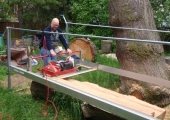
    Anyway, late in life I bought a nice little Logosol sawmill, a chainsaw mill, which uses ripping chain. I found out very quickly that I really needed an electric sharpener, because 1 -- running a saw that way wears on the chain a lot and dulls it, but mostly  2 -- the chain needs to be really precisely done, with all the teeth just alike. That's easy with a good electric sharpener, not so easy by hand especially as the chain gets worn down, things tend to get just a little out of whack. And it's easier to just have several chains that you change out during the day and then sharpen them all at night.
14 years ago
I have a logosol M-7 mill with a big 123cc Stihl saw engine on it. It cuts very well and is fun to use, but you are right, it is not a production sawmill. If you had some real specialty wood or purpose, I guess you could make a living with it but not just sawing pine, spruce, or cedar lumber. But they are extremely well designed and made. They are a really great homesteader type sawmill, much more affordable and more useful than a bandsaw mill. I love mine, but probably will sell it this Summer because of my health.
    But I used to have the best portable sawmill ever designed, and that's a Mobile Dimension Sawmill.  http://www.mobilemfg.com/portable-sawmills.html
    They have a main circular blade and two edger blades that travel with with the main blade, so every pass of the saw down the log gives you an fully edged board, and there is almost no slab at all. You start off at one edge of the log and cut a 1x2 or 1x4, and just keep going. And you can literally, and I mean literally, saw the biggest logs in the world, but just mounting the saw track right on the log, starting at one corner and sawing it up. Wonderful machines, nothing compares to them for production sawing with a portable mill.
14 years ago