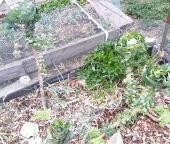
Hugh, something I saw once in Nevada that I would love to do against our south facing wall in is to grow squash vines up at an angle, using metal cables to attach to the eaves, but making sure that the plants do not touch all the way. A dense planting of any annual vine that stays green that you are able to keep trimmed near the top should be useful for both fire resistance and shade. However, our challenge is getting things to grow fast enough to work before wildfire season starts, since nights often drop to cooler temperature that slows down growth. Perhaps it would work if we built a stone/concrete planter box and put rocks around the plants. (I tried this with some tomato plants that were given to me two months early and they actually survived the cooler weather and have been producing well. It also ensured that we got apricots this year, and our almond tree has thrived incredibly well after being moved next to a rock wall and having rocks around the base of it.)
As to general wildfire proofing, here is our situation:
We are on a 4+-acre property in northern California with a Mediterranean climate and high risk for wildfires. The property above us is heavily wooded with lots of brush, and we do not mow the area about past 150 ft from the house, although we do try to make paths through it, and keep the dry stuff under the trees near the road down (often find discarded cigarette butts).
I recently saw a talk by local firefighters and they said in the U.S. the first five feet next to the house are responsible for 90% of fires - mostly from embers. Whoever built the 100 plus year-old house we are in put concrete up around the base of the walls at least 7 inches high, and the area near the walls was already cleared, so that helps a lot, as it's easy to keep that way. There are a couple of sections where an addition was built and the wood siding is down to the ground, so we have protected that with metal flashing.
Home hardening and fire resistant coatings:
We bought the property just after the awful Paradise fire that took 82 lives, and one of the first things we did was to add metal siding and a metal roof to everything - we were lucky enough to source half of the panels inexpensively from a brewery that had dismantled a warehouse. Being new on the property and with Covid making it difficult to socialize, we had the energy to do all that ourselves. (If you combine our current ages and average it out, it comes to 70, and we would not be able to do now what we did then). There are several very old outbuildings on the place that we covered in addition to the house. One of the outbuildings had a dirt floor, so we dug down as far as we could before we hit boulders; then got a pond liner and have a 3000 gallon water storage tank that also doubles as a cold plunge on a hot day. The water doesn't heat up because it has a loft and metal roof above it.
One other thing we did was to spray unpainted wood in all the outbuildings with a product called Timbor that has borax in it, which is fire retardant. For painted wood, and since the wood siding on the house needed to be repainted anyway, we added a product called Master Flame that also has fire retardant properties - you mix it 50-50 with your paint and you can use a paint sprayer. Lately, we have been fine tooth combing any cracks and crevices around the house and have added a steel mesh that can be scrunched up to fit in those places. We also changed the mesh size on the attic vents to prevent ember entry. We took the gutters off the front of the house because they were too dangerous to clean once the roof changed to metal. There were two big stone wall planters that started cracking once the extra winter moisture collected in them, so we removed the bushes that were in them and concreted them over (which took care of the holes the skunks were digging trying to get in under the house. One of the bushes was a geranium and it is much happier in its new location on the north side of the house.)
Keeping gutters clean is another task to keep on top off. After a windstorm took down one of the huge ponderosa pine above our house, we had the other two taken down as well and there is so much less debris to clear out. We do have metal flashing covering the wood timbers on the edges where the gutters attach, and that is another preventative.
Vegetation management:
We had 60 inches of rain over the winter and spring, with the last rainfall at the end of May, which delayed fire season this year but also created a huge abundance of grasses and tall weeds. We have an old riding mower, that my husband has to baby along and is limited to areas that are not too angled or bumpy and somewhat obstacle free. We used to have a 3-wheeled trimmer mower (Cub Scout - no blades - just thick plastic string). However, the thing took a lot of effort to push, especially along sloped terrain, so we sold it and hubby has been experimenting with taking handheld battery-operated weed whackers and trying different things to use as blades. We took leftover plastic string from the Cub Scout, and are now using it instead of the skinnier type on one of the weed whackers. The string has to be kept a bit shorter to begin with because otherwise it makes the motor work harder. On the plus side, we are not losing bits of plastic everywhere, and there is less danger of sparks when we hit a rock.
With the more high powered whacker, he tried copper wire and then some aluminum blades. They worked until you hit an unseen rock, and then you'd spend time having to straighten the blades out. The best thing he has found so far is some links of stainless steel chain. He is still fine tuning that process.
Firefighting policies and news:
One thing that changed since we moved here is how local firefighting crews respond. Any time there is a report of smoke, they head out. We have a local website owner (Yubanet) that provides details. As soon as someone in authority has verified the situation, they either call off teams or ask for more resources. Sometimes it is just smoke from someone's barbecue! We often get strong breezes here during the hot, dry weather so every minute counts. It has made a big difference in the size of the fires we are seeing locally.
Another thing that is happening is that our electric power company (PG&E) has changed their practices after having been found culpable of their equipment being the cause of some of California's very large fires. They now shut down power to selective areas when strong winds could cause their equipment to create sparks. This has made a noticeable difference. Since they became more selective, we experience a lot fewer outages. We get alerted via text when the power is out and often what the cause is and when we can expect it to come back on. Most people now have generators for backup power.