Win a copy of Sourdough Without Fail this week in the Bread forum!"

Todd McDonald

+ Follow
since Apr 27, 2015
Merit badge: bb list bbv list
For More
Mid-Missouri
Apples and Likes
Apples
Total received
In last 30 days
3
Forums and Threads

Recent posts by Todd McDonald

Yes good idea. I will set up a laser level and mark all the posts before I put the dirt on the roof and we'll see what happens.
Summary of the consultation as it pertains to posts in the ground and whether or not they need a footer under them to spread the load.

Typical structural engineer assumes you are installing the post at the surface not in the ground, also assumes the acceptable amount of settling movement is zero. To that end a very large concrete footer is required to spread the load out over a large area. Paul doesn't like concrete. I also would like to avoid it.

Paul's position on pole structures is that once in the hole, the post can only move down two ways. One if it compresses the soil beneath it (not likely in that case of a well compacted rocky subsoil) or two, if the material beneath the post is able to move out of the way to the sides allowing the post to sink (again not likely in a well compacted rocky subsoil). Paul was asking if there were tree roots down there that could potentially be air pockets in the future which would create the opportunity for settling. I haven't seen any in my digging at this depth. The house site is an already excavated hillside cut to make a level spot and uphill patio and then I am digging further beneath that to set my posts. I am also okay with some minimal settling, like 1 inch.

They are currently installing posts at Wheaton Labs the way that I am doing it here. Dig a hole, a few inches of crushed/angular clean gravel in hole (no fines), compact the gravel, install post, compact post with excavator, refill remainder of hole with gravel and compact that around the post. They refer to it as the gravel sock.

Paul suggested I watch the Wofati greenhouse movie since it contains everything they have learned from the first two Wofati's and he feels really proud of that build quality. Good news, I supported the kickstarter for it and already have access to it! Only reason I didn't watch it already is because I'm not building a greenhouse yet, but I'll watch it now.

Other stuff was talked about too but that's the basic nitty gritty on posts and whether or not they need a footer under them.

When the large footer was suggested I got nervous about how to proceed but I feel confident now about how I've been doing it and moving forward with that plan.

Beyond the sinking effect, are you doing anything to the posts to protect against moisture/rot over time beyond the gravel sock? Any charring/treating?


I am. I 'm treating the base of each post with a solution made from borax and glycol. Borax is anti fungal, toxic to insects, and available in the laundry soap aisle at the grocery store. The glycol helps the borax penetrate deeper into the wood than it would with just water. Mostly relying on keeping them dry under a roof with 20ft overhangs. I first encountered this recipe when I took a log home building class from the LHBA and I have since found out there are some commercially available wood preservatives that are essentially glycol and boric acid.
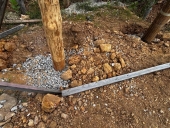
Here is a picture of one of the posts, you can see the rocky spoils from digging the hole to the right of the post. I'm digging with a 4 ton mini excavator and it has a hard time getting through this stuff. My process so far has been digging a hole, then putting in a few inches of crushed gravel and compacting it, then placing the post on the compacted gravel, then backfilling around the post with more gravel for drainage.

Another picture shows some progress of the build.
The purpose of this thread is to prepare for an upcoming consultation I have with Paul, and it is my hope others who are interested in this type of building will find the information useful. I am in the process of building a Wofati inspired home on my land in central Missouri and ran across an engineering question/problem and needed to talk to one of the few people on the planet who understand and have experience with this type of building. I have been to Wheaton Labs and visited the Wofatis and was truly inspired by them.

I say "Wofati inspired" because my building does not exactly fit Paul's definition, however it is heavily influenced by Paul's Wofatis and the same builders/authors that informed the Wofati concept. My home is a pole structure made from trees cut off my own land (mostly) and it will have an earthen roof and here is where my engineering problem creeps in. I did try to contact local structural engineers but despite multiple phone calls and emails I couldn't get any of them to call me back. Its probably for the better, I suspect they are super busy and are more interested in pressing the easy button (copy/paste) for another stick frame house garage door header than figuring out what I've got going on.

My design calls for posts on a 8x12 pattern for most of the building, so each of these posts are carrying 96 square feet of roof. I am doing my calculations with a 200 lb per square foot roof load. That was figured by adding 1ft of dry dirt at 80 lbs per sqft, then insulation and waterproof membrane, then 1ft of wet dirt at 100lbs per sqft. then adding central Missouri's snow load of 20lbs per sqft. Total is 2 feet of earth on my roof and 200lbs per sqft of a roof load. For a single post carrying 96 sqft of roof, multiply 96 by the 200 lbs and you find that that post is carrying 19,200 lbs of weight. I have read Mike Oehler's book on the subject, and John Hait's on annualized solar. I had done all this engineering about 5 or 6 years ago when designing the structure to figure out how big the horizontal logs had to be to carry this roof and I feel really solid in those numbers.

Like I said I am in the process of building, I've got 13 posts in the ground and am trying to make progress. My conundrum arrived last week as I was putting in a vertical post that was a little smaller in diameter than some of the others so I thought I would double check it could hold the weight. I turned to my new structural engineers Google Gemini and Grok. These tools were not around when I first started working on the design but I now use them to double check stuff. I asked the AI how much a weight 7 inch diameter white oak post could support, and after a few back and forth questions arrived at the conclusion that the post could indeed carry the weight. THEN it asked me if I wanted it to design a footer for this post to sit on. This had not occurred to me at all. Oehler's book doesn't mention it other than (paraphrasing) "if you want to, toss a large rock in the hole". I've scoured the Wofati build threads on permies and it seems that they just put posts in the ground. But now AI is asking if I want a footer designed, so I say "sure, design a footer for 19,200lbs" This thing comes back and says I need 42" by 42" concrete pad 10 inches thick under every post! What?! No! My soil is basically rock and clay so I tell it that and it amends it's recommendation to a 31" by 31" concrete pad under each post. Gemini claims that without the footer to spread the load and this kind of weight pressing down on that small of an area, that my post is just going to sink into the ground like a giant nail. But Mike and Paul don't have footers so what gives? So I stop working and decide to ask someone who has experience in this arena.

I've since revisited the threads on the Wofati builds and discovered that 2 of the posts at Allerton Abbey had indeed sunk but there's a lot more than 2 posts in that building, what was it about these 2? No mention of the posts at Cooper Cabin, everything there seems fine. So I decided to get Paul involved and talk it out and see what he has to say about this. Follow along if you're interested.
Question on the urine diverter. I was there in 2015 and if I recall correctly, the urine diverter was a funnel with a window screen over it. What was the purpose of the screen? Splash back prevention? Insect infestation prevention? Has the urine diverting system been upgraded since then? If so what problems were solved?

Asking because I am adding a urine diverter to my neighbor’s existing compost toilet system and want to get it right the first time. Thanks I’m advance for any insight.
4 years ago
Okay time to update. My last post on this thread was four years ago, the thread started 6 years ago. A lot has happened since then. On a personal level, back in 2017 not long after my last post, my carpentry subcontracting company found itself embroiled in a legal battle with a general contractor over a project gone bad. It involved four separate lawsuits, an arbitration, a year and a half of my life and nearly all of my money. In the end the business closed, my former partner declared bankruptcy, and I've been recovering ever since. Thats 2017 through 2019 in 3 sentences. Looking forward, in regards to a permaculture real state development, my capital and my relationship with my bank are in shambles so it doesn't look likely that I will find myself in the roll of "developer" any time soon. I'm constantly keeping an eye out for land or a potential investor. When I meet someone with land that they are thinking of selling, I propose the permaculture real estate development idea and offer to spearhead it. No takers yet.

Don't worry about me though, I'm actually doing really well now. We found 15 acres of our own with owner financing next to a friend of ours and another family we know bought the acreage on the other side of us and will be moving out here soon. Its almost as if the community is happening anyway, its just not officially organized. If you want to come out here too, I highly recommend it. I have posted several times on permies that Cooper and Moniteau counties in Missouri is a great place for permaculture and off grid living.

All that said, I would like to continue the discussion of what a permaculture development would look like. I think about it all the time and now having moved out of the city and into the country I have gained a slightly different perspective. I also have a better understanding of, and identify with, the people I mentioned in my previous post from 2017 who did not want to see any development in their back yards. I get it now . . . sort of. A big problem out here is that small towns are dying all across America and I believe this is just the kind of thing to bring them back. The heart of this neighborhood is an operational, profitable small family farm with a lot of people living on it or nearby and many of them making a living on the farm instead of working in the city and commuting every day. Part of me believes I just need an effective way to communicate all this in order to bring people around to the idea.

Back to the details of the neighborhood. I've been thinking about and researching this idea for 7 years now. The longer I think about it, the smaller the shared community area gets. I once pitched this idea to Grant Shultz of Versaland. He liked it but his gut reaction was that there should be no community area at all, just different lot sizes from 1 to 30 acres. I'm beginning to see the wisdom of that and am wondering if the followers of this thread agree or disagree. Would people prefer to own a small lot and have access to a larger shared area? Or would you rather own a larger piece outright? I'm envisioning 90% of disagreements at an HOA meeting revolving around the management of the communal portion of land. So in theory limiting this area would be limiting conflict.

Lots that I'm leaving out and I need to stop here for now, the dinner bell is ringing. It makes me very happy to see people still posting here and still interested in this. I'm still hopeful that I can be a part of a permaculture development in any capacity. If you know anyone in mid Missouri that wants to see something really awesome happen on their land please point them in my direction.

5 years ago
I don’t have Facebook either. My wife keeps track of the Facebook group. I’m not sure how to start a subgroup or new forum but would participate if it existed.

We just recently moved out of Columbia just west to the Cooper/Moniteau county area near Prairie Home. We have a decent little community of neighbors who are somewhere on the permaculture spectrum out here, so if you are west of Columbia you’re not alone. If you’re in Columbia, there’s a lot of people!

Either way I would like to see something a little more organized but I simply don’t have the time to organize it myself. Tried once but couldn’t stick with it.
5 years ago
Most people don’t think of Sherwin Williams because it’s such expensive paint but they also have oops paint. They call them mis-tints. Sherwin Williams often processes large commercial orders and if they mess one up its your lucky day. Mis-tints often go for $1 a gallon and more than once I have walked in and they have mis-tinted an entire order and there is anywhere between 2 to 5, 5 gallon buckets of matched paint sitting there. Many times I have bought $1,000 worth of high quality paint for $30 to $50.
8 years ago
NOT speaking from experience, just pontificating. If possible, place the chinampas on the upwind side of your prevailing summer winds. That way any scum and algae forming in those pockets will be blown out to the middle of the pond. I usually see one spot on a pond where the algae tends to collect, don't put chinampas there. If algae is a problem, grab a rake, scoop it out, and place directly on the chinampa. Instant fertilizer! Again, not from experience, but I have been thinking of this same idea, just haven't put into practice yet.
8 years ago