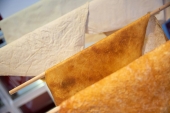
I'm sure a lot of you have seen the project to make apparel from kombucha scobys:
https://www.ted.com/talks/suzanne_lee_grow_your_own_clothes
The idea of growing a material instead of weaving is really attractive -- I'd like to be able to make clothes out of what I can get from sunlight on my own in a way that is less laborious than making fiber, spinning, and weaving. However, the kombucha thing is a only the roughest of starting points for several reasons. Maybe looking at the reasons why this isn't workable will help some ideas come out as to what we could do that might be practical.
1. The scoby material is so water susceptible that it actively degrades from sweat while being worn
2. It also doesn't appear to be very durable or comfortable
3. Growing enough scoby to make meaningful quantities of apparel in this way would require a ton of simple sugars, which would take a lot of land and processing to obtain
4. The designer herself doesn't seem to see this really as a material for clothes, clothing is just a fun proof of concept for growing cellulose mats
5. The designer is talking about engineering the organisms to do crazy things, which to me suggests that her particular research may not result in much of use to permies. So if we want something from this, it's probably up to us to figure it out.
I suspect that most "grown clothes" might run into similar issues right out of the gate. But surely it's possible in theory to come up with something workable! So, any ideas about how we can get nature to weave us things to wear?
Jason