

Jordy Buck

+ Follow
since Sep 26, 2018
Merit badge: bb list bbv list
Biography
A west Michigan native, I run a 1 acre homestead with a 1/2 acre market garden, pigs, rabbits, and chickens. We raise and grow most of our own food, and work within a well rounded sustainable farm model that builds up the world around us. I believe in "give more than you take" and the natural laws of multiplying what you have. I am a writer and educator in the topics of holistic farming and small scale agriculture.
For More
Ensley Center, MI, USA
Apples and Likes
Apples
Total received
In last 30 days
0
Forums and Threads

Recent posts by Jordy Buck

Anne Miller wrote:We use french drains in a similar fashion.  

The french drains could be directed into swales.

Do you have a low area where it would be convenient to drain the water?


I have three spots that would be fairly easy to drain to and also have the contour to hold water once I add cay to the soil.
11 months ago

Rachel Lindsay wrote:People that I read about doing stuff like this also pay attention to creating swales and placing organic matter on land nearby for catching and holding water.

Have you thought of any water-loving plants you would place nearby?

I believe your very localized ecosystem there will probably  undergo changes from even a very tiny pond being there, and ampohbious critters might show up in a couple years if it develops into a healthy micro-ecosystem!


We have been planting willow and poplar to grow as coppiced fodder trees all along the way. My land is full of small swales and rises.  The pond is going to be at the second lowest spot of the land, a natural catch pool. It's also quite near all the animal pens so it'll be easy to haul water from. We've already seen frogs show up just by laying the drain pipe, before even digging anything. I'll probably bring in some cattails from down the road too. I'd love to see some wood ducks make the place home.
11 months ago
I divert my laundry drain outside. It uses roughly 13 gallons of water a day so about 4,700 gallons a year. Add to that the gutters I want to install and we're at 6,200 or so gallons in a year. I may add more diversion from sinks and a bathtubs, but first I need to see how much water water my septic needs to actually function. So, lets say 6,000 gallons, possibly double that, for a year's worth of catchment. My soil is mostly just sand so I'm planning letting the pigs wallow in it a bit then adding some bags of pond clay to seal it up.  Right now it's just swamy as we're digging. The idea is to have a mini wetland wild area, emergency livestock/garden water, and better growth of my willow fodder trees.
11 months ago
Yes, our laundy drains out to a pipe that runs to my pig pen, it makes a great wallow and we're in-process of digging a pond there. After getting rid of detergents in the wash, we've seen a lot of frogs show up in the wallow. We're adding rain gutters to divert more water to the future pond.
11 months ago
I'm building a rainwater pond this year. I expect it to be a minimum of 4,500 gallons after the first 12 months and it will be able to grow annually for a while. We get about 27 inches of rain annually, plus around four or so feet of snowmelt. I have a natural pit area, but will dig it out a bit steeper to make roughly a 25-foot wide, 7-foot deep pool in the center. Based on a similar farm pond in the area, I would think that would hold fish through winter. I want to have fish in it both to grow food and to make the water more fertile for garden use. My first thought was bullhead because it's common knowledge around here that they can handle lower oxygen and warmer, shallower water than other gamefish. I have also read about fathead minnows as less of a food crop but more of animal feed. Does anyone have any opinions on the matter? Zone 5, Michigan.
1 year ago
I have roughly 1,000 landrace fodder trees in my back lot. Mostly Quaking Aspen with some cherry, elm, oak, beech and red maple. Once my hand heals I'll be planting 37 black mulberries and just bought cuttings of hybrid willow, hybrid poplar, and white mulberry to get rooted. I'm working the fruit trees and higher-growth hybrid trees in system with my pig pen to help feed the trees, basically just planting them outside the fence. Any tips for managing fertility for trees? Some of them will be harvested multiple times a year and some will be harvested every few years for useable firewood.
1 year ago

Hans Quistorff wrote:Thank you for posting this project and adding to our knowledge base. please fallow up with results of the trial.


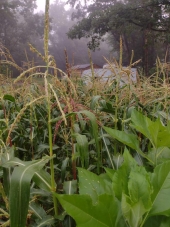
I have it all harvested and tallied up. I just measured the the planting area as 13x20 feet. We harvested 22 pounds of shelled corn. I had hopped to do better. The average yield of corn for the area falls between 120 and 180 bushels an acre. We got the equivalent of 65 bushels an acre. But, we panted two weeks later than most and harvested four weeks earlier than the next earliest stand of corn in town. That timing would let us grow and kill off a serious cover crop before, and grow a second crop like turnips or even another heavy cover crop after. I harvested it all late August, just as the local sweet corn was coming in.

My biggest gripe is that there isn't a lot of corn on a cob, even the larger ones. I saw 2-3 ounces of grain per cob. The largest had 9 inches of grain but only 3 ounces once shelled. And, I got very few double ears. If I were looking for the heaviest yield of grain per square foot, while keeping to a flint corn for higher protein, I'd go back to Wade's Giant Indian. But that's a 100+ day corn and it's hard to dry out late fall.

I should yield significantly more with my Early Pink popcorn (80 day, which is fairly standard for the area), which being a flint should be higher in protein than standard. It was planted late but looks like it'll bring mostly double ears with between 3 and 5 ounces per ear, so 6 plus ounces of grain per stalk. But, it's not as early as the Atomic Orange.

The Atomic orange is definitely a useful tool of a crop and I'll keep experimenting with it for it's early harvest. We grow feed for pigs and getting some grain a month or more sooner than standard is certainly a big deal for self-sustainability. It's actually a 5 weeks sooner type of corn, it's just that it's maturing in the heat of summer instead of late summer/fall. Corn dries out super quick in that hotter weather so it's ready to be harvested extra soon because of that.

J Manszewski wrote:I think hosting classes are very valuable! Either online or in person. Charging for each event. I am too, from West Michigan, and there is little to none hands on classes for basic learning skills. Even simple as garden planning. Or hog butchering. Basic farm practices.


That's true.
2 years ago

William Bronson wrote:Thank you for sharing this!    
Can you tell us more about #10?
Specifically,  are all three components fermented, and also, what kind of fermentation is happening?
I would expect  yeasts and actobacter to dominate, but lacto fermentation is usually what is touted as best.


I tried fermenting just the grain, and fermenting the grain/root mix. Everything was fermented in only water, without any other additions. This was last fall and in winter so we did the fermentation indoors. Room temperature was around 65 degrees fahrenheit.
I'm not positive about the fermentation type, but I observed a few things.

The grain by itself ferments rapidly, presumably through yeast and bacteria. It went fizzy/carbonated in about 24 hours. After about 3 days, it slows down carbonation and starts to sour a bit. That's when I used it, but before it was very sour. The beets by themselves, I let them fermented through what I assume to be lactic fermentation because it didn't smell like acetic acid. I did have one batch that soured (smelled like vinegar).

Together at inclusion rates over 10 percent of root to grain, it didn't get quite as fizzy quite as fast. No acetic smell though. I took it to be a combination lactic and yeast fermentation. I mixed up to 50:50 grain/sugar beet root. This was all done in plastic 5-gallon buckets that were not rinsed between batches.
2 years ago