L Anderson

pollinator
+ Follow
since Apr 04, 2020
Merit badge: bb list bbv list
Biography
Retired Sociologist.  2 acres, 2 horses, 2 alpaca, and 3 little dogs. Multiple Sclerosis (I know, I shouldn’t boast. Just my little contribution to building awareness of a very weird disease. Job done.)
For More
Willamette Valley, OR
Apples and Likes
Apples
Total received
In last 30 days
0
Forums and Threads

Recent posts by L Anderson

Joe Paul wrote:I must admit to really liking the idea of going with option "A" Dillon. If I could find an animal that could keep it under control to the point whereby it doesn't spread beyond where it is now and may even die back a bit then it is a winning recipe for our situation.

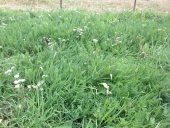
I will speak to the neighbors today about potentially getting some sheep in there. Does anyone have experience in whether or not Pigs, geese, or other animals will target this weed for us?


When we had large animals (a few horses, a few cows, a few alpaca), we managed the pastures with goats.  Big ones, little ones, doesn’t matter.
They will take care of your blackberries too. And tansy.

They also live well with other animals. They had their own sleeping quarters but spent their days with their large friends.

Goats like browse more than grass.
Sheep might handle it too — but maybe not as well as goats. In the west, it’s common for sheep herders to overwinter their sheep on alfalfa fields in California— I used to live across the road from one such field outside of Bakersfield. I enjoyed watching the sheep outside my kitchen window. But I hesitate to recommend sheep for your project. My only experience with sheep being used in this way is from herders bringing their animals down from their summer pastures to winter in alfalfa fields when cutting was finished for the season.  The sheep are less aggressive eaters - over a few months they did a pretty good job of clearing annual weeds without destroying the perennial alfalfa.  Since yarrow is also a perennial, it might also survive a season of “sheeping the field” like the alfalfa did - unless whatever is growing in summer comes in thick and fast enough to overwhelm the shoots of the undesirables, as happens with (irrigated) alfalfa in hot climates with very short winters.

I’ve had a variety of goats over the years ~ Nubian, angora (where mohair comes from), pygora …,
They eat all the weeds. Even if they don’t kill the roots, no new shoots would remain for long.  
We liked to keep goats in the same large pasture that the horses and alpaca used.  By the end of the first season we lived there, all of the Himalayan blackberries that had blanketed it were totally eradicated,

Now, being in a climate with no rain in summer, we didn’t depend on the pasture for feed (and didn’t have enough acreage to grow and bale our own feed).  What they got from our  pastures in summer was enrichment, a little variety, and something to do.  I have no experience in places where it rains in summer.

On the other hand, in Oregon, the mild rainy winters do produce some good growth until the rain stops - but with the goats out there, the bad stuff was still kept in check.  I had a large vegetable garden directly adjacent to the pasture - and had to do the berry and tansy, etc, eradication from the garden myself.  So I know there were still seeds and long roots around.


But a few goats might still be enough to keep the yarrow in check without taking too much from the cattle. Plus, they like weeds and brambles more than grass.  I guess it depends on what you are growing for your cattle.
For example, they do like alfalfa.  And you would need good fencing (or a hot wire down low).  And if you have trees in the pasture, as we did, the will eat leaves and limbs that the6 can reach (of course the horses did too - they made great tree trimmers).

From your photo, it looks like you might need a fair number of goats to get things under control, then just a couple for ongoing maintenance and send the home (if you are lucky enough to find a herd to borrow or rent - if not, then to the market).
Bonus: they are fun to watch.

I think the most expensive aspect of the goat solution is the fencing. *
However if the pasture is large and they don’t see anything outside of the fence that looks more delicious than what is inside, just adding a hot wire to your cattle fencing would probably do it.

3 days ago
I only buy woven shower curtains, and aim the shower spray slightly (very slightly) toward the shower wall. I do not have a bathtub.
The shower curtain gets wet, but as long as the spray isn’t directly on it, the water just seeps down to the shower floor instead of ending up on the bathroom floor.

I throw it in the washer every now and then.

They last for years. I bought the one I’m using almost 16 years ago for $14 and it still looks good. Unfortunately it’s synthetic (polyester),  it it’s better than plastic.

Having recently moved into a house with 2 bathrooms,  I had to buy a second one. That one is linen. Cost a little more. Same system.

Both dry within a few hours, faster when the windows are open or when the heat is on.

Woven shower curtains cost more than plastic ones. But they last forever. And they are scertainly cheaper than having glass shower doors installed, and much, much easier to clean.

I think most people use these decoratively, with a plastic liner behind it.
I skip the plastic.
Works just fine.

2 weeks ago
Check out Kate Downham’s sourdough book. You might never wonder what to do with Sourdough again.
Best kickstarter ever. (Sorry Paul).
2 months ago
I shamelessly make people tour my gardens. I’m beginning my third summer “in town” after living on acreage for a long time.  I’m also pretty old and have a pesky autoimmune disease that makes it difficult to work outdoors in summer. As a result I am inordinately proud of my successes, am endlessly fascinated with experiments in growing, which I have continued to enjoy, albeit on a much smaller scale than in the past, having learned to make peace with needing an extended timeline for accomplishing.

Granted, where I see life and food and beauty, most people see an untidy mess (backyard, hidden behind a 6 foot cedar fence and the stomping grounds of my 2 uncivilized ankle-biting mutts), or unfathomable decisions (front yard - included in the tour).  The front yard, which is way too big in comparison with the back yard, and has for more than 30 years has been  wasted on a ridiculously large chemically manicured lawm.  It’s now on year 3 of a slow process of replacing lawn with native plants.  I cannot be relied upon to keep bird feeders stocked , let alone assist other city dwelling varmints in their efforts to find a meal.  Nor can I be relied upon to mow, water, and weed  as often as city neighbors expect. So instead, I am addressing both issues by working on planting what the wild ones want to eat, out front where my pup dogs won’t bother them. I’ll know I’m done when the lawn mower dies of loneliness.  And the air will be a little cleaner, the house better shaded from the hot summer sun, and I’ll see something interesting when I look out my window.

Of all the different things I do, my gardens, messiness and all, are the most important to me.  They bring meaning to my life.
As a result, anyone who knows me understands that if they decide to risk coming to my house, sooner rather than later they will be coerced into submitting to a tour and a monologue about the whys and wherefores. Thus, people  who come to my house already know I have “odd ideas” about how the grounds around a house should be dressed and managed, and most will gamely tolerate the forced march and accompanying monologue.  I am lucky that the people who visit me tend to tolerate my enthusiasms, even if they don’t understand why I don’t just hire a landscaper and buy all my food at the store like everybody else around here.  Mostly they are pretty good at feigning interest, and frequently, often surprisingly , the interest is genuine.  One fun thing is how often people who showed the least interest during their tour start asking questions a year or so  down the road because they have gradually started looking at their own city lots in a different way.

So yeah, I confess, I drag people through a tour, even the uninterested. To be honest it’s not because I want to teach them things or change their ways or learn from them, though of course all of those things do happen sometimes.  My motivation is actually quite selfish. I have a captive audience that allows me to talk about things I love best while standing in the midst of it. Any other positive impact is purely coincidental.  It’s amazing what grandmas can get away with when they put their minds to it.  


2 months ago

Edward Lye wrote:


It must be nice to have an abundance of spoons.

My current number is equivalent to one hour of determined walking.
After that I get close to crashing.
How many spoons is that?


I haven’t figured out spoon math yet - but in my book I’d call that about 14 nickels. Only 6 left for the rest of the hours in the day.
5 months ago
This sounds similar to some good advice I received after being diagnosed with multiple sclerosis (primary progressive) in early middle age.
I had been the person who held up the world for others most of my adult life.
Not that I wanted to be — I’m a soft touch I guess.

Back to the we point. There are lots of challenges that MS throws at us, and it’s an odd sort of disease that provides a different combination of symptoms for different people. It all depends on where one’s lesions show up - what systems those particular brain or spinal cord nerve bundles happen to control.

Ok, I own up to another digression.

The similarity to spoons?
Fatigue is one of the most common symptoms associated with MS. Overwhelming fatigue. Predictable in its unpredictablity. Except when the weather heats up. Fatigue automatically follows.

For me, it’s body fatigue.
Back to the spoons.
A good neurologist told me this:
When you get up in the morning, you have a dollar to spend on the day. 20 nickels.
You need to reserve some of them for yourself - grooming, feeding yourself, cleaning your clothes, paying your bills ….

Decide each day how many nickels will be spent thusly.


As people start asking you to do things, think about how many nickels each will take.  Will that put you aver 20 for the day? You MUST decline or postpone some of those things.
AND: you must save at least a few of those nickels to do things that you want to do, necessary or not.  Those things will keep you out if the dr office, and make life worth living.

Spoons, nickels, whatever the coin of the realm is today: some of us feel too willing to squander ours so that others may be able to control theirs. (Boundaries — who knew?) Without them, we “givers” fall apart. And the “takers,” who usually don’t realize the value of their “asks,” find others to give them what they need.

Boy, that spoon thing struck a cord.

As did the thoughtful observation posted by another permie that there is often a mismatch in value of a particular act, whether measured in spoons or nickels, from the points of view of the giver and the receiver.

This is something I have been grappling with of late. I have a lovely group of friends who insist on helping me to avoid heavy work, like moving furniture or walking about at a good clip. Despite my frequent observations that, although I must take frequent breaks while doing heavy work (like growing food), it’s not the carrying and good walking that brings in pain and fatigue - it’s sitting around, or what I call “shop walking” (step, step, stand, read labels, repeat….grocery delivery is the greatest invention ever).

So let me walk fast and carry heavy things. Just don’t make me go shopping (which I suspect is something my lovely friends wish I would do instead … shop, and lunch).

OK - I could blather on a few more paragraphs.
I’ll conclude by saying we all should have spoon systems or nickel systems or whatever, and share the logic of those systems with the people that matter most. But those systems are especially important for those of us with particular challenges. They help us to live good lives.

I’ll be thinking about spoons as I spend the rest of the day working on my raised beds and planters, getting them ready for spring planting soI won’t have to work in the heat.
6 months ago
Here is a quick description of a successful experiment using madrone:

https://jenjoycedesign.com/2020/07/25/a-natural-dye-experiment-part-2/

Thinks to note:
The dye materials must be heated to extract color. A week-long soak in the sun is one way to get things started, but jus5busung the stove is fine. Don’t boil! A gentle simmer. Typically for at least an hour, though I unusually go longer.
Once it’sremoved from heat, let it sit for awhile, at least overnight. You will get stronger color the longer it soaks.

Soak your clean wool thoroughly (minimum 1/2 hour) before adding it to the cooled dye pot (after the dye material has been strained out). Don’t add room temperature wool to a hot dye pot - you risk felting/fulling* the wool.

Wool deteriorates in high ph. Most wool dyeing involves adding vinegar (the kind in kitchen cupboards) or citric acid crystals
Kool-aid makes a great fuss free dye for wool because it already contains citric acid.

Wool will also deteriorate if your dye pot is too hot. Heat is good, up to a limit. Heat the pot slowly, and try not to let it get above a slow simmer.  If it boils you will still get dyed wool, but it will most likely lose softness, become a little crunchy, and wear out faster.

Simmer for an hour or so, then let it cool before removing the fiber. In fact, for many natural dyes, the longer you leave the fiber in the dye water, the more dye that gets taken up.

There is great variation in color- and light-fastness when dyeing with natural dyes, depending on the plants used.  It helps to wash natural dyed items gently in cool water, and hang to dry away from sunlight.

6 months ago
When measuring and mixing powders (alum, ground dyestuffs, etc) wear a mask. You don’t want that stuff in your lungs.
9 months ago
I echo the benefit of including a little more information about the rocket part.  If I didn’t know anything about it, seeing the picture and reading that it is (may be) fueled by wood, I would probably imagine fireplace wood or woodburning stove wood. Pretty big pieces that have to be tended, and added to.  So something more about the characteristics of “the wood” and how easy it is to get it (you don’t need a woodshed) and how little tending is necessary —- all the stuff that makes the system economical and efficient in terms of time, effort, $$, and environmental protection.
10 months ago