brian keath

+ Follow
since Apr 16, 2022
Merit badge: bb list bbv list
Biography
escaping the city but in tragically slow motion
For More
Oregon, USA
Apples and Likes
Apples
Total received
In last 30 days
3
Forums and Threads

Recent posts by brian keath

Joshua Myrvaagnes wrote:According to a quick search, the temperature in Boston varies between 67 and 82 Fahrenheit in the hottest month of the year (August).  

I am not buying the idea that 82 feels cool to me just because my internal temperature is 98...it feels more like the bare floor gets hot pretty quick and then is stifling and sweaty.  Partly because it is insulative so it traps my body heat.


A small refinement on this:  98.6*F is your **core** temperature.  Your body works hard to maintain this, and yes you are hypothermic if **your core** drops to 95*F.  But your extremities are usually lower, the surface in general is lower.  Your thermal regulation depends on this because your body produces heat during metabolism.

I feel temperature in two fundamentally different ways.  When touching a surface, what I feel is heat transfer -- a surface feels cold because heat is leaving my body or hot because heat is entering my body.  This is different from "I feel too warm", which is my body encouraging me to alter my environment to allow it to cool better.  As a desert person who now lives in a humid climate, I struggle at 80*, but 90--100 "back home" feels cozy.

There are some other complicating factors.  As others have noted, a blanket is not a heater, it's only an insulator.  If you are uncomfortably warm with a blanket over you, it's because your body is trying to release heat and the blanket is inhibiting that.  This is why a blanket can be very comfortable in a hot summer after you reach equilibrium.

Returning to what we know about hypothermia, there are three contributing factors: cold, wet, wind.  You probably don't want to climb into bed wet, but some surface moisture and a breeze will lower your temperature quickly (the same "phase-state-change" cooling as sweating).    In the summer, you can wipe a damp cloth over your skin and walk around a little before you climb into bed.  A fan works if you have that option, but keep in mind that electric fans produce heat, so they can make your body feel cooler due to the breeze, but they also (slowly) increase the temperature of the room.  Incidentally, getting some breeze can be helpful in the winter, especially if you're using a sleeping bag, because you want your skin dry.  A damp sleeping bag is very hard to heat in the cold.
1 week ago

Leigh Tate wrote:Bill Mollison said

The Problem is the solution. Everything, works both ways. It is only how we see things that makes them advantageous or not.


Stanford economist Thomas Sowell said the same thing but spelled differently:

There are no solutions.  There are only trade-offs.
1 month ago
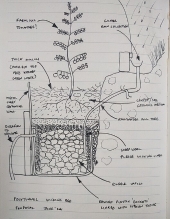
I made some wicking beds from IBC totes.  In general they work well, but I wish I had put the drains much lower -- as low as possible.  Mine have a pipe extending from the drain hole ~2", then an elbow, then another pipe ~18".  This can rotate to adjust the water level inside the bed (or drain nearly completely if needed for repairs or relocation).  The higher the drain, the less water you can remove.

(The pipe assembly rotates.  In the vertical position, the top of the pipe is roughly level with the top of the soil.  I can plant with a high water level and lower the level during the season, encouraging deeper roots.  I can flood it at the end of the season to minimize weeds -- anything I don't want in the bed.)
1 month ago

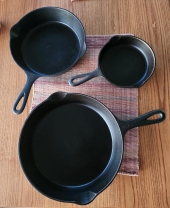
Kevin Olson wrote:So, I've wiped on a thin coat of food grade flaxseed oil and put the iron in the oven at 350F or so, leaving it until the oil stops smoking.  It will stink up the house a bit.  It will smell like you've been using a heat gun to strip old oil-based paint.  It's better to do it on a day when you can open some windows and get a good cross breeze, but it's still winter-ish here, so that's a no go.  Maybe in a few weeks, but not now.


I've not tried flax seed oil, do let us know how it turns out.

I would definitely avoid oils labeled "linseed oil", as "flax seed oil" is usually meant to be safe to ingest and the other is usually not.

I seasoned my iron with butter after a vigorous bout with steel wool.  It's been about 20 years now, and I haven't had to re-season.  I just cook with whatever is nearby, rotating through bacon grease, butter, and beef tallow.  I rarely put soap in mine.  I gently scrape the bottom with the metal spatula I use for cooking (just enough to get a smooth surface again).  If I put water in it, I dry it by heating it on the stove just until the water evaporates, this saves on paper towels.
2 months ago

Nancy Reading wrote:About methanol; I think it's what we would call methylated spirit in the UK, although the concentration and purity might be different.


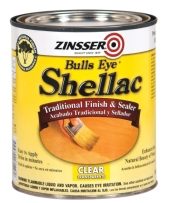
It might be.  We have stuff labeled methylated spirits in the US, but it is not reliably methanol.  I have used this mystery solvent to mix shellac and not had any trouble with it.  But without knowing what's in it, results can be hard to reproduce.  There is no requirement I've ever found dictating that "methylated spirits" must be made from methanol, despite the implication.  Similarly, "denatured alcohol" is not a specific product nor a specific alcohol.  It could be ethanol (with toxins added to make it not a beverage, ostensibly so that solvents are not subject to a liquor tax), it could be made with methanol, it could be made with isopropanol (commonly mixed with water to make "rubbing alcohol").
2 months ago
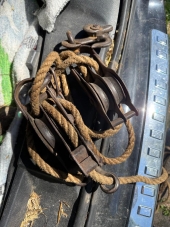
In case you're new to lifting / hoisting:  if it's heavy enough to need mechanical advantage to lift it, don't stand under it.

To phrase the mechanical advantage a little differently:  nothing is free, so if it's easier to lift the thing, you're paying for that somehow.  With block and tackle, the trade-off is that to get the job done with less force you must pull more rope.  If you can lift at most 50lb and use pullies to lift 200lb 5 feet, the force you apply drops to about 12.5lb, but you pull 20 feet of rope.
3 months ago

John F Dean wrote:Besides use as a car jack ….which is questionable the way cars are built now


Agreed, they tend to be a poor match for modern vehicles, which are much rounder than older styles.

They also tilt in use.  The base and the lift point both act as pivots.  The higher you lift, the more the top of the beam tilts towards the thing you're lifting.  This can easily mangle a vehicle body.  So for lifting a vehicle, the lift must initially be tilted away, which puts the base of the lift more "under" the lift point.  Vehicles are also heavier than they were 40y ago when I last used a high-lift this way.  At the time I had a 1500lb car.  Today my truck is 6500lb.  Lifting at the bumper would just rip the bumper off the truck.  I could possibly lift at the tow hitch with a long enough hitch (not directly on the receiver tube, that would be very unstable and could damage the tube).  But I don't have a front hitch receiver.  I don't carry a high-lift in my truck because it's just not a good match.
3 months ago
Hi Greg,
I just stumbled upon your post, I hope you're making ends meet.  I'm not great at sprouting business ideas, but Jack Spirko frequently talks about this stuff on his podcast at https://www.thesurvivalpodcast.com/.  Searches for terms like `side-hustle` and `income` match posts that might be helpful, maybe also https://www.thesurvivalpodcast.com/home-v-homestead-24 about moving a home from liability to asset.
The body of most harddrives is a chunk of aluminum, so if you're into casting, you can melt that and use it.  Aluminum tends to oxidize very quickly during a melt, so melting thin stuff like beverage cans has a relatively low yield of usable metal, but harddrives should be much better.  I think I have a couple dozen waiting for the day I finally get around to doing some casting.  I'd love to make a Gingery-style lathe
2 years ago
There's some good info here on Linseed oil.  As several others have mentioned, boiling (either with heat or with additives) is to speed the "drying" process (it dries through oxidation and polymerization, not through evaporation).

Here are a few more bits I've pulled from Stephen Shepherd's Shellac, Linseed Oil, & Paint:
  • heat boiling is done at 300*F
  • the flash point is 420*F, be wary of fires if you try to heat-boil without good temperature control
  • once some linseed oil is boiled (or otherwise the polymerization has been jump-started), it can be added to other (raw) linseed oil to boil the whole; the book suggests 25% boiled to 75% raw

  • some other ways to speed the polymerization process (all of these can be used as "seeds" to "boil" a quantity of raw oil and mentioned above):
  • blown linseed oil has had air forced through it (the access to oxygen thus allowing the process to begin for oil not at the surface)
  • sun thickened linseed oil is made by leaving raw linseed oil in a clear container (glass is probably best) and placed in the sun; the viscosity increases throughout the polymerization process
  • stand oil is heated to 550*F for a long period of time; it becomes very viscous


  • Regarding oily rags, this oxidation process releases heat, and a pile of oily rags can easily become hot enough to spontaneously combust.  Dispose of your rags properly.  The simple way is to hang them to dry out doors where the heat dissipates as fast as it's produced.  The "industrial" way is to submerge them in a container of water, then pay to have them hauled away somewhere.

    Also note that linseed oil can be used to make cloth or leather waterproof (oilcloth, oilskins) or to make tack  cloth (for removing fine dust from wood before applying a finish).  Perhaps a rag from applying linseed oil as a finish can also have another life in your shop after being allowed to safely dry.
    4 years ago