Lan Chan

+ Follow
since Mar 01, 2023
Merit badge: bb list bbv list
For More
Apples and Likes
Apples
Total received
In last 30 days
0
Forums and Threads

Recent posts by Lan Chan

Peter van den Berg wrote:The chimney should be the same cross section area as the rest of the system. In the pictures, the feed looks quite large, is the system the same cross section area throughout?
In case it is, the transition area from barrel to bench should be *much* bigger than that same system size, more like twice.


Thanks Peter, I had read about this and have been trying to convince the husband to try it out.
Can you say something about the length of the taper to CSA from that larger opening?

...The CSA is constant throughout the system, almost. On the outside, part of the chimney is a bit smaller towards the end since this is what we had lying around. Metal prices are skyrocketing so it's a tough decision to invest in something when you don't know if it even works. When we take that part off nothing changes with the burn, which could mean it's not helping the draw or it's not influencing the problem. So far we've argued for the latter but I'm happy to learn we were wrong - if you think it will make a huge difference.

Still wondering about the temperature differences necessary to smoothly run a rocket. Does anyone have numbers?

2 years ago
Thanks for taking the time to answer.

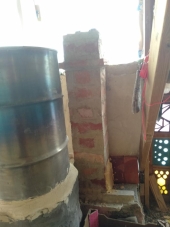
Here some images of the system as it stands right now.

I believe I wrote the distance between the heat riser and barrel is over 5cm because that's where we started out and then raised it as our first burn failed, so it's probably around 8-10cm.

Would it make a difference if I started the burn at 4a.m. when the temperature is at its lowest outdoors?
2 years ago
Quoting these from memory:
The system is 8" or whatever is closest to that concerning brick dimensions and masonry ability of the builder. The duct work is about 6m long in total with one 180° bend, so the bench would be around 3m long once put in.

We checked ratios of feed:heatriser and have something slightly over 1:3. The gap between the barrel and the end of the heat riser is a bit over 5cm. CSA is constant throughout the system, give or take a few mm perhaps.

Our chimney is a bit of an odd ball, part masonry part metal. It had to exit the wall for various reasons so it has two bends in it. We did try with a no bend chimney but got zero changes. The chimney is perhaps just shy of 4m in total height. Even when we dump the smoke out of the masonry bit at 1m height the burn doesn't change. But the temperature of the masonry part of the chimney does effect the burn. Could it be that since it cools down during the burn and after the priming fire we never build up enough draft? What temperature difference between ambient temperature and exhaust gas is needed to produce enough draft?

From the barrel to the duct work there is just the CSA opening into the ducts without any tapering. I've read that people recommend making this exit a bit larger then tapering it off to CSA. Not sure if this could explain the bad performance, or if it's climate related and thus would need shortening of the ducts/bench.
2 years ago
I'm trying to understand a failed rocket build and whether there is any way to remedy the situation. I'm not the person who built the rmh, I'm the sidelined physicist who watched her carpenter husband decide to build it without doing any research and mainly based on YouTube videos and some of the book, though he said he didn't understand written English...
Needless to say, we have different methodologies, my husband and I.

I have two going theories of why it's not working, one having to do with the opening from the manifold into the duct work, the other being climate/length of duct work...

Here's what happens: initially there is no draft in the system so we have to start a fire in the chimney section to prime it. After that we get consistent draft in the right direction and horizontal fire but it never does the rocket, it never burns clean and the fire eventually creeps up the wood leading to flames and smoke where they shouldn't be. The ducts warm up slowly but since the fire doesn't burn very hot, even after two hours of feeding all we have is a bunch of ash and embers and lukewarm bricks.

Everything except for the barrel and the chimney is masonry. There is no mass on the brick ducts at the moment since we're still testing. It's a regular J-tube design following the Mediterranean build from the book as closely as possible given slightly different dimensions of bricks here. Heatriser is insulated but nothing else is. I'll have to measure the exact dimensions of the system when I get the chance to give more information.

Our climate is desert-like with mild to warm daytime temperatures in winter between 10°C and 25°C and night time temperatures below freezing with minimums around-1C to -8C usually but can be as low as -15C. We heat our small wooden cabin every night in winter and the rmh is built on our non insulated veranda to create a bit more livable space during winter evenings. I only saw a few remarks here and there about ambient temperature being an issue, so I'm struggling to understand how it affects the draft and what to do about it.

When we start the heater temperatures both ambient and of the bricks are around 12C. After 2 hours of smokey fire the bricks furthest from the fire are at around 25 or 30C and that's usually when we give up. Maximum temperature on top of the barrel is between 200 and 300C.

Any suggestions or thoughts would be greatly appreciated.


2 years ago