

|

|
|
|
|
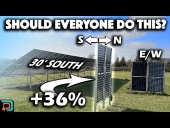
Mikael Korhonen wrote:One more data point from 60° north: for year-round off-grid use, splitting into two fixed arrays has worked better for me than any single compromise angle. A steep winter string around 65-70° catches the low sun and sheds snow almost by itself, while the summer string sits flatter. It is more racking, but as David B. noted, panels are cheap now and it completely avoids moving parts.

Megan Palmer wrote:One of our favourite desserts is a French pear flan with a shortcrust pastry and almond cream filling (aka frangipane) with the fruit sandwiched between layers of the filling.
Apples, plums, peaches and cherries can be substituted for the pears.
Jay Angler wrote:
Dennis Mono wrote:...To Generate 60% more energy per Year, you simply install a Dual Axis-solar Radiation Tracker (DART), that follows the Sun from as earl as 5:30AM to 8:00PM, depending on your Latitude.
I can see something like this if space is really limited. What I see in my area, is that now that panels are relatively cheap, they just put them on different angled/direction roof surfaces, so that they cover more times of the day and year.
As David B said: "Installed once and maintenance free (or virtually) operation for its life span." In our wet and occasionally windy environment, I can't imagine a tracker like that not running into maintenance issues.
David Baillie wrote:
Dennis, The link kind of reinforces what I said above. It makes sense to me and I can admire the tech (but distrust their 60% figure) while not being willing to commit to it. If the system was for me and I had a single smaller array due to lot size or solar availability I would consider it. For my clients? Nope.
As an installer I can tell you it rings all kinds of service technician alarm bells in my head. Cost per hour to have someone like me out to site is free for the first year , $75 per hour after that if I installed the system, $100 plus if someone else did. The clock starts when I leave home. Off grid arrays are generally in remote areas which means said technician will be traveling for hours. If you are lucky you bring all the parts with you and can diagnose and fix it in one shot. In reality nobody has all the right parts. So second trip with more travel time. You end up trying to present a $1000 bill for a $100 part replacement. So that in a nutshell is why the larger array that does not move is generally preferred. There is a lack of qualified technicians out there for everything mechanical electrical electronic. I try to simplify and keep my systems as resilient as possible. Its a design philosophy at the end of the day.
Cheers, David
David Baillie wrote:
All the research I have seen claims a 30 percent increase for dual axle trackers. They have lost favour here due to their high maintenance requirements.
I do live at 45 degrees so that is a huge ark in summer and challenging temperatures swings in the winter so it pushes the mechanisms hard. If you are the type of person who can change a control board, a dead sensor and an actuator you stand to gain some production. If you have to call in a technician every time a component acts up then no. For my thinking A good portion can be made up with a manual seasonally adjusted array angle. For the rest add panels which are cheap and do not require any maintenance. Installed once and maintenance free (or virtually) operation for its life span. Its a case by case thing though.
Cheers, David B.
.jpg)