Mark Stephenson

+ Follow
since Sep 21, 2012
Merit badge: bb list bbv list
For More
Apples and Likes
Apples
Total received
In last 30 days
0
Forums and Threads

Recent posts by Mark Stephenson

     I’m planning a building with greenhouse this summer in Gouldsboro, Maine (usda hardiness zone 6A). It will have a 48’x48’ footprint. It will be divided into two 24’x48’ structures with the long axis oriented east/west.

The north half will be an insulated two floor workshop/storage space with a single slope roof and the 32’ high ridge on the south side. It will have a frost protected shallow foundation with cast in place pex for heat, and a 4’ skirt of 2” xps foam buried around east, west, and north sides.
     
     The south half will be a lean-to greenhouse framed with pressure treated simple post and beam type construction, with a 45 degree sloped roof which will meet the ridge of the north half and run south down to a 6.5’ wall. The top 6’ of that roof will be a roll roof under 15 - 400 watt solar panels. The greenhouse will have a second floor deck attached to the south side of the insulated building. The perimeter walls will be icf’s  2’ above grade and 4.5’ below grade, and their footings will be cast onto granite ledge which will be cleared of subsoil so it will be an open ledge floor. The roof will be light scattering twinwall polycarbonate, and the walls will be clear twinwall polycarbonate. There will be a 60’ long drainage pipe from the northwest corner to allow the water that is persistent at the footing drain to drain out to daylight. There will also be a 160’ trench for power and water from our house. All pipes in trenches will have 2” xps foam board buried over them because we don’t get too deep before hitting ledge no matter where we dig. Combined with the perimeter of three sides of the greenhouse, that’s 536’ of wet trench that I’m thinking of as a good source of geothermal. Should be around 48 degrees F.
     
     I’d like to find a way to use the pv panels to the maximum for maintenance of this building’s needs, because any extra goes back to the grid and each year the power company zeroes out my credits on the house pv, so I’d like to avoid annual donations to the corporation that owns the power company.
     
     I’d like to build as much passive temperature control as possible into the greenhouse, not only because its cheaper, but because I think it’s the most reliable. I’m thinking of 62 gallon pickle barrels with sand, water, or Glauber’s salts, raised beds with raised walkways between to create a heat sink below, a horizontal curtain I can pull from the south wall top to the deck on winter nights...
     
     Can anyone advise me on how to get the best out of this situation?

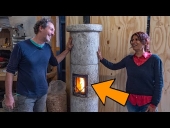
I love the stove pictured. Very simple, attractive design, very efficient, small footprint. It burns to ash though.
I just made a similar one out of steel barrel and sheet metal as a test. I'm running it on pellets for now and still experimenting with cycle time to find the sweet spot when the pellets are fully converted to char and before becoming ash. I made a large ash pan at the bottom and I pull a stainless screen out from under the fuel tube to drop the burning coals into that then dump them into a bucket of water to quench. I'll change the design around in the next one and incorporate a water container instead of an ash pan to simplify that process.
I find these tlud's so much easier than j-tube or batch boxes in terms of achieving visibly clean burns throughout the cycle. I'm curious as to temperature differences between these and rockets, and what a gas analyzer would have to say about the actual noxious gas numbers though. Have any of you pros worked that out?
3 years ago
Thanks so much for all the advice. It's a lot to take in.

For now I'll be replacing the tubing with black to keep the algae out of that part of the system. I checked the tubing in the beds and it is clear so far, probably due to lack of light.

I'll definitely update at intervals or as things change significantly.
10 years ago
Hi again ElfN.

I like the dripping standpipe idea you describe in principle, but the tiny weep hole does seem very "cloggable". Since building this setup I've heard that flood and drain isn't really necessary at all for a healthy aquaponic grow bed. I'm wondering of just a standpipe alone is sufficient.

What do you think of the idea of solid color tubing to inhibit algae from growing in the tubes? From what I read, algae need light (except for some recently created genetically modified marine algae).

10 years ago
Thanks for the thoughts Elf Nori. You may well be right about that. After six weeks the visible tubing that supplies the top bed and the one that drains into the fish tank have algal growth. The root systems in the beds are just ramping up, and I could imagine them clogging the tubes at the end where the netting keeps the pebbles out.
I wonder if having solid color tubing would keep algal growth down. I'll have a look in the gravel and see if those tubes are cleaner than the visible ones.
Mark
10 years ago
After messing around with bell siphon designs and getting mixed/poor results I stumbled upon a very simple, reliable alternative, a hose. This has the advantages of using less materials ($), taking up zero space in the grow bed, and working flawlessly for the past six weeks. Check out my video:
10 years ago
Hi Alan. This was my question. Bryant was offering some help.

The bog lies in a "dogleg" shaped gap between granite ledges. It's about 40' across and 150' long. The property is at the top of a hill and the ground on one side of the bog is about 10' higher. Because the the hill is really just an enormous mass of granite, solid here and split there, there are lots of random pockets where soil has built up over who knows how long, and a pretty thin layer of soil sustaining shrubs and small trees all over. This also means there is a tremendous amount of runoff when it rains. The culverts in the driveway don't always keep up with the amount of water that flows with the rains. This is why I imagine that if I could dam the ends of the bog, it would end up being maintained without the benefit of a spring. The question of adequate depth to prevent freezing is another question. I'd say 4' would be maximum.

Thanks for the interest.
10 years ago
Hi Bryant.
Between the peat and the likely rise up the sides of the ledge, not more than four feet deep I think. We're within a mile of the bay so maybe not as cold as it gets inland, but still pretty cold.

My sister had a coi pond in inland Ct, and it wasn't more than eight feet in diameter, and two feet deep, but they made it through for years.

I see your point about leaky peat, but thought that a 50' long run might clog up eventually.

Thanks for the response.

10 years ago
I have some land in downeast Maine. Most of front of the lot is granite ledge with blueberries, huckleberries and small trees. There is an area that is about 150' long dogleg shaped peat bog that drains at both ends through culverts under my driveway which is a virtual mirror opposite of the shape of the bog.

I've plumbed the bog and it's about 2' deep but the ledge on either side is another couple of feet higher. Could I excavate the center and dump all that peat at each end to create say a 75' long fish pond?
10 years ago
Hi all. Sorry to arrive so late for this topic.

I have built a pretty large oven with a rocket stove as it's heat source. It burns very well but really can't heat the clay oven I built above it sufficiently. I've now added a chimney so that I can burn a fire directly inside the oven body with less smoke than occurs without a chimney. The upshot is that in my experience rocket stoves burn clean but not hot enough to heat a large clay oven, fires inside even large clay ovens heat well but are smokey even with a chimney. Maybe it's all a trade off or maybe I'm just too inexperienced, but it was definitely a worthwhile project.
Good luck all!
11 years ago