Nicola Bludau

pollinator
+ Follow
since Jan 16, 2013
Merit badge: bb list bbv list
Biography
Hi from Australia! We are in the beautiful Port Stephens area, growing a food forest, growing vegetables, caring for chickens and running a small nursery of rare perennial edible and medicinal plants. Our climate is warm-temperate officially, but more a cross between subtropical and Mediterranean, which means more rain in winter than in summer. We are plant collectors - everything edible, medicinal and some otherwise useful plants.
For More
Zone 10a, Australia
Apples and Likes
Apples
Total received
In last 30 days
6
Forums and Threads

Recent posts by Nicola Bludau

I grew peanuts for the first time, and it was very easy.
But I had no idea how to process them, and now they seem to be off.
I don't like raw peanuts, but roasting a bigger quantity seems to be a lot of work.
How is it done?
What do you do with your peanuts?
4 days ago
If this is not done 100% you can wreck a lot. There is no advantage of a wet room. Just get a "normal" shower basin (80x 8o cm) you will need that space anyway.
Even if done conventionally, you need to seal the walls and everything VERY well. A wet room looks modern, but any leak causes problems, and a house with mould is about the last thing I would like.
If you choose your dream, get a very good professional. Also, the bathroom needs a good ventilation - the window has to be used after every shower and be big enough.
4 days ago
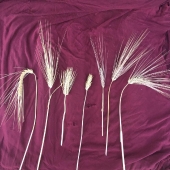
There is a huge difference in the seeds we can get in Australia and the huge variety available in America. I never old-fashioned wheat that is on a long stalk.

Josh, your corn harvest looks amazing! I grew something white, and it looks way more boring. How about usability and taste? Does the red corn taste more interesting? Corn has a huge advantage: the birds are less likely to get into it, but rats like it, though. This should be a cornerstone of home-grain production.
Has anyone done the nixtamal so far? How much work is it?
Chi I def agree with the muscovies, no one will know about them. The bad thing about the cow (cut and carry system) is that everyone will know about it, and then they dob you in with the council. Goats are better in this regard, they are less noisy. Milking animals have a huge advantage, which is a continuous supply of fat and milk every single day. They are a lot of work, especially in cut and carry systems (and you have to walk them too), but the reasons why humans did it for such a long time is exactly that.  
I don't agree with the rabbit: even in suburbia and in many cities, you'll get enough greens to feed a rabbit. It is the source of protein in tough times. Quinoa has very little protein compared to rabbit meat and can be harvested once a year. If you need to use your square meters wisely, the rabbit wins big time, also because this is a cut-and- carry system. I know that many people here lean towards plant-based foods, but onc the trucks stop rolling this is a very luxury option, just run the figures.

My daughter managed to lose the laptop we borrowed her. When I wanted it back she gave me another old one telling me that it does not work and no windows key on it either. I simply deleted the whole system and put linux on it and now I can use it. Simply use a functioning computer and ask ai how to do it. Otherwise give it away on FB marketplace.
1 week ago
No matter from which angle I look at the problem, I always come to the same conclusion: the house cow. Something small, maybe a Dexter Jersey cross.
Goats are good too, but they seem to be much more difficult to keep. Sheep just don't give that much milk, but they are easy to keep and a little bit difficult to milk.

But the cow is like no other animal; no other animal produces more manure and improves the soil in a more dramatic way. It gives a decent amount of milk so that two families can share one cow.
They eat more than just grass; they eat things like lablab bean, sugarcane, banana leaves, banagrass and more.

I don't have a cow, but the cow is the difference between malnutrition and being good. (You can have that with goats, too, just less docile)

It depends on how well your soil holds water, but  I would dig a bit more to make the whole thing worthwhile. Sepp Holzer has some videos on how to seal ponds. A packet of bentonite would help to seal it but watch these videos (I hope there's something in English)
1 week ago

Joseph Lofthouse wrote:Grains!? What a huge topic.

The grain called corn produces huge yields with minimal labor. A simple, hand cranked, hundred year old sheller can process hundreds of pounds per hour.

The grain rye grows wild in my community without irrigation, without weeding, without planting. It self-grows as a feral food. Harvest goes quickly.

A 13 foot long row of wheat provides 5 pounds of grain for me, which could feed me bread for a week. It takes me an hour to harvest and clean with simple tools like a stick, tarp, and a couple of buckets. So in 50 hour week, I could harvest and clean enough wheat to feed myself for a year.

I grow oats, but haven't fallen in love with productivity or processing.

Barley seems hard for me.

I can't grow rice.

I might could grow sorghum, millet, amaranth, or kinwa grains, but I didn't grow up with them as part of my social indoctrination.


.


That sounds good, I simply try everything. I can't grow rice either. We have a tiny house garden there is no space all planted already and our bigger garden has no water - that means no rice. Amaranth has an insane yield but I wasn't good wth processing and the chooks didn't like it. Quinoa is more of an altitude thing and we're at sea level. But there is nothing bad with wheat only wheat and rye make good sourdough breads (and all the older wheat varieties like spelt).

Josh Warfield wrote:Saying flat out that grains aren't worth it is a little intense, compared to what Mr. Lawton actually said in the video. I thought he seemed quite careful to clarify that he wasn't making a universal statement, only one based on his specific context, and suggesting that most small-scale producers would find their context to be similar to his.

Of course, he did say something more nuanced. But I liked the punch of the video.

I tried to grow oats back in the colder climate, and the rats ate it. The same with the corn.
But I had a huge success with amaranth but the processing was a bit difficult.
I think that the main problem with grains is the processing and not the growing, but I will see how my trials go this year (rats, birds, kangaroos, deer)
I use seeds from the supermarket or the Indian grocery store., they germinate just fine.

With the sweet potatoes, I found there is a decline in yield after a while. I planted them in our sandy garden.

I did grow peanuts for the first time this year, and they did well, and the harvest was very good. I will repeat that. I believe peanuts are not very good as a staple fat because of the type of oil.
Goats are super destructive if they jump a fence, and you need several of them, which makes me think that maybe a small Dexter cow would be much better.
There is an advantage of herbivores because they don't really need grain or very little if they get other sources of carbs like canna edulis for example.