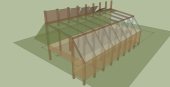
A crucial factor for those high pipes acting as an effective 'heat ramp' is their diameter, because such ramps work by letting hotter and cooler air slip past each other, in a convection circuit. As far as i understand, relatively warm air rises and cool air sinks as a a matter of convection. This is a very gentle forcing of air up or down depending on its relative temperature, it is relatively gentle but it can move air because there is little resistance involved when a corresponding body can move in the opposite direction. Concerning these ventilation pipes, relatively little convection might occur within them, and where it does occur it may mix and slow through turbulence.
Besides the local dynamics in the top pipes, they are part of a larger circuit with its own tendency for a flow of air through them in one direction or another. It seems intended/hoped that the overall flow will normally exit out bottom vents, and hence, enter through the top vents. I think on the warmest days the low lying air may be warmer than the air in the system - resulting in no overall flow. Without such flow some heat will still be able to move down the top vents by turbulent/mini-convection in the pipes, and by conduction, which might be enough to effective, but the only way i see to be confident of the design is by modelling it, or at least some ball-park heat conduction calculations.