gift
Diego Footer on Permaculture Based Homesteads - from the Eat Your Dirt Summit
will be released to subscribers in: soon!
bogdan smith

pollinator
+ Follow
since Jan 16, 2016
Merit badge: bb list bbv list
For More
ukraine
Apples and Likes
Apples
Total received
In last 30 days
14
Forums and Threads

Recent posts by bogdan smith

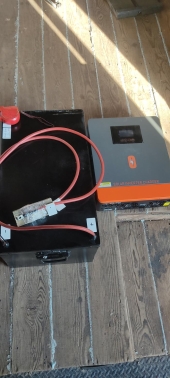
Какие я сделал выводы
1 мой дешёвый инвертор позволяет работать при очень низкой генерации,
Он также может работать при очень  слабом напряжении в сети в то время как для дорогих
Инверторов у нас очень распространена Deia, это критично и необходимо ставить стабилизатор напряжения
2. Мне необходимо увеличить аккумулятор но это проблема так как у меня кастомный аккумулятор с Ant bms на 100а и 48 вольт и продавец на мою просьбу как  увеличить ёмкость до 10 кВт дал цену 1700 долларов, что очень дорого
3. Необходимо обеспечить подогрев аккумуляторов
1 hour ago
The next problem was the freezing weather; I temporarily covered the battery with a warm blanket, which allowed it to last until spring and gave me a chance to draw some conclusions.
1 hour ago
The next problem I encountered was snow. We don’t have standard snow brushes, and the makeshift ones people put together using telescopic pool-cleaning poles just didn’t work for me. I ordered some aluminum tubing and built a sturdy, lightweight 12-meter brush that can be operated with one hand. I don’t even take it off the roof; I just leave it propped against the ground, where it stays until spring.
1 hour ago
My system proved its worth during a severe blackout, when there was no power at all for two weeks due to a failure in the city’s electrical grid. Furthermore, this winter saw the most intense cold in the last 15 years. Thanks to the system, I was able to get through the winter without needing a gasoline generator. Unfortunately, the capacity of my 48V, 100Ah battery bank wasn't sufficient, so I had to purchase an additional 12V, 100Ah battery to keep my gas boiler and modem running. My UPS was low-capacity—with a charging current of only 6A—so I had to buy a more powerful 60A battery charger. In effect, my main 48V battery bank would discharge, while the 12V system handled the boiler and the modem.
1 hour ago

D Nikolls wrote:I really hate those ball style first flush diverters.

The idea is neat, but you need a sizable first flush reservoir for it to be a meaningful amount on even a medium sized roof. Worse, in my experience the little drain thingie at the bottom clogs up despite having a nice fine screen at the entrance point.. then it  stays full and no diversion happens until you clean it out. Then it clogs again.. rinse and repeat..

Then things freeze and the damn thing explodes. Then no rainwater collection happens.

Then you say a lot of VERY rude words, startling the cat and annoying your wife,  and buy a different system. In my case a Graf Optimax Pro, there's also the Wisy Vortex, among other options. Both are STUPID, like surely you are joking, expensive. I found a deal on Ebay or would have tried DIYing with these 2 as inspiration.

That's as far as I've gotten, can't report on how well the Graf works as it's not installed yet.


I agree. Yesterday, I was also thinking about how to drain the water from the settling tank, so I included a valve before it—this way, it can be shut off for the winter. I also agree that it needs to be cleaned periodically; you’ll be able to remove the end cap (which will have a valve fitted into it) at the bottom, scrub the inside of the settling tank pipe with a brush, and clean the ball, which will likely get dirty as well.
2 hours ago

Phil Stevens wrote:I'd put the ball design in the category of "cost effective, works great if you make it a monthly or quarterly habit to check the drain and blow it out if it's got schmutz in it" and also add the caveat that one reason they're popular here is the mild climate. In most of the North Island it just doesn't get cold enough to freeze one of these things...and if it's full of water on a night that is that cold, the rain stopped a long time ago and you should have checked the drain. Another motivating factor for keeping on top of this is that a blocked drain means it's not diverting and you're getting bird poop, pollen, and who knows what in your tanks.

Rainwater harvesting is not a set and forget system, in my experience. Gutters need to be cleared, screens washed, valves inspected, and tanks vacuumed out from time to time. If you're used to outsourcing all the operational overhead to the municipal water works, then providing your own supply requires a shift in mindset and a reasonable maintenance schedule.


I absolutely agree with you. Currently, I have to devote a great deal of extra attention to tasks like stoking the stove, maintaining the solar energy system, and servicing the heating system—which includes flushing it out and maintaining the heat exchangers in the gas boiler. Managing the rainwater collection system also requires discipline and effort, but for me, this is now a matter of actual survival, and I am prepared for it.
2 hours ago
The system is assembled from plastic sewer pipes that are subsequently painted; the valves—located before the settling tank and used to divert flow either to the lawn or into storage containers—are 3D-printed.
https://makerworld.com/ru/models/1900408-rainwater-diverter-valve-80mm-gutter-selector?utm_source=chatgpt.com#profileId-2036655
2 hours ago
The roof area is up to 70 square meters, with two 80 mm diameter downspouts at the edges of the house. A rainwater collection system is installed on the right-hand downspout. Water flows down the pipe into a 1-meter-long settling chamber (made from a 160 mm pipe); the bottom of this chamber is fitted with a cap and a 3/4-inch outlet, allowing water to be drained via a hose onto the lawn. A valve is installed on the 80 mm pipe upstream of the settling chamber, making it possible to shut off the chamber and drain it during the winter. As the settling chamber fills, a float ball shuts off the inlet, causing the water to continue flowing down the 80 mm pipe; at the bottom, a standard downspout outlet directs the water onto the lawn, just as it does currently. A valve is located on this section—if closed, the water is diverted into a line that transitions into a 110 mm underground pipe, leading to a primary reservoir with a concrete base. Once this reservoir is full, an overflow mechanism directs water into a second, bottomless reservoir. During winter or heavy downpours, the valve above the settling chamber can be closed and the chamber drained, while the valve at the base of the downspout is opened, allowing the water to bypass both the settling chamber and the reservoirs entirely.
3 hours ago

Rad Anthony wrote:That's what the ball is for,

https://www.youtube.com/shorts/8tUXD5IfQ14


thanks, that’s cool
19 hours ago

Rad Anthony wrote:Yea have at it. You should be fine. Build redundancy in your lines so that you could always divert or bypass tanks for cleaning servicing. The first initial wash of the rain is the worst quality, then it gets better until it stops raining lol.

Gravity is your friend here. Store first then purify. If you're able to, create a pond for extra reserve and to help the ecosystem. Liners are really popular and cheap nowadays. They have calculators to scale your system tanks and pipes. Aim for flow vs pressure, let the pumps or air tank guide you for pressure.

Brad lancaster has good info to your approach. Use the orientation of the sun and your home to your advantage for freezing pipes etc. build a compost pile around even lol, run hot water lines, get creative bud. Have fun with it, but keep timelessness and practicality in mind with your creations and you will be fine. Best of luck.


Thanks, Rad; I’ll look into all the options and put them to use.