
Colin Miller

+ Follow
since Jan 05, 2021
Merit badge: bb list bbv list
For More
Apples and Likes
Apples
Total received
In last 30 days
0
Forums and Threads

Recent posts by Colin Miller

I just came across this online article (with links)  that is somewhat helpful.

Some Notes on Earth Tubes:  https://builditsolar.com/Projects/Cooling/EarthtubeNotes.htm

4 years ago

Marty Mac wrote:....As I stated before math is NOT my thing but feel free to check my work and play with the calculators yourself. .

Ditto here, especially that level of math!  I'm hoping to find someone who has done an earth tube cooling system for a house more similar to mine that I can use as a basis.  The systems I have read about so far seem to use two parallel runs of about 100' each of 6" PVC.  Filed away somewhere I have an article on static pressure losses in different lengths and diameters of pipe, and the contribution to static pressure of elbows etc. which I can use to choose an appropriate fan (which will have a speed control for adjustment.)
4 years ago
With the recent heat wave out here in the west,  I've been thinking of an earth tube cooling system for my house as well. Normally summers aren't too bad  but on July 1 it hit 103ºF here, with the temp. in the house reaching 90º.  

One question is how to figure on the length of the tubes.  (Marty Mac, I'd be grateful for any links to the sizing calculators you referred to. I've not fouond them so far.)  
Also, if 2 spaced tubes are used, which is I think usual. are there considerations re air flow/velocity when they are combined into one tube to enter the house? I would think that as long as the velocity isn't high, there may not be a problem. 'm thinking I'd need around 100-125 cfm.

My house is medium size- about 1100 sf. main floor, open-plan, with a 16' cathedtal ceiling and a 12' deep loft bedroom (so, effectively 2 storeys) with a 52" ceiling fan in the main room and a smaller one in the loft bedroom, so I have lots of air circulation available. Walls are very well insulated with rigid insulation. There is a small library/spare room on the main floor and a small bathroom. The basement is below ground and stays relatively cool, so it won't factor in the cooling system.

I have a small excavator and can do the trenching myself, down to about 4' or so.  I did a test dig a while ago and put a piece of 3/4" plastic water line to the bottom and backfilled,  then put a thermocouple in the tube and it seems that at that location the earth temp is about 57º, which is a bit higher than I was expecting  but with the open-plan and fans, figure that bringing air in at that temperature might be enough to temper the heat (?) The house is pretty well sealed when all the windows & doors are shut, but  I could use the stove fan and/or a bathroom fan to relieve any pressure buildup.
4 years ago
Cristo, thanks for the detailed reply. (Pic is pretty small and I don't seem to be able to download it but I can see the basic details )  

I anticipate some maintenance to keep the pile hot over the winter and will design the box to allow access from the top for poking or turning. It will also have a thermocouple or two in the pile to be able to constantly monitor the temperature in the middle.  One end of the box will be removable so it can be cleared out in the late spring/summer when heat isn't needed.

The plan is to run a u-shaped loop of 6" spiral duct (about 18' in all) through the middle, with the tubes spaced about 20" apart, so except where the tubes enter the box, the tubes will have about 20" of material around them on all sides.  A fan will be installed on the outgoing duct from the studio to circulate air through the duct line, which will be a closed loop, pulling air from the studio into the box and returning it.  Controlling the trmperatire the studio (about 45' x 25' x 9') would be done by adjusting fan speed and putting 45º take-offs fitted with dampers on both the outgoing and incoming air lines, both of which will be insulated as the total run will be about 85-90'. A rather ambitious project..... (!)

I take my compact excavator over to my neighbour's every couple of weeks to muck out the barn, so we have a regular supply of poop and hay, and will spray it down before dumping into the box to get it properly moist.

It's all very much in the planning stage at this point as I wouldn't begin building it until next summer, hoping to fill it up in mid-Sept. so there might be some heat in October  :)
4 years ago

Jeremy Baker wrote:The more heat it generates the more natural draft it would have. I’m wondering about mixing the pile so it’s hot? Ive got similar questions for the diy composting toilet I’m designing. How to vent it? How to contain it? How to regulate it? Is mixing necessary? Etc.


I understand mixing is a "given" part of the process. The backyard rotary compost tumblers are designed to do this. I read where one fellow pokes hole in his compost pile with a length of 1/2" rebar to allow air to circulate and he can tell how hot it is by how warm the rebar gets. So I expect I'll have to do this from time to time and will design the box so it can be accessed from the top- and the location of the duct pipe inside clearly marked to avoid poking it!

I haven't researched composting toilets for a long time but as I recall, the Sun-Mar units don't require turning, just an additive to create the proper environment for composting. They do require that the drum be kept warm, though, and some models have a small fan. Check their website- it might give you some ideas.
4 years ago

William Bronson wrote:I definitely would not aerate the sides of the pile.
Maybe seal the whole thing, put a solar chimney on top and supply "preheated" air into the bottom?
The preheated air could come from an earth tube, a solar collector,  or a combination of the two.

Many thanks. Creating draft through the pile via a solar chimney + earth tube is interesting! I suspect the solar chimney would only work in a suitable climate and location with lots of sun, though. The purpose of this ezperiment (as it will be at this point)  is to heat the studio in winter and its location doesn't really take max. advantage of solar gain, plus we get too much dull, dreary weather over the winter to make a solar chimney practical.  Perhaps more practtical would be the earth tube and a fan at the top of the box that would be controlled via a moisture meter, as I've read about unregulated air circulation systems drying out the pile.  At this point the project is an experiment and I'm trying to keep it as simple as possible, but the earth tube + fan might be a possibility if the heating system works well enough and it becomes "a thing", ie a permanent installation.
4 years ago
Elsewhere I started a thread about designing a forced-air compost heating system for my neighbour's studio but thought I'd make a new thread on this as it would apply to composting in general.

I want to make the composting bin as mainentance-free as possible. It will be about 10' long by 5' high and wide.

Knowing that it will need to be aerated, I'm thinking of framing in the bottom with heavy steel mesh (about 1.5" square openings) on top, and mounting the box about 6" off the ground to allow airflow beneath.  I'm in the Paciic NW and we get a fair bit of rain, so I'm also thinking of a metal-clad lid which would have about a 3" gap around the edges rather then closing tight, to also aid with airflow through the pile while keeping rain out. It could be opened to allow access for turning/poking/watering, as necessary.  I've heard of people using fans and perforated pipes for aeration but I'd like to avoid that and encourage natural convection.

Would it also be advisable to put slatted, rather than solid, sides on this? I've seen small home-made compst bins with slatted sides. If so, perhaps 1 x 6 (actually 5.5") with about a 1" gap between them? On the other hand, this might allow too much cooling around the edges?  Ultimately some of this will have to be determined by experiment but I thought I'd ask here to get opinions from people with some experience.

4 years ago
For those who might be interested, I just rediscovered the reference to Jean Pain heating a shed with hot air, which you can read about here: https://www.permaculturenews.org/2011/12/15/the-jean-pain-way/
Scroll down about 1/3 of the way to:

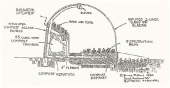
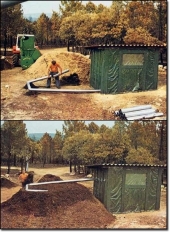
Directly heating air with a compost pile is also possible as Jean Pain shows. By burying a 125mm [5"] air duct in a 50 ton pile, a 12m3, uninsulated forest shed can maintain a constant temperature of 52°C for 8 months. This system used a thermo siphon effect, the hot air coming in at the ceiling of the shed, and the cool air falling to the floor and exiting through a pipe there.


It would appear to be an experimental setup only, although I don't have the book so don't know for sure if he ever went further with it. It's a very small shed, but getting it to 50ºC (125ºF) for 8 months isn't shabby.
4 years ago

Mike Haas wrote: I think you want a lot of turbulence in the air stream to increase heat transfer...


Hmmm... i wonder if some sort of vane system at the inlet to the box could help create more turbulence? Something like a very low-angle fan blade or length of twisted sheet metal (like a twisted longitudinal turbine blade)? Or even a lightweight passive fan blade?  I believe any bends will also contribute.  Both would increase static pressure/resistance in the air column a little but this could be accommodated by using a variable-speed fan.
4 years ago

Mike Haasl wrote:I'm glad you said 80-90 feet, that suggests to me that you have a decent feel for the amount of surface area of pipe that needs to be touching the compost.  Would the black corrugated drain tile (non perforated) be an option?  I think you want a lot of turbulence in the air stream to increase heat transfer.

There are some calculators that have been used to calculate GHAT systems for geothermal air transfer for greenhouses.  I think SunnyJohn was one that isn't available anymore but searching for that and GHAT could get you connected up to a calculator.


I'll take a look online for those GHAT calculators- thanks.  I hadn't thought of (or in fact heard of) black corrugated drain tile.  I'm familiar with what we up here call "Big-O" corrugated (ribbed) plastic drain line, available from 3-6" diameter, but it's not "tile"...  Not sure about its heat tolerance. Agreed about maximizing air-duct contact area/turbilence. I wonder if the heavier, commercial "spiral duct" would do? Easier to support inside the box as well, and I think it will need some rigid support to allow the compost to be dumped in and/or removed.  I can weld up struts for this.

All ducting outside the box would be well insulated. I'm thinking the box would be about 8' x 6' x 6' high, built next to the studio and the air lines run up the wall to the second floor where the studio is (barn & storage is below.) Knauf makes pre-slit semi-rigid fibreglass pipe insulation with a jacket to fit various pipe dlameters, and with insulation thicknesses from 1" to 3". Something like that would be used on the run up to the covered deck, where I'd build an  insulated box along the inside edge of the deck to the inlet point, lined with R-14 Roxul.

@ Bill Haynes: I'm not familiar with sawdust compost piles, but this one will definitely use the available hay + poop. I understand that such compost piles need to be aerated (or the contents turned regularly) and protected from too much rain, so the initial idea is to provide an air space underneath and make the sides of the box of slatted/spaced 1 x 4 or similar to allow some air in. The lid would be light to allow it to be lifted, and also 3 or 4" above the sides to keep rain out while allowing some air in.  Hopefully this would allow the interior of the pile to heat up to 130º -140º, but prevent the contents from going anaerobic at higher temps. As I recall, Jean Pain used a sawdust pile in his hot-air experiment, and the interior of the little shed got up to 51ºC (124ºF).
4 years ago