T. Smith

+ Follow
since Jul 04, 2021
Merit badge: bb list bbv list
Biography
My name is Tim Smith (but that name was already taken so it isn't my username). Since 1999 I have run my own business, a small outdoor school and guide service in  northern Maine. I spend a lot of time off the grid, and am interested in low tech solutions to common problems.
For More
Masardis, Maine
Apples and Likes
Apples
Total received
In last 30 days
4
Forums and Threads

Recent posts by T. Smith

I trap a few beaver every year - very good eating. Muskrat as well. Mammals that live in water have a lot of subcutaneous fat, which is high in calories. These are focused, targeted catches, where we're trying to catch specific animals. Ironic as I was having this conversation earlier today in real life (not online). To trap legally in Maine (all laws are state by state), you have to check your traps every day. And you want to, so you can process anything you catch right away. The difference between great meat and tastes kind of off is only a few hours of exposure to heat. Trapping season is during the colder part of the year here (with the exception of nuisance beaver), so caught animals are often dead and cold when we get to them. But it is all about getting the animal cold, fast, if the weather is warmer, to get good tasting meat.

If meat tastes a bit gamey, a good fix is to soak it in salted water overnight before cooking.

As far as the health of the animal, I agree that most wild animals are very healthy. As the other poster mentioned, it is a good idea to check with local fish and game to learn about any diseases in the area and what to look for.
3 weeks ago
Sure. Here are three things I'd love a bit more discussion on:

1. The book is a couple of years old. Any new insights that have developed since writing it that would be counterintuitive to a reader who just came across it?
2. You mentioned the book as an experiment in trying to create a recipe for communities that could help future communities develop. If you had to summarize it into short form, like a recipe, what whould it look like? Such as 2 cups gardening, 1 cup problem solving, etc. Shortest description possible, a sort of elevator speech.
3. To use the recipe analogy again, what would the experience level and timeline for the cook of such a recipe look like? I see many posts of people wanting to start a community. Based on your experience and in your opinion, how much experience (years) and in what (skills) should someone work to accumulate before starting?

Funny how these things happen. After being a member on Permies for a while, I was going to write you (Paul Wheaton) and ask about best practices for organizing a community based on your experience. And, probably more importantly, ask about pitfalls to avoid. Then I read about the book. Then I read the book. And I learned a lot from it. In my work I often tell people that the soft skills, the people skills are the hard part in most endeavors. This book reinforced that view. Thanks again.
1 month ago
The bit about aluminum trailer wheels threw me for a bit of a loop because I had never heard that. But after checking ours, they are all steel.
1 month ago
I bought this book this morning and read the whole thing today. I didn't know anything about Paul Wheaton yesterday, but now I'm a big fan. I have been running residential wilderness programs (ie. community, but not quite) for a few decades. Paul's ideas mesh with what I've learned experientially, but I also learned a bunch from his vast experience. I loved the book, will be recommending it to our students, and rereading it soon. If you are interested in how communities function in the real world, this is a must read.  Thank you Paul for putting it out there.

1 month ago
A bit later. Anyone in northern Maine?
1 month ago
Great post Michael. Agreed that outhouses are the great equalizer. Not super worried about the breakdown of society and flush toilets, but it could happen. I'm 31 years into my humanure habit, so not a scary scenario. But just took off the river after a week on the Allagash Wilderness Waterway in Maine, and the outhouses there were well maintained, but I was happy to get back to the sawdust as it smells much less bad. The toilet, the water pump, and the kitchen is where we share germs. And some of them are pretty gross.
1 month ago
Sure. Hit me up anytime, but I'm gone a lot guiding in May and June. https://jackmtn.com/contact/
4 months ago
I'm a few hours north of you in Aroostook county but wanted to say hello and wish you the best.
4 months ago
Hi Michelle,
I once spend three Barbados months in Rock Dundo, St. James, while I was a student. Loved the place, loved the island. I love the Bajan accent, it sounds musical to me. We had a big kitchen garden, and so did everyone else. Just wanted to say hello and wish you the best.  
5 months ago
We don’t have any ticks at our field school in northern Maine. Traditionally, we’ve been quite a bit north of the tick line, below which they live. However, a few hours south, the Maine coast is overrun with ticks. The bad news is that they are slowly moving north. The good news is that our predominant tree species is Balsam Fir, and Balsam Fir kills ticks.

According to an article in Nature, the needles and essential oils in Balsam Fir kill overwintering ticks at cold temperatures. Ticks burrow into the leaf litter on the ground as a way to survive a long, cold winter. According to the article, where that leaf litter is composed of fir needles, the ticks have a much lower survival rate. They tested it a bunch of different ways, but their conclusion was that “Balsam Fir needles kill overwintering ticks under both field and lab conditions”.

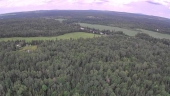
This is just another reason to love Balsam Fir trees. The picture below was taken at altitude above the field school, and just look at all those beautiful Balsam Fir trees! But don’t take my word for it, go read the article (see link below). And for more information on Balsam Fir, the state of Maine has a great book called Forest Trees Of Maine that is free online. Here’s a link to the section on Balsam Fir (pdf) - https://www.maine.gov/dacf/mfs/publications/handbooks_guides/forest_trees/pdf/MiscConifers.pdf

https://www.nature.com/articles/s41598-022-15164-z – “Balsam fir (Abies balsamea) needles and their essential oil kill overwintering ticks (Ixodes scapularis) at cold temperatures”

7 months ago