

|

|

|

|

|

|
|
|
|
|
|
|
|
Bonnie Kuhlman wrote:
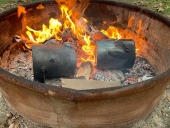
Mike Farmer wrote:At a small scale for animal feed, making biochar can be as easy as throwing a (clean/new) metal paint can with a few holes punched into it full of wood chunks into a backyard fire pit (or wood stove) while you have the fire. I've fed biochar to my chickens when I make it (I also add it to their bedding) and I think it's a great use for biochar (and the chicken's guts are great at inoculating biochar).
But don't you have to seal it off from oxygen after everything is burned? Or would you just pour water on this?



Kathryn Skinner wrote:Just curious. Has anyone thought about how to use the heat from making the biochar for something else? Any heat differential is possibly a source of electricity.

Neven Curlin wrote:
I've made an image to show the 'smolder' standing upright (see attachment). The bottom half is where the to-be-charred material goes, and then the upper half slides over it.
As you can see, the side sheets extend past the bottom, so there would be some room between the bottom and the grate. The grate is at the bottom of the fire box, so a lot of ash falls through into a small container that can be removed when the grate is lifted. It's also where the air comes from (via a duct to the exterior of the house), so maybe it wouldn't be wise to drill a hole at the bottom of the 'smolder'. Maybe better at the sides, so the oxygen is consumed by the fire outside of the 'smolder'.
As it is, without holes, I think the gasses would come out where I've added the red arrow. I don't know enough about retorts as of yet, to judge whether that's fine, or whether it would be better to have holes at the top or bottom (sides).
Neven Curlin wrote:If there are still people around who have experience with making biochar in a wood stove, I would like to ask what you think of this stainless steel 'charcoal smolder':
Would this work in a wood stove to make biochar? And also, to fit my wood stove (see attachment), it would have to stand upright. Would that work, or would it be better to drill holes somewhere (at the bottom?). It seems gases can escape through the slits between the two parts.