Kara Ann

pollinator
+ Follow
since Jan 25, 2026
Merit badge: bb list bbv list
Biography
Steward of a small, off grid, regenerative farm in the Pacific Northwest. Recovering clear cut timber property into productive farmland with pastured flocks, gaggles, fluffles and herds, pollinator and saffron meadows, and cork oak silvopasture. Fascinated by landrace animals and plants. I value real food and community around it, play harp, learning squeezebox and uke. Totally intimidated by chainsaws.
For More
Mason County, WA USA:Ha; Harstine gravel ashy sandy loam
Apples and Likes
Apples
Total received
In last 30 days
30
Forums and Threads

Recent posts by Kara Ann

Hey everybody -
thanks for the feedback and suggestions.
I do have one piece of styrofoam that came packed around something spherical, and would be great for a hay box making a perfect holder for a pot - thanks for that suggestion Burra.

And John - great idea for underground pipes - since it lasts indefinitely, that seems like a good use. I have just finished digging a 2ft deep ditch for a water line from the new well, and I can use styrofoam under that pipe for sure.  Good timing for that suggestion!!

Thanks Alder - I love your no-garbage-pickup strategy, and I am aiming for the same thing.  As for the 'stuff it somewhere to insulate' idea - do you worry about it as a fire hazard? Styrofoam burns hot and fast.... and there are electrical wires in those places? Or maybe not?

Wow, Anne - you have a such knowledge of what is contained in this massive file cabinet of Permies.com posts!  Mealy worms eating styrofoam and Stanford research!  If mealy worms eat styrofoam (which is admirable), and my chickens eat the mealy worms (which they would no doubt love), then...? I am appreciating reading all the thoughts about implications of that in the mealyworm thread - thanks for the link!

Hey Douglas - I had no idea that recycling styrofoam was a thing!  I just checked and found a location in the Seattle area. I have to go over there next week to pick up some IBC totes from a cider brewery, and I can drop some of this stuff off!  The website says ONLY clean full blocks of styrofoam with no tape or stickers. No problemo!

Thank you Phil - I am glad to know that small amounts can be fed to the RMH and disappear into nothingness without creating toxins or trashing my burn box with residue.

Y'all are the best!  So glad I asked the question. Thanks from all of us here on the farm....
5 days ago
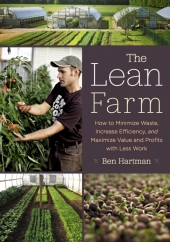
This book gets 10 out of 10 tacos from me - reading it truly changed how I think and operate on the farm.

Ben Hartman farms in a small space, and the book uses the same strategies that were made famous by Toyota leadership's car 'lean manufacturing':
 -  just in time processes: make only what is needed, when it is needed, with materials on hand only to the extent needed
 -  quality control throughout the production process
 -  process improvement as a small daily ongoing mindset, not an occasional review

Farmer Hartman got serious about implementing Toyota's same 'lean manufacturing'  timing tasks, counting steps, assessing more or less efficient ways to do the same things. He brought a sharp focus into which products were profitable and which were not, in the full evaluation of effort, costs and payment. He emphasized the value of producing items that are pre-ordered, so each item is sold up front and the sales are tracked to plan for the next year's production.
His rewards were cost savings (stop growing what doesn't sell, stop spending time on things that are not being done well), larger profit in dollars and minutes.  The book describes each of his major and minor considerations. These are valuable to anyone who feels like they are overstretched or underresourced.

We farm because we LOVE farming. We love little plants popping their leaves up, and we adore our spring lambs or chicks, or whatever you farm.
So when we are planting a row of something, we are happy to plant a few more seeds, a few more feet, a few more chicks, two more trees, another few goats.... and Farmer Hartman explains his conscious choice to NOT do that - to stop at the point that the planned amount is planted or onsite, even when there are a few more feet of row or another empty stall... because those plants or critters will grow, and will need to be managed or harvested, and then when they are beyond the amount that sells, something will need to be done with them, decisions will have to be considered and actions will have to be taken. This creates additional burden that is completely unnecessary. The difference between an ideal, efficient farm and a stressful life for the farmer can be this simple - more is not better.

Because we like a lot of the things we do, we don't feel a need to pay attention to how long we spend doing them or how they could be done more efficiently.  Farmer Hartman penciled out the numbers to show that it was actually a more efficient and profitable strategy to have multiple tool sheds, all with the same tools, located strategically near where they were needed, than to have one central tool stock that required travel back and forth.

Lots of farmers are more interested in the work of farming and less interested in the spreadsheet side of tasks planned and done, connecting expectations of production and market, balancing the numbers.  The less awareness there is of the numbers, the more likely that the farm will not run efficiently.

Big conclusions (maybe they should be obvious, but they weren't to me):
- paying attention to the quantification of work is a quick way to reduce useless effort
- paying attention to exactly what the marketplace actually purchases from your farm is the best way to do more of what works
- it takes MUCH more effort to increase your profitability (and income) than it does to reduce your expenses (which increases your income)
- if you reduce production costs by 10%, that is MORE than 10% raise in your bottom line, because you don't also have to pay tax on that difference.
- Don't create additional work for yourself by overproducing
- Avoid speculative production for anything other than a small scale trial

Highly recommended - see what you think.

5 days ago
Hey Permies -

In Adam Klaus' Permaculture Voices presentation on biodynamic farming, he said that they brood their chicks in their greenhouse in the spring. The young chicks have enough heat, safety, space, and are able to be foraging basically from day 1. He described it in a way that made it sound like a great option that I would like to try!

As I finish getting my greenhouse built out, I am considering what I might put in place so that I could be ready to brood chicks in there in spring 2027.
The greenhouse footprint is 12.5ft x 33ft, south facing polycarb panels and other three walls enclosed. Centrally placed rocket mass heater and bench for heat.  Flooring mostly wood chips with some paving stone paths. Stones and water filled drums for heat retention. There are several citrus trees in very large containers, tender plant beds, benches for plant starts, two IBC totes as ponds for channel catfish and a wide trough for azolla (mostly covered to manage warmth and water), zebra finch enclosure. Storage for tools and equipment, some in bins along the lower portion of the east and west walls.  Rigging for overhead traveling for hose and solar lighting.

I love the idea of brooding chicks in a place that is already set up and does not require additional equipment or separate space. And the Clucky Mama-hen part of me can't help but imagine that there are a hundred ways for a curious, wandering, foraging chick to get in to trouble, get lost, get chilled, drowned, get stuck, get stepped on, get into and out of wherever they are supposed to be...

Can we have a reality check on this idea of brooding in the greenhouse? Has anybody followed in Adam K's steps, with some experience on how it worked for them?
5 days ago
Hi All,

Rudolf Steiner was such a remarkable visionary, and we are still catching up to his concepts and guidance.
I've been studying his lectures on agriculture, and uses of the biodynamic preparations...
most recently with Glen Atkinson from New Zealand (https://biodynamic.org.nz)

Glen is doing some interesting pioneering in using the biodynamic preparations in dilute microdoses as medicine for the farmer, not just for the farm.
He has made microdoses with dilution and succusion, in the same way that homeopathic products are prepared, and has been taking microdoses of them.
He recommends this as an ideal way to understand the nature of each preparation.

Anybody here on Permies doing this? Or interested in participating in a trial of this where we can microdose and share our experiences along with implications for any deeper understanding in their use on our farms?

5 days ago
OOOooooOOOOO Robert, that is a really interesting option! Never heard of that - who'da thunk it???
Thank you for posting that. Will try this.  Molasses + water + bucket + time.

Will let you know how it goes in a few weeks!
5 days ago
Hey smart / experienced Permies who know these things...

I searched for rusty in the forums, and did not find a good match, so maybe we can get a thread going on how to take care of rusty old items?

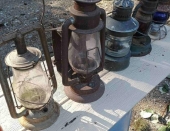
I got a box of old rusty lanterns. They are beautiful, and old, and definitely rusty.
I want to use these, and [as a total newbie with no experience in this] would like to take good care of them, and prevent further deterioration.
Clean? Restore? Use not-dreadful-chemicals to do whatever-a-wise-person-would-do to befriend each of these?
Advice on taking them apart for cleaning?
Vinegar bath + some steel wool scrub?
Protect with tung oil after clean + dry?
Identify appropriate fuel and learn to use each different one?

Calling all lantern-afficionados to help map out the way forward for these?  
Thanks!


5 days ago
Wow Ulla - these are so creative and visually interesting! Well done with the content and the presentation style on these. Educational and very-NOT-boring! Clearly you have solved your initial 'boring' problem.

Have you maybe thought about a comic strip or comic book kinda format for this material? Seems like it would be very popular, bite size consumable, and attract a following as people learn tiny sips of gardening and look forward to each next one.

Dream big / Don't quit!
1 week ago
Hey all,

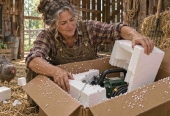
Sometimes my farm purchases include equipment or supplies that arrive boxed and thoroughly padded with stryofoam.
I groan every time I see it - argh, it breaks into a zillion tiny blobs that have static cling persistent enough to stowaway on a rocket. And it is BULKY. And I don't want to burn it.... Or mulch it. Can't recycle it.   And I definitely do not want any of the animals to find/nibble/eat it.

This morning it occurred to me that maybe I should reframe my exceedingly poor opinion of styrofoam, stop hating on it, and think of it as a weed? Maybe it has some use in some way on a farm?  

Maybe some of you clever and creative Permies peeps have actually found some use for it?
1 week ago
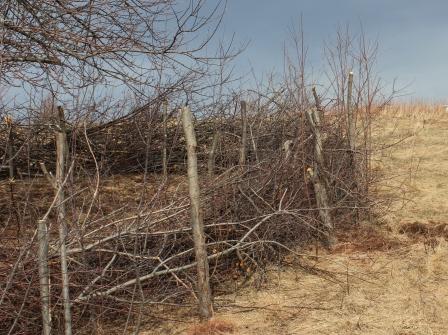
Oh Nancy - your fence looks beautiful and it inspires me! Thanks for posting the pictures. The strategy of establishing the dead hedge first, and then getting plantings along it for the long term seems like a good way to implement this.

and Benedict - thanks also for your update. Good to know about the material decomposition and gradual reduction in size. I do have A LOT of material, but maybe once I start building next week I will realize that it is not so much - like a pile of bricks that gets used up quickly once a project starts. I love the idea of lilacs placed along the deadhedge, and I have some dwarf blue willow cuttings that have grown well - I am eager to get them in the ground.

Seems like anything 30inches or higher would keep the cotton patch geese in or out...
1 week ago
Hey Benedict - thanks for sharing that! It encourages me to think that maybe I do NOT need to gather and haul all this....

And a few years ago, you were making some hedges (prior post).  Would you like to give us an update on how yours turned out, what you decided to do with your dead hedge (with limited materials) and your steel fencing and any live hedge progress? Pictures? Lessons learned?

1 week ago