Priscilla Stilwell wrote:I'm experimenting with a completely different thing based on my hunch that sawdust can be "charged" similarly to biochar.
I've spent the afternoon snooping around the Permieverse for confirmation that sawdust can make potting soil. Like Priscilla, I have access to unlimited quantities of sawdust, and an even greater abundance of belief that I can use it as a base to add readily available, on-site ingredients to grow my seedlings, without having to resort to titrating chemicals and tweaking specific gravities of solutes.
Almost every recipe available online for making your own potting soil advises purchasing the ingredients listed on the bag of some commercial product, then mixing it yourself. No thank you. I'm cheap - I mean frugal - and ideologically driven to prove myself correct.
So far I've confirmed that bare sawdust is not the answer. Some seeds may sprout (beans will thrive in anything), but very little will flourish as the wood steals away nutrients that should be going to the plants. I tried adding coffee grounds, which helped, but the babies still stopped growing after they squeezed out their first true leaves, and begged to be plugged into real soil to survive.
Not surprisingly, the sawdust that choked out the first round of seedlings did better mid-season. All failed pots were emptied into a separate container where the sawdust darkened as it slowly deteriorated, tip-toeing its way toward compost. Tree seedlings that needed to be repotted did fine in a 50-50 mix of this partly percolated stuff and forest floor debris. The rest of my 'used' sawdust just kept getting daily doses of coffee, whatever dirt was stuck in the bottoms of old pots, and a few soakings from stinky weed tea, all of which predictably tendered the best results yet.
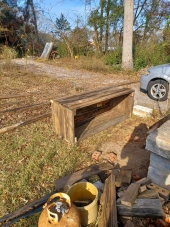
Taking Priscilla's lead, I used some scrap lumber to build a large bin for further experimentation. This I filled with sawdust and coffee grounds, and doused thoroughly with compost tea and more stinky weed sauce. I even added mushroom spawn, which I'd grown successfully on sawdust in the past, hoping the mycelium would permie-ate the substrate and kick-start the decomposition. Things looked good through the spring, but this summer's heat turned the wannabe incubator into a sawdust-y coffin. I finally wound up scooping it all out and using it to dress a couple of the vegetable rows. Through August and September the bin was filled with grass and weeds, hoping to attract crickets and collect their frass. (Instead I got grasshoppers and anoles. One of these days I'll move the weeds to the compost bin, and see if anything more valuable ever accumulated at the bottom.)
After today's reading of Permie threads on the subject, I'll probably refill the bin with a combination of sawdust, leaf litter, coffee grounds, forest soil, compost, and charcoal, soaking well with organic tea and Vitamin P and stirring occasionally between now and next spring. I might even consider giving everything but the soil a pass through the shredder before loading it all into the bin.
If all else fails, I just found out we have a new mushroom farm close by. Maybe they would be willing to contribute some of their spent growing medium to the cause. One way or another though, we're going to have sawdust potting soil, and lots of it.