Jack Edmondson

pollinator
+ Follow
since May 05, 2014
Merit badge: bb list bbv list
For More
Apples and Likes
Apples
Total received
In last 30 days
4
Forums and Threads

Recent posts by Jack Edmondson

Hugo Morvan wrote:
I wonder if something similar goes for grasses? ... and have to say about it.


For me it goes back to one of the core principles of permaculture.  The problem is the solution.  Your plants need the microbiota in the soil to thrive.  The biology needs the exudates from the plants to multiply.  If there is a natural oraganism like grass that thrives and works symbiotically with the biology of your soil, why fight that?  Yes, people talk about grass and weeds 'competing' for resources; but do they?  Can you manage the competiion to maintain the benefits of what nature has selected for?  

Let the grass creep into the garden.  Let it provide for the mycillium and other biology.  It it shades out the sun, trim it.  Don't pull it, poision it, or fight it.  Does it 'steal' all the water? Transporation is a process we are just learning to understand.  All plants cycle water.  The grass clearly is helping collect moisture with the dew.  Work with the grass and benefit from its symbiosis.  Let the problem be the solution when well managed.  Is it more work to trim the grass rather than pull it?  How much work is it doing for your soil unseen and unmeasured?  Biology is telling us more and more "a lot".  Isn't permaculture the shift in perspective to work with nature rather than against it?  Rather than trying to keep the meadow out of the garden, learn to garden in the meadow.  The meadow is more successful and sustainable than a garden will ever be.  

Are we stewarts of the plants or the soil?  If we feed the biology of the soil the soil will feed the plants.  And that is our goal.  Why are we fighting against the organisms nature has evolved to feed the soil?  Does the grass do anything detrimental to the plants?  If so, can we manage that?  We have writings of agriculture all the way back to the ancient greeks; and earlier civiliztations develop those techniques centuries earlier.  But what if we found we have been doing things unnecessarily for all these milinia?  

Our modern look at biologic processes of soil, plants, and microbia are telling us we need to rethink our assumptions from the core.  It is not about killing what is there, turning the soil over and removing anything that returns.  But old habits die hard.
18 hours ago
A quick run through google says the likely causes are a stuck thermostat, faulty ECT sensor, or 'electrical glitch'.  

Start with the easiest.  disconnect the negative battery terminal and leave sit for 15 minutes or so.  This will clear faults in the computer memory and hard boot the computer.  If the problem does not come back, you're golden.

If it does buy a new theromostat and install.  I have no idea what it should cost, but a thermostat used to be a $10 item.  They go bad over the years.

If that still does not fix the issue, you need to run a scan for OBI codes to narrow the electrical sensor that is twitchy.  If you are sure there are no actually over temp issues, you can just tolerate the false positives, but that can be annoying.

Also check (Fuses 12, 13, and 42 in the under-hood fuse box) that protect the cooling fans behind the radiator.  Quick and no cost to eliminate the possiblity of a gremlin there.

Next check your wires to the fans for any short, bare spot, or damage.  

My guess is you have a computer that is getting a false read, either from a software glitch or a a bad ECT sensor.  Let us know if we can help trouble shoot further.

1 day ago
Once I was shown this, I was humbled, embarrassed, and frustrated I had not figured this one out myself.  One can also use a straw, since the volume (vacuum) between the buckets is small...if you can blow with some force.


webpage

https://www.youtube.com/shorts/eXeQPJDsrsU
3 weeks ago
Alix,

I don't want to send you down a rabbit hole, so take this with a grain of salt.  The photos you post look a lot like a Kubota 3 cylinder fuel injector pump.  In trying to cross reference the part numbers above, I noticed your tractor may be a 3 cylinder turbo diesel, with this engine code: Valmet TD33DS4 .  Long story short, (and a few rabbit holes later) I came across this video.  The pump body looks similar and he tears everything down on camera, so you may be able to recognize similarities and differences with your pump.  I know a lot of companies will use off the shelf parts from other manufacturers rather than investing the time, research and engineering to develop all the parts themselves.  Since Agro Corp has bought up Valpandana appearently, you may have to find the OEM of the part rather than the tractor brand.  Anyway, take a look at the video and see if this looks familiar.

3 weeks ago
Alix,

For clarification:  This is for the fuel delivery system's injector pump?  Is the accessory you are looking for a solinoid?  What is the part?  The photo of the pump body with the threaded port, is that for the fuel line or does the part you are replacing thread into that oriface?  

I am not familiar with Italian tractor parts; but I feel your pain.  I had to find parts for a 1963 Oliver tractor at one time.  Company had been closed in the early 70's.  I played hell trying to find a supplier of parts after decades of being out of production.  A quick internet search pulled up these folks.  They have a number and a request section where you can tell them what you need for this brand of tractor and they can help locate.

[url=https://www.lectura-specs.com/en/4wd-tractors-valmet/spare-parts/984764/983531]
part supplier[/url]  https://www.lectura-specs.com/en/4wd-tractors-valmet/spare-parts/984764/983531
3 weeks ago

Dennis Barrow wrote:I need to find a big piece of leather that I can make into a strop.


Dennis let me add this:  When I was involved in bow making, keeping a SHARP draw knife was important.  I learned to strop then.  It was much easier than I thought.  He is what I would suggest.  a piece of wood, anything will do.  I used a 1x2" construction grade piece of furring I had in a scrap pile.  An old leather (real leather not synthetic) belt that was showing age.  Some adhesive.  I think I used contact cement because it worked well on the rough unsanded wood.  

If you don't have a leather belt, hit the thrift shops or goodwill.  One can pick up a belt for maybe 5 bucks with enough material to make a couple and give one away as a gift.  8" of lenth is plenty for a strop.  a 2 foot barber's strop was the only one I had ever seen but is longer than necessary.  The contact cement goes on both the wood and the leather. Let it get tacky for 15 to 30 minutes before joining (if I recall.)  Set a weight on the two pieces to cure.  Then you have a piece of wood with a strop that can be moved or stored as space requires at whatever size is most convienent.  Then add a little jewler's rouge or metal polish.  I had a friend who liked to use Flintz metal polish because he could get it locally in the grocery store cleaning aisle, rather than a specialty shop.  I found harbor freight carries multiple grits/colors for a few bucks.  

Using it is as simple as swiping the bevel over the belt following the angle of the bevel.  Both sides, a dozen light passes on each edge.  Makes for a sharp edge.  Cost is minimal to zero depending on what you have on hand.  I can litterally shave with my draw knives.  
3 weeks ago

Timothy Norton wrote:

What/how do you folks utilize this kind of gear. Is there a modern alternative that you utilize?


We use them daily in industry.  The modern 'take' on the block and tackle is called a chain fall.  it uses a continuous loop of chain rather than a length of rope. (the more mechaincal advantage or number of pullets increases the length of rope needed to lift the object.)  the loop allows one person to raise an lower the hook/piece without belaying a line or tying off.  
4 weeks ago
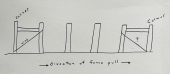
Keep this in mind.  Deer can jump high.  They don't like to jump far.  They also don't do 'detail' so well.  If confronted by a fence they cant get close to they are reluctant to spring over a high fence.  Likewise if they encounter a high fence with a chaotic landing zone on the other side, they are reluctant to take the risk.  Will they?  Can they?  Yes, of course.  Deer are very capable.  The idea is to make the risk higher than the reward.  

Since they don't do detail well, adding things like cd's or shiney foil to fishing line above your fence makes them reluctant, since they see the movement but not the support.  Again, trying to disincentivise your garden.  A double fence or visual barrier on one side or the other gives them pause.  Try stringing a line of from supports in their landing zone with things that will move in the wind or 'bounce' around.  It will likely make them think twice before jumping into something they can't really make sense of.  They are prey animals.  Getting hurt in the wild usually means risking fatality.  Use their nature against thier drive for an easy meal.
1 month ago
I don't know Douglas.  I am always wary of those 'metric' broadforks.  I think the SAE or Imperial garden tools are superior.  But it may work for you in the Great White North.  :)
1 month ago
Waco is a tough environment.  The native soils are normally adaquate.  The growing season is long, but summer moisture is an issue, as I am sure you are aware.  I come for the Texas gulf coast.  Before I answer your questions with questions, I will give some general tips.  Don't mow the lawn low.  Allow some growth between cuttings, especially if you the lawn is struggling.  Eveporation is your nemisis.  Give your soil and roots some shade and don't cut too low.  Find a grass that works for you.  Bermuda and other 'wire grass' species will do well in heat, and survive.  It is hard to make a tidy lawn.  Crab grass is another that will do well in your heat, but who likes crab grass.  St. Augustine may be your best bet, but requires watering.  I have not had a lot of experience with buffalo grass or the new zoysia varieties; but worth looking at.  I know it is a pain to replant an established lawn.  What are you working with currently?

I like to collect all my clippings rather than having a mulching blade 'recycle' the cuttings.  I think thatch becomes a problem that adds work to your annual duties.  I prefer to have a mulch pile and hot compost until it is well broken down..  Then when things get hot and starts to thin, you can come over an area or the whole yard and top dress.  It looks like crap for a few weeks, especially if the mulch has not aged fully.  But during the few weeks of killer temps you can cover your plants to seal in moisture; and feed the soil.  After the heat spell the grass will pop up through and thrive.  You have fed the soil which feeds the grass, and kept the heat from baking the roots.  A small price to pay for the effort.  The lawn is going to look bad anyway.  Make it a 'remodel'.  If your neighbors are out long enough to object, they likely have mild heat stroke themselves.  Be kind.

I have mixed feelings about compost tea, but it may be something that works for you.  Make a batch and water with it when you feel the soil needs a boost.  I have come to the belief that the bacteria population will balance itself to the food supply and the tea will give you a few days of boost, and then normalize.  Hardly worth the trouble.

With this method you also get great compost for a garden if you have one.  I worked my way through a few years of college mowing grass (back when one could.)  The customer with the absolute best garden and a certified green thumb, would tell me to bag his yard, but dump the clippings in his gardens randomly.  He would let the small piles feed the worms who did all the work for him.  I reduced work and input for us both, and his gardens were always in terrific shape.  

Always (never say always) water in the early morning.  It soaks in, evaporates less, and the 'lens' effect of the water droplets don't hurt the blades.  What type of soil are you working with?  Clay, loam, hardpan?  Take a screwdriver and stick it in the ground.  Get a rough idea of how much force it takes to go 6 inches.  After 200psi of pressure, roots have a hard time growing and it is indicative of hard packed non-aerated soil.  If it does not go in smoothly, aerate.  Take a broadfork, insert and lift the soil.  Don't turn it over.  Just 'fluff' it.  If it takes a lot effort, like having to jump on it, Waterlog the lawn and get the tines deep.  Fluff throughly as frequently as time allows until the screwdriver goes in 6 inches like a garden soil.  

Water, Air, Food.  That is all a lawn needs, just in the right amounts and in approxiamately the right time.  Find the grass species you like best that will grown and start seeding in the fall (october and november for you.)  If you want green grass in the winter/cool months try a winter rye or even grain rye and buckwheat and clover after the summer grasses start to flag in September.  They will die off when it gets warm again in march and april and the warm season  grasses will take back over.  So sometimes you have 2 lawns, one for each season.  (for non texans there are only two seasons.  Summer and Not Summer.)  

One more tip to add...  The gardener I mentioned had a 'secret trick' that he loved.  Back before glyphosate was sprayed on everything, he would get a load of horse manure.  He would let the stall litter age in a pile until it had broken down.  Horse manure is way to 'hot' or green to use in your garden or on a lawn until it has age at least year.  He would use it fresh.  His trick was to add a few scoops to a watering can each time he filled it with water.  When something was struggling he would hit it with that nitrogen rich, but dilute water and the plant would respond.  now with so many hay farmers using 'roundup' type chemicals, it is a gamble.  But if you can find a small batch of horse manure, take a hand full of rye, buckwheat, clover or other small fast germinating seed and water into the pile.  If it sprouts and lives for a week, it is likely chemical free and safe to use once the manure has aged.  If nothing germinates or dies soon after, haul that toxic waste off your property (and apologize to your plants for trying to poisin them.)

Good luck.  WELCOME.  and keep us posted on your results.    Edit: And you have a lovely yard.  You don't need to change a thing.
1 month ago