Patrik Schumann

+ Follow
since Nov 06, 2015
Merit badge: bb list bbv list
Biography
ecological design, drylands horticulture, regeneration forestry, special expeditions
For More
Nuevo Mexico, Alta California, upland New York, aiming Andalucia
Apples and Likes
Apples
Total received
In last 30 days
0
Forums and Threads

Recent posts by Patrik Schumann

Loquat has broken out of cultivation in southern California, is commercially grown in southern Spain, reached its highest expression for me in central Brasil.  We've found significant differences in fruit quality between seedling trees, as well as one season to another on well-established trees with highly variable conditions.  What varieties & terroir are you involved with?
2 days ago
We have a mix of our "forest garden" harvest, bi-weekly CSA box, back-filled with extra veg & fruit we occasionally buy at our distant Co-op or nearest supermarket, sometimes we go to our local growers markets for specialty items & specific sources.  

I'd say: with olive oil, butter, onion, garlic, chile, black pepper, salt, No Salt Seasoning, broth, miso, shoyu, apple cider or balsamic vinegar, + whole dry cumin, coriander, greek oregano, fennel, clove, cardamom, fenugreek, + bulk ground berebere spice, + fresh ginger & turmeric, one can cook up an exciting version of just about anything.  

We cycle through pulses & greens, roots & tubers, brassicas & alliums, in that priority, with all the fruits & nuts as snacks & desserts.  I'm vegetarian but my family aren't.
2 weeks ago
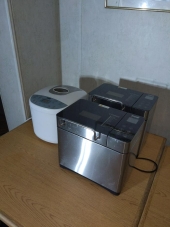
I use Jim Lahey-Mark Bittman's No Knead Bread approach, modified for ½ whole-wheat, ½ all-purpose, some rye &/ or einkorn, small dutch oven into toaster oven.  It makes a nice rustic, farmhouse, sourdough- & crunchycrust-as-you-like loaf I can pop out three times a week for the family now that we can't find good bread in the big city any more.
2 weeks ago
We used to fill the freezer mid-late summer from thickets between forest & swamp.  Then through winter our mother would make German pancakes, sprinkling berries on while batter was liquid, flip as it solidified.  They'd get embedded, melt & burst, spread a little into the pancake.  The range of textures & flavours was exquisite.  Couldn't get enough.
1 month ago
Hello Chance, I sure like your proposition, though it seems to be starting from scratch (compare with Miyawaki & Greek almond/ apricot seeders also mentioned here).  I've been doing something broadly similar though starting with degraded & declining mixed north-central Appalachian forest.  The way private forests are there, many are going to white pine because quality hardwoods aren't regenerating without active management, while current financials result in the same overall income.  However, climate changes favour the return of fire & oak-hickory.  I myself am heavily thinning pine, interfering with & suppressing deer predation of hardwood seedlings, & planting in climate-change adapted native species/ select hardwoods genetics, fruit/ nut/ berry propagates, forage edibles, etc.  We have a subsistence amount of decent standing timber for selection harvest to the custom large beam & furniture/ slab market, not to mention paying the taxes just from fuelwood scraps.  But I'm ¼ century in, only half-way done thinning, don't have first dibs on the tax-relief for my forest management to fund everything, suddenly the chainsaw vacations aren't impossible because I'm raising a young son but challenging because I'm over 60 & the timeline has stretched over the horizon.  And I'm no longer sure who the family land is going to.
1 month ago

Ben Brownell wrote:Without heavy equipment, options seem rather limited on that scale. Dealing with not just trunks but stumps there is quite a challenge, if you want to convert toward meadow conditions. I'd be inclined to consider large pit burning to further reduce woody material into charcoal, and slowly work through the area in patches. It sounds like it's pretty flat topography, or I'd consider stacking log segments into any gullies or depressions and burying. One more thought is just playing with some creative "snow fence" lines of log poles to create a bunch of minor microclimates and more protected zones (shade and browse) that also catch winter snow drifts for additional hydration.


There's no funding for any of it, though could ask rancher at far back to use his road & lower his fence if we were to obtain use of equipment.  No need to deal with stumps & can simply drop hazards & let everything just decompose in place.  It was a meadow encroached by trees likely historically cleared by fire cycle, called El Valle because same soil as in valley far below, possibly long ago dryland farmed for wheat or beans.  It's as flat as could be, helpful for infiltration of just adequate normal 22" of rain, & 2% slope does fill a stock pond in lowest corner.  The cow trail is more deeply cut than any drainage line.  I do like the snow poles idea.  It's at this sweet spot near highest precip location in NM, getting fairly reliable winter snow & somewhat extended summer monsoon.  Apricot is my dryland benchmark which need the right 8" to survive, 16" to be healthy, 24" to produce.  Having just pounded a 2' hole at center for soil test pit, I'm looking at an auger to drill hundreds if we can line up fencing & rootstock.  
1 month ago

Anne Miller wrote:Your project sounds good.

Can you plant mushrooms?

Add wood chips?


It's a 500' climb to the top of the mesa on steep rocky hillside with incised drainages, eroded old tracks, loose rock.  Could inoculate with chain oil & spread spores, though what's native is likely already blowing around so better to just foster substrate.  Could possibly eventually get a chipper up there but it would have to eat small-med trees.  
1 month ago
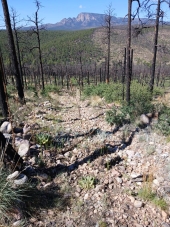
Thanks Douglas, These trees are charcoal on the exterior only but after four years are already rotting through & coming down.  No sign of that two years ago.  Local salvage loggers have been surprised.  A friend & mentor who's a tree explorer & nurseryman + soil microbial inoculant manufacturer says they have a full spectrum of fungi from exterior to center.  Failing any experimental guidance, collaboration, or support, I'm just going to leave a buffer untouched then fell E-W to get into soil contact + make winter shade lines & snowblow barriers so more lingers to melt in place rather than sublimate away.  Happy to compare notes.
1 month ago
Good day,

I'm looking for project case studies of using burn-killed timber for soil improvement in forest regeneration, reforestation, agro-forestry, orchard horticulture.  

I've started working a site burned over by the Hermit Peak Calf Canyon wildfire, New Mexico's largest ever, in 2022.  The rest was lightly & beneficially burned but 70ac of ponderosa thicket on a level mesa top at 7700' were 100% killed, are starting to keel over & snap in wind, dangerous enough people don't want to go up there, there's some post-fire aerial seeded & weeded + light meadow cover, the fences remain down & cattle wander through.  It's very difficult to near impossible to get heavy equipment up there.  

My proposal is to clear the boundary lines, get the fences back up, in contrast to the extensive grasing outside manage it as an intensive rotation grass bank.  Within that exclose ½ with a wildlife fence to keep out deer/ elk/ rabbit/ bear to compare that regeneration.  Within that plant a seed tree repository of the best genetics most valuable native species.  Within that replicate as a dryland planting the 600-variety collection of high- & dry-land adapted fruit/ nut/ berry we're propagating into the river valley below.  

I'd like to try various side-by-side treatments of the burned trees to soil surface across these different zones.  Thanks for any references & referrals.
1 month ago
Well, summer is migrating from primary, winter, family homestead to forest-steads & secondary, summer, fallback homestead.  First a two-week break in lush green over-watered over-grown north-central Appalachia, planning & prepping autumn & spring heavy thinning & plantings + mundane matters like ground transportation/ equipment staging/ food provisioning, seeking cost-share funding to help make good other peoples' degradations & other generations' neglect, picking off & gouging out every day's ticks, jumping in a real lake with wet water.  Can barely lift a finger when temps + humidity both over 80.  Second, hot bone-dry high desert homestead which caretaker eventually turned out to water minimally but not to cultivate at all.  Then, southern Rockies dry forest for beginning monsoon, hinterland recently ¼ burned to standing charcoal & ⅔ spot-burned scattered openings, the rest meadow with running rivulet, old acequia & orchard, new fruit/ nut/ berry plantings.  Chainsaw, brush cutter, hand saw, pruner, shovel, pick-mattock, rolling rocks into rills & gullies, lidar precision GIS individual tree database, fuelwood & riving.  Working on putting up shelters, deer exclosures, rain-water tanks, equipment storage, orchard-gardens, greenhouses, nurseries.  Dream of shipping container, solar, forestry E-UTV.  Getting as far as a few weeks solo + friends can before heading back to winter horticulture.  Always over-whelmed, never well-resourced, gritting my teeth, hauling out the old body, but realised making do is the only way & this is the life for me.  
3 months ago