BEL #843
A few
Bootcamp updates, along with some more progress to report at the stewardship acre.
Skirret is a plant that has fascinated me ever since I'd heard about it as a medieval and/or survival, perennial crop. I was hoping to see something come of the plantings we did earlier this year, though nothing materialized.
Paul had later heard that skirret is very difficult to grow from seed, but propagation through division has a much higher success rate. Here's a late-season skirret arrival. I'd like to see this eventually overtake a large portion of Hugel Prime. There's great growing area back there, so here's to hoping.

While working on the cob wing walls earlier this summer, I'd witnessed the hatching of a praying mantis egg sac. I suppose they take on their greenish and brownish hues as they mature. This was wild to see.

Speaking of the wing walls, here are fellow Boots
Oscar,
Erik, and
Samuel filling in the last nooks and crannies of
Wing Wall One over at
Allerton Abbey. I spent a shift coaching them through mixing and applying cob, to the point that they're now able to make new batches and apply it all themselves. We've since moved to
Wing Wall Two and will continue construction through the Building Season.

I love baking bread for the team. I usually bust out one batch of poly-dough, and then divide it into a savory and a sweet variety. The team has their pick between two loaves of each. The sweet variety is currently set at the fan-favourite "cinnamon raisin" bread, while the savory loaf ranges from thyme and sage to Herbs de Provence, to walking onion loaf, and more, all with a generous helping of garlic and salt to help sell the herbal flavors.

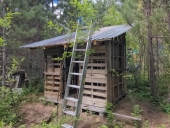
Over at the stewardship acre, I've been slowing on the roof. Bending poles to the point that they'll work for the job but won't break is a challenge. I think that for my next few, I'll follow
Coydon's advice, and lash two smaller ones together.
Meanwhile, I've been taking inventory of my available dimensional lumber in order to shore-up the frame that was built for me a couple years ago. Pictured here are various angle supports, which help prevent the structure from twisting in the wind and possibly falling over.

I also used a pair of 2x4s to provide solid contact for the roof supports. I finally splurged on a box of screws (they're hard to find at
Missoula Home ReSource, so I bit the bullet on a box from the local hardware store) and I feel more comfortable about finding a way to affix the roof to the frame.

And the roof frame itself hasn't changed much since earlier this week. I've snapped at least one of the roof supports in the attempt to bend it across the frame. The ones I've found and peeled are just a bit too brittle for use, at least in the way I'm using them. So again, lashing multiple together to provide a flexible bowed support seems to be the way to move forward.

The canvas is purchased, as well as a tarp to serve as an impermeable layer beneath it. I acknowledge that this is a temporary roof, until we can have the sawmill up and running again. At that point, I'll make a whole bunch of panels, and cut shakes out of those. Once those are ready and staged, I'll use more milled lumber for a proper roof frame, then attach as many shakes as needed to make for a legit roof.
That's all for now. It's a rainy day today, and the first one we've had in a while. They're actually forecasting snow for Sunday...! Sure, sure...
Thank you for reading, and enjoy your day...!