Burton Sparks

pollinator
+ Follow
since May 29, 2020
Merit badge: bb list bbv list
For More
Apples and Likes
Apples
Total received
In last 30 days
2
Forums and Threads

Recent posts by Burton Sparks

J.P. I noticed this comment from Lawren Richards here who mentioned having done mycoremediation.  You may be able to send Lawren a Purple Moosseage.
3 hours ago
Carmen, welcome to the forum!  Can you provide an image of the general greenhouse structure?  Is it arched, or peaked?  What is the structure made of (e.g. PVC, metal, or wood)?  Is it a prefabricated greenhouse or homemade?  It sounds like you're using a plastic cover that is not fitted/seamed.

We've bent metal electrical conduit to make different shaped low tunnel greenhouses and arched cattle panels to make taller greenhouses.  I wonder if either of those could be shaped to match your roof.  Small diameter PVC pipes are also used as supports in some arched greenhouses.  Alternatively, could you stretch the cover material tighter?
1 week ago
Jp, I've tried, but haven't yet had the success I wanted.  I'll share my experiences below in case it helps you or others have success sooner.  Paul Stament's work was an inspiration to me as well.  

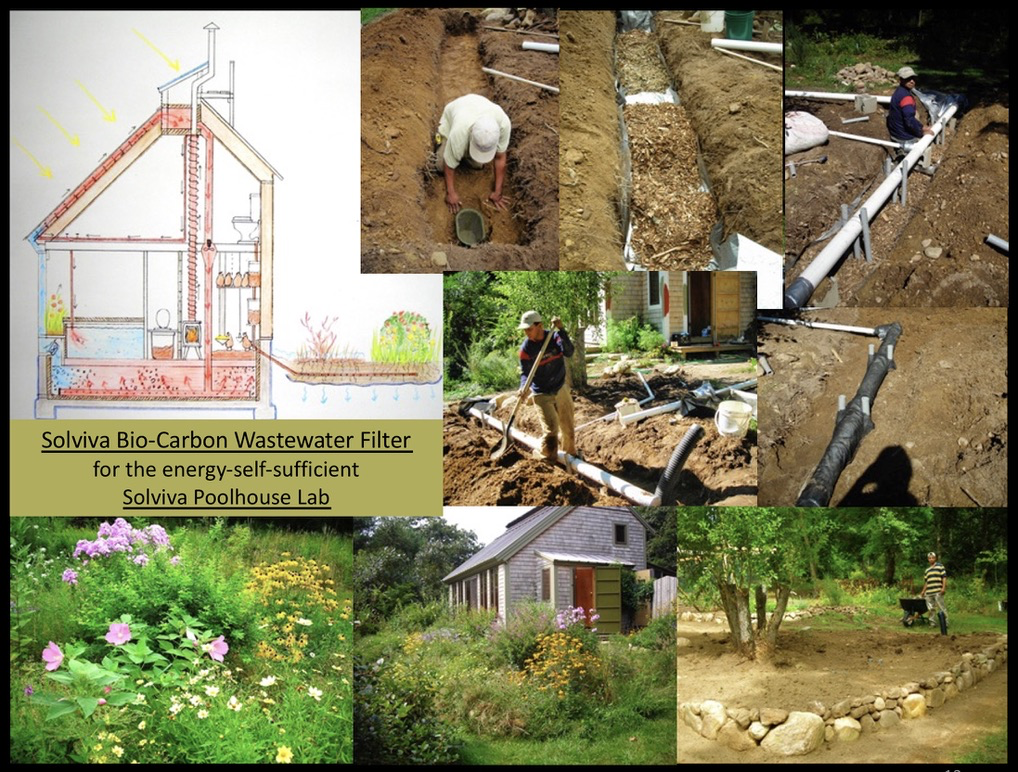
For my first attempt I soaked bulk wood chips in a large kids pool for a few days, then drained and inoculated.  Soaking for a few days stresses any prior mycelium giving your inoculation the advantage, but don't let it soak so long that the soaking wood chips go anaerobic (I think the recommendation was no more than 1 week).  It was based on the method introduced by Paul Stamets which I thought he called "mycototes" for growing bulk King Stropharia in large agricultural crates, but I can't find the video right now.  Colonization was very fast.  I put the inoculated wood chips in a trench below our cow feeder where the sprinkler would wash off the manure from the rubber mats we had there to prevent mud.  The system went anaerobic, I suspect because direct cow manure is so mucky that it overwhelmed the system, suggesting pre-filtering would be useful.

For my second attempt, I put bunker spawn (inoculated wood chips in burlap bags) 2 bags deep directly in a greywater flow (including kitchen sink flow).  That one also failed, drying out and clogging.  I suspect the influent needs to be better protected from our high desert and often windy environment, and mud.  I probably should have let the bunker spawn get more inoculated first as well.

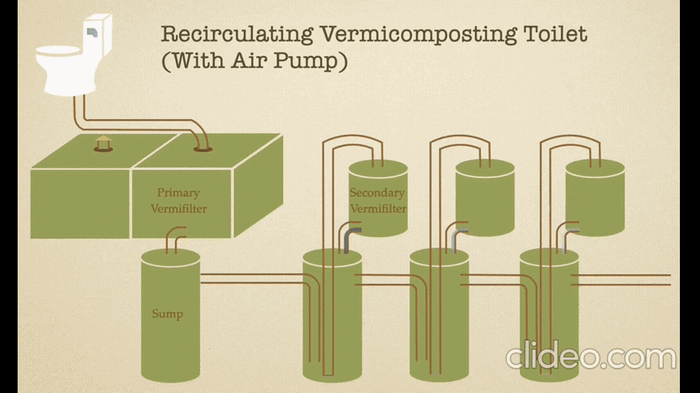
We're building a flush vermicomposting toilet this coming Spring, and I've thought about playing with a Mycofilter after the tertiary treatment and test performance before and after.  I've also thought about trying it in our poultry coup, similar to this article.  Keep us posted on your work!

Here is an excerpt from a couple email replies from Fungi.com where they provided additional resources back in 2019 when starting my first project:

Keep in mind Mycoremediation is still an experimental technology. If you end up deciding to start your own project, we are happy to provide cultivation advice and spawn, but we cannot guarantee that it will reduce contamination.

To read the methods and results of past experiments using Mycoberms to create an inoculated drain field, see the online article A Novel Approach to Farm Waste Management. For hydrocarbon remediation strategies; The Petroleum Problem. I attached more information on our study with the Washington Department of Transportation [link].

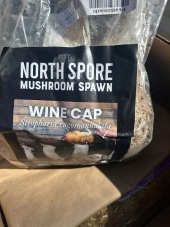
Our Pleurotus ostreatus is the same strain we used for our MycoBooms. Another species we have found to be very useful in remediation is Stropharia rugoso-annulata Wood Chip Spawn. You may want to consider utilizing both species and comparing them side by side. Oyster mushrooms have been shown to be capable of metal hyper-accumulation, though they can be more challenging to cultivate outdoors on a remediation-scale level than Stropharia. While the species we use are edible, we do not recommend consuming mushrooms that have been used for Mycorestoration.

Further experiments have been done to assess the removal of bacteria by such bags of myceliated wood chips; research results are available in our online article Mycofiltration Enters the Commons. Be sure to read and share the attached reports:
http://fungi.com/pdf/articles/Fungi_Perfecti_Phase_I_Report.pdf
http://www.sciencedirect.com/science/article/pii/S0925857414002250
....
I have a couple of other references that may be helpful in your endeavors:
Our coworker, Alex Taylor, recently had his masters thesis manuscript published on Mycofiltration with Stropharia. You can read this here: http://www.mdpi.com/2073-4441/10/9/1226/htm
One of the most comprehensive sources for research done on Mycoremediation is by Harbhajan Singh entitled Mycoremediation: Fungal Bioremediation.

1 week ago
T. Smith, thanks for your inspirational post.  I too have used the system for several years, and find it works great, but have become discouraged by some of the challenges.  Maybe you have some tips that might help, as I'm planning on going one more winter with the system before pivoting.

My back is not as strong after sitting at a desk so much.  If I'm not available, I'm not sure my wife or kids would be able to or want to manage it, but they do find it incredibly useful to manage various farm wastes.  I know you can fill each bucket less, and I use steps around the compost pile so I don't need to lift so high, but do you have any other tips there?

My compost end product doesn't grow anything, and I think it ends up hydrophobic.  Perhaps I'm keeping the pile too hot, but it has to keep going all winter down to -27F and I live in an area with decent winds.  I use kiln dried pine sawdust bought from the store as cover material because I wasn't able to find or make readily accessible right-sized cover material.  I'd hydrate and age the sawdust, but I don't have room to store months of cover material for so many people inside the house to prevent it from freezing solid outdoors.  Any ideas there?
1 month ago
John, thanks for your questions!  We won't build until Spring, so I've only purchased the four used IBCs (2 extra) for $165 each, and the two 18in HDPE culverts 20ft long for $365 each.  I probably have all the 55gal barrels I need for recirculation.  The structure it'll be in will add cost, but we'll build it ourselves.  I'm hoping to 3D print drainage cells to reduce cost and make them closer to a pipe in shape as I don't need the ~1ft width of standard drainage cells.

Yes, surface discharge as greywater is allowed (reasonable restrictions).  When subsurface discharge is used, the goal is to subirrigate roots (reuse instead of disposal), so it would be nice if sub-irrigation pipes could be installed shallower than in a leach field.  To help establish trees, shrubs, and other plants along the lateral (e.g. a hedgerow), pairing surface water (e.g. swale) with subsurface irrigation would help.  Swales would increase how wet the soil can be around a subsurface pipe when freezing occurs, increasing the risk of cracking shallow pipes, a risk at least for PVC pipes.  I think HDPE is more flexible than PVC, but I would assume drainage cells would be less prone to cracking than HDPE perforated pipes, but I don't know.

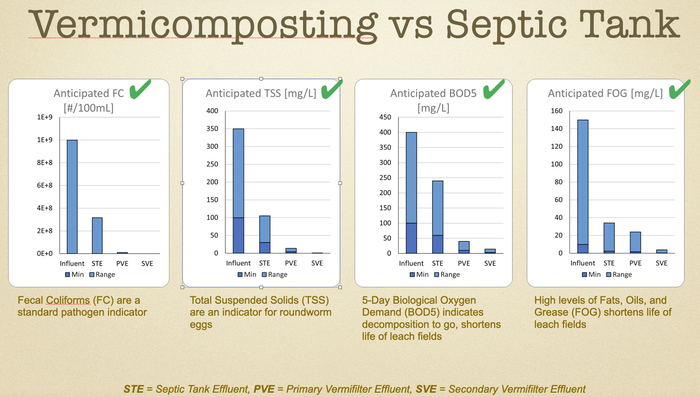
My understanding is that gravel mixed with dirt (either directly or from root dieback in the long run) creates an impermeable layer, hence French Drains put geo-fabric outside the gravel surrounding the pipe for more longevity.  As far as clogging the geo-fabric wrapped around the drainage cell (called a Flo-Log), I'm guessing the risk factors would be similar to what causes leach fields to clog... BODs (biological oxygen demand), FOG (fats, oils and grease), suspended solids, and localized distribution.  Recirculating vermifilters are great at reducing the first 3 risks, and I hope to use dosing to help with the fourth.  I'm guessing that having something like 90% void space of a Flo-Log would be less likely to clog than the 20% void space of aggregate and perforated piping.  Ideal would be to use open ended pipes, but I haven't found a cost effective way to distribute effluent over a large enough area to maximize reuse.

How big are the holes in HDPE perforated piping, and what are the hole positions across the circumference?  I think you'd want holes at the 6 o'clock position to ensure complete drainage and the 12 o'clock position to reduce the risk of sweating, minimizing risk of root intrusion.  I hear PVC becomes structurally weak with more than 3 holes across the circumference, and perhaps the closest you could buy commercially is the version with 3 evenly spaced circumference holes installed upside down (holes at 2, 6, and 10 o'clock), which might be good enough.  I hear geo-fabric will dissuade roots as long as there is no standing water on the other side, but I suspect you could wrap perforated piping as well as you could a drainage cell.  If you could get perforated piping to fully drain, prevent sweating, and not crack in freezing soils, then it may help the effluent spread farther, maximizing reuse, which would be really nice.  

Too many users, undersizing the primary bins, media that breaks down slowly, colder temperatures, and use of toilet paper increase the risk that you'd need to pull off worm castings.  Media that breaks down quickly (e.g. wood chips) create humus faster, increasing the risk of clogging and sending more suspended solids downstream.  If I can get each IBC to at least take several years to fill before switching to the redundant one (to allow sufficient time for roundworm eggs to die off before removal of worm castings and humus), I'd prefer to use pine bark chips that break down very slowly.
1 month ago
One of the risks with our design is the size of the primary bin (IBC tote).  An IBC tote is common for 4 full-time residents using toilet paper, and we have 8, sometimes 10.  That was one of the drivers for having two bins to alternate between.  We think we've mitigated the risk of worms slowing with cold temperatures, helping keep drainage open and minimize the risk of filling a bin too fast.  We can also compost the toilet paper separately if the bin still fills too fast.

We plan to use media that breaks down, which will also help with not filling the primary bins.  It also means that media size will decrease over time, and smaller media size in a small surface area means higher risk of clogging with the larger flow coming from greywater.  The shade cloth covering the drainage cells along all the walls should still trap solids if the media cannot drain fast enough.  Given these later points, one option for us to partially mitigate an undersized primary bin might be to separate greywater into its own primary bin.

The most straightforward mitigation would be constructing twin 5ft x 5ft or even 6ft x 6ft bins, which would minimize all the risks cleanly, but take up more room.  It just seems like if we can keep the portable & contained solution for primary bins, it would be more palatable for a home build.
1 month ago
Shayok, I agree that it would be great to see some data from actual units in use.  Although I don't have a Willow Feeder, here is some data I've seen that may help.  The Composting and Dry Desiccating Toilets (Latrines) paper from the Global Water Pathogen Project summarizes some research on the topic and describes the factors that influence pathogen die off.  The World Health Organization Guidelines for the safe use of wastewater, excreta and greywater Volume 1 states in part:

Table 5.2 Recommendations for storage treatment of dry excreta and faecal sludge before use at the household and municipal levels
TreatmentCriteriaComment
Storage; ambient temperature 2–20 °C1.5–2 yearsWill eliminate bacterial pathogens; regrowth of E. coli and Salmonella may need to be considered if rewetted; will reduce viruses and parasitic protozoa below risk levels. Some soil-borne ova may persist in low numbers.
Storage; ambient temperature >20–35 °C>1 yearSubstantial to total inactivation of viruses, bacteria and protozoa; inactivation of schistosome eggs (<1 month); inactivation of nematode (roundworm) eggs, e.g. hookworm (Ancylostoma/Necator) and whipworm (Trichuris); survival of a certain percentage (10–30%) of Ascaris eggs (≥4 months), whereas a more or less complete inactivation of Ascaris eggs will occur within 1 year.
1 month ago
Ben, Excreta Disposal for Rural Areas and Small Communities section on Soil and Ground-water Pollution is a good reference for underground bacterial and chemical plumes, including distances.  The WHO Guidelines for the Safe Use of Wastewater, Excreta, and Greywater outlines the types of risks, quantifies the risk in terms of Disability Adjusted Life Years (DALY), and describes various prevention methods and their effectiveness (e.g. Volume 1 section 2).  The Humanure Handbook chapter on Worms and Disease provides a nice summary of persistence for pathogens.  I'm not sure about a good resource for summarizing various types of risk reduction steps that could be taken after the fact, but the use of fungi for remediation of certain types of issues was described in Mycelium Running: How Fungi Can Help Save the World.
1 month ago
I once purchased from a mill that sold sawdust in Bulk Bags/Flexible IBCs.  Here is a link to example products from Uline, with their product video linked below.  Sand is heavy enough that you may just want to store it in sand bags.  
.
1 month ago
Reminds me of Toilet Tech Solution's Conveyor Toilet, which uses a conveyor instead of an auger.
2 months ago