• Post Reply Bookmark Topic Watch Topic
  • New Topic
permaculture forums growies critters building homesteading energy monies kitchen purity ungarbage community wilderness fiber arts art permaculture artisans regional education skip experiences global resources cider press projects digital market permies.com pie forums private forums all forums
this forum made possible by our volunteer staff, including ...
master stewards:
  • Carla Burke
  • John F Dean
  • r ransom
  • Nancy Reading
  • Timothy Norton
  • Jay Angler
stewards:
  • paul wheaton
  • Pearl Sutton
  • Eric Hanson
master gardeners:
  • Christopher Weeks
  • M Ljin
gardeners:
  • thomas rubino
  • Megan Palmer
  • Benjamin Dinkel

Updates on my Flush Vermicomposting Toilet Design

 
pollinator
Posts: 110
36
fungi composting toilet composting greening the desert homestead
  • Likes 8
  • Mark post as helpful
  • send pies
    Number of slices to send:
    Optional 'thank-you' note:
  • Quote
  • Report post to moderator
This post is in response to requests to keep folks posted on the progress of our flush vermicomposting toilet plans and share some details on how we got our permit approved.  This is my first time starting a new topic, and I had been wanting to wait until we started to build, but that got delayed to next Spring.  While we've used various compost toilet designs over the years, flushing toilets are what more of my family is willing to adopt indoors.

Because improper waste management is one of the leading causes of death worldwide, I wanted to design the system in a way that gives confidence to approvers.  I want to take test data and invite the county approver over to see.  I want them to know that a DIY design can still take advantage of the positive strides in protection they are there to hold up.  The design would need to manage disease vectors, treat in a way that gives confidence, meet setbacks, uses materials that have been shown to be compatible with waste, uses materials that will last, something I could DIY, wouldn't penalize me for being water conservative, could help me irrigate plants in this arid climate, and doesn't break the bank to build.

Several years ago, when we wanted approval to use the Humanure Handbook method until we could get the flush design approved, I read through the applicable codes and reached out to the county approver.  To my surprise, their interpretation on some things was different than what I thought, and I learned that our state directed its approvers to allow "composting" designs.  The approver pointed me to the following policy statement on their website:  Incinerating or Composting Toilets - Permanently installed or non-self contained incinerating or composting toilets to the property will require a permit to construct.  Permanently installed means that building materials would have to be modified for the installation or removal of the system.   Portable incinerating or composting toilets, which are completely self contained, do not require a permit to construct.

As it turns out, the outdoor Humanure Compost bin with periodic 5 gallon bucket deposits was legitimately considered "contained", so it was approved.  When I asked about the flush "vermifilter" concept, the approver said the design would need be signed off by a state engineer, which was expected based on my reading of the code.  We went ahead and found an engineer willing to work with us, but because we didn't have enough water available at the time, we were forced to hold off.  In the mean time, I learned more about the state criteria for reuse of wastewater, got a permit to do surface discharge of greywater, and continued to read technical papers and reach out to more experienced designers.  Knowing that our long term goal was to move toward a flush vermifilter design, we went ahead and installed standard house plumbing for future use.

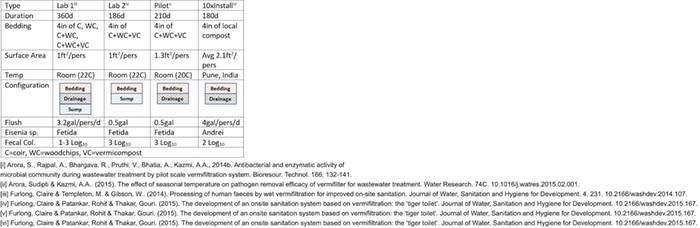
Eventually, I had inspiration to switch from using the technical term "vermifilter" to using the term "vermicomposting toilet", and align with the portable concept. Here's how I worded my next permit inquiry to the county: "I'd like to have a flush toilet that runs into a portable vermicomposting bin. It does not modify building plumbing [uses existing plumbing] and uses any standard toilet. All solids are contained and composted by the worms..." I also provided links to the Wikipedia vermifilter article which cites numerous technical references, and to two DIY design resources on the web: vermicompostingtoilets.net and vermifilter.com.  To my surprise, they directed me through a permit-by-rule type of process similar to what I went through to get surface discharge of greywater approved.

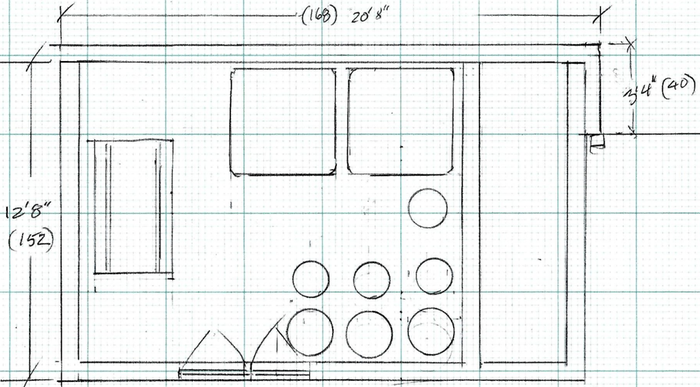
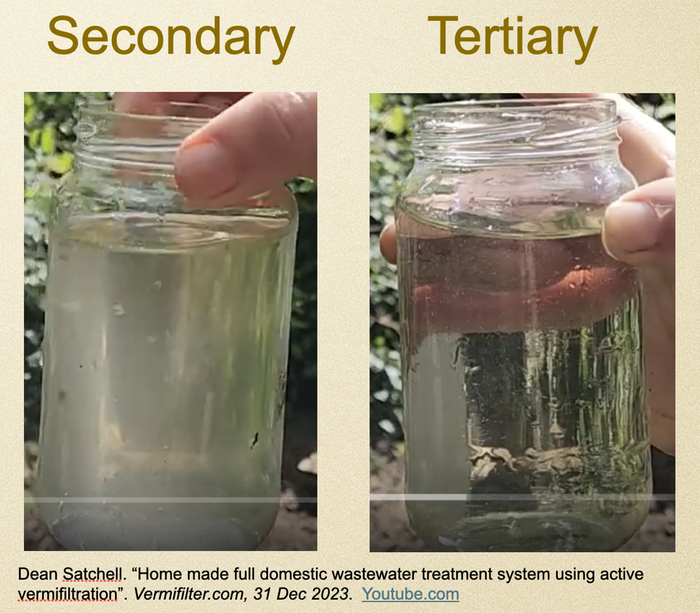
The final permit form ended up including a diagram showing that setbacks for a septic system would be met, a notional flush vermicomposting toilet layout diagram with subsurface discharge, which of the reference website designs I would generally follow, effluent design flow numbers per code, and statements about the composting being portable and contained. Because I wanted the capability to surface discharge as greywater and reduce the risk of contaminating our well, I opted for a recirculating design, stated it would generally follow the design at vermifilter.com, provided rationale from technical literature showing that the pathogen reduction targets for surface irrigation could reasonably be met, and stated that more stages could be added if needed. I listed myself as the installer.

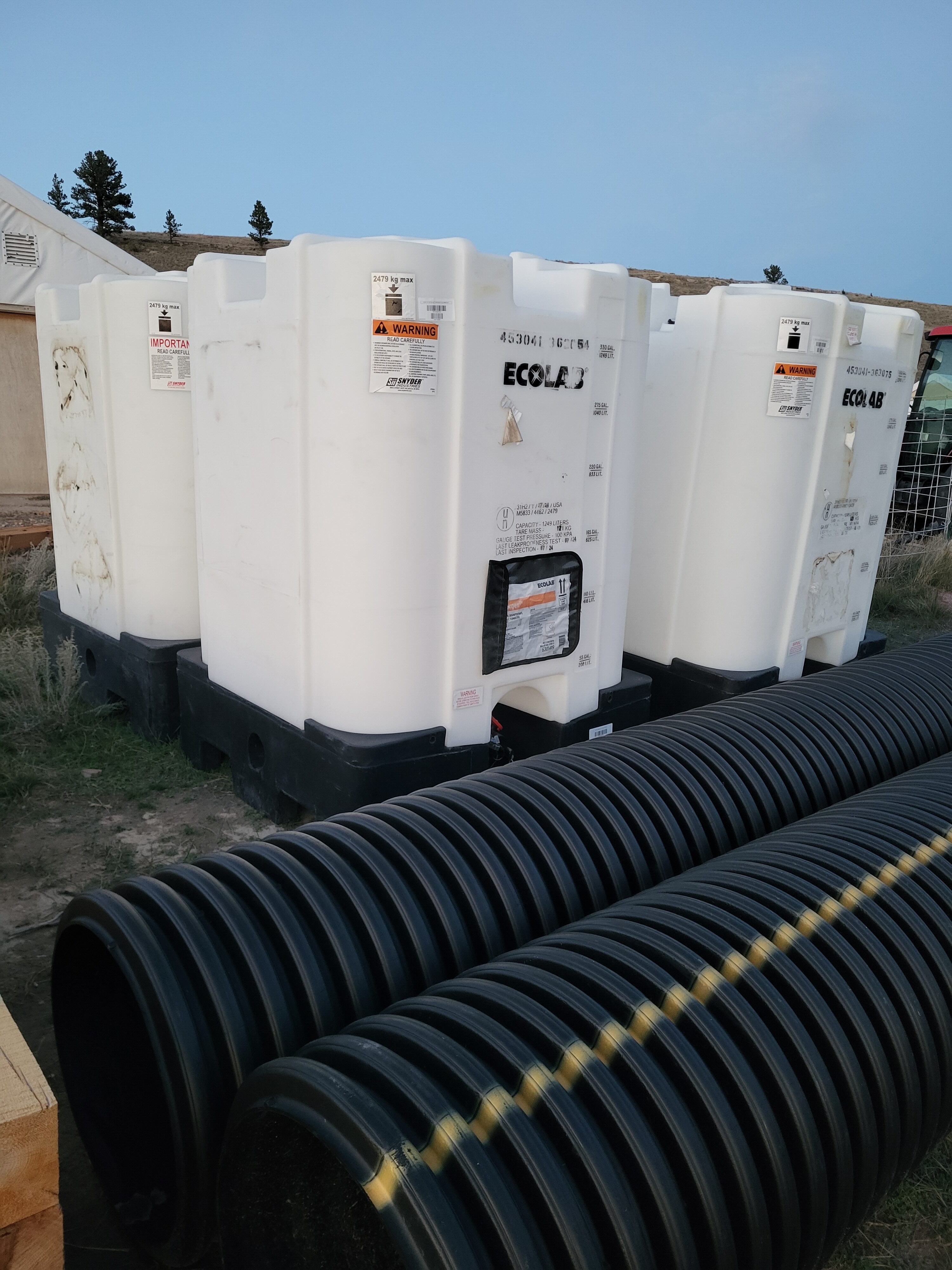
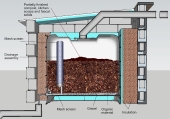
For the portable, contained, primary vermicompost bins I've purchased used Snyder Industries square stackable 330gal plastic IBC totes. Compared to standard IBCs, these are much more rugged (1/2in thick walls), have more surface area, and are fully draining. I'm much more confident in those as I've seen a standard IBC tote crack.  Redundant IBCs allows for switching between them should one start to get too full, and bins can be replaced should an incompatibility between worms and cleaners is discovered or some other issue occurs.

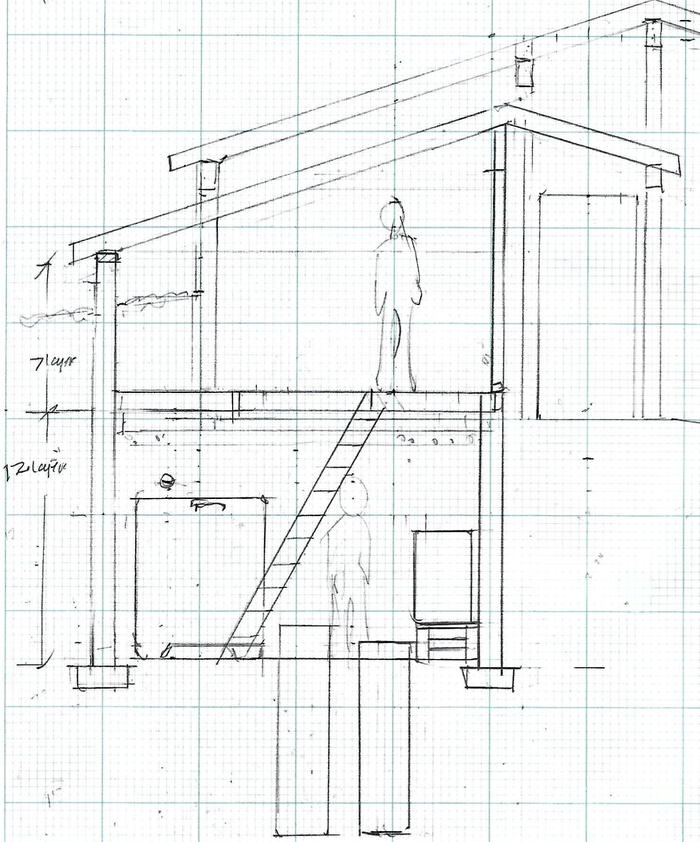
To minimize the risk of flooding the worms in the IBCs, the inner walls and floor will be lined with drainage cells, then lined inside that with shade cloth. The primary sump will have an emergency overflow to downhill subgrade distribution such that the worms in the IBCs can never back flood. The available surge height will extend into the space created by layers of drainage cells placed on the floor of the IBCs. Recirculating vermicomposting bins will use 55gal HDPE drums lined with layers of coarse plastic drainage netting or something I may 3D print, and then shade cloth, and drainage cells on the floor.

To minimize the risk of freezing the worms, the vermicomposting bins will be subgrade in an insulated area that will eventually be inside a greenhouse. Warm greywater will be routed to the IBC that is not in use by the blackwater. Solar evacuated tubes will be used to heat dedicated water barrels in the room, and a propane buddy burner will be on hand.

For recirculation, we'll use airlift pumps to reduce electricity, add aeration, keep electricity away from water, reduce risk of clogging by any solids, reduce pump noise, and enable easier repair should something fail. The tradeoff for using airlift is a less compact design and more sump depth.  We're getting the depth by using dual-wall HDPE culverts with a heat welded bottom. Dual wall HDPE culverts have a straight inner wall to reduce anaerobic nooks, come in various diameters, and can be cut to length and buried. Where pipe penetrations are needed, I'll remove just the outer corrugated wall and use a normal bulkhead fitting to go through the inner wall.

When freezing temperatures prevent surface irrigation, subsurface discharge will irrigate trees and shrubs along contour laterals, using up the nutrient left in the effluent. The current thought on how to do that is to use drainage cells wrapped in geo-textile fabric for the laterals (see Flo-Log).  The drainage cells allow lateral flow while the geo-textile fabric ensures no water is left inside the virtual pipe, significantly reducing the risk of root intrusion.  I'll likely use a Flout to send a surge farther down the laterals and allow time for the surrounding soil to dry out between waterings.  I'm also toying with the idea of holding the effluent up by lining just the bottom of the trench, a few inches below the Flo-Log, with plastic to help ensure plants get a drink before it goes too deep, similar to Anna Edey's original design.

I've included a photo below of the IBCs and Culverts, as well as an animation of the recirculating design my daughter did using Apple's Keynote version of PowerPoint, converted to a gif (click on the gif to animate).  Thoughts?

Recirculating-Vermicompost-Toilet-(With-Air-Pump).gif
Recirculating Vermicompost Toilet (With Air Pump)
IBCs-and-Culverts.jpg
IBCs and Culverts
IBCs and Culverts
 
Rocket Scientist
Posts: 331
131
  • Likes 7
  • Mark post as helpful
  • send pies
    Number of slices to send:
    Optional 'thank-you' note:
  • Quote
  • Report post to moderator
like the heavy duty plastic parts , much better and sure to last---my worm composter  system ---still under final construction ---is a wavin pipe ---lengthways  -----i will  adding in a lacto solution to the bedding material every now and then --as per the terra preta sanitation method---the outflow is into a "forest floor" of sorts but i am collecting materials  for an under cover modular pond to make use of a further treatment by using the azolla weed pond/trench . ---heres a modular reed bed system
reedbed-module-system-in-polytunnel.jpg
[Thumbnail for reedbed-module-system-in-polytunnel.jpg]
reebed-modules.jpg
[Thumbnail for reebed-modules.jpg]
 
pollinator
Posts: 401
41
  • Likes 2
  • Mark post as helpful
  • send pies
    Number of slices to send:
    Optional 'thank-you' note:
  • Quote
  • Report post to moderator
You seem to be on your game, Burton.   Appreciate the information
 
Burton Sparks
pollinator
Posts: 110
36
fungi composting toilet composting greening the desert homestead
  • Likes 7
  • Mark post as helpful
  • send pies
    Number of slices to send:
    Optional 'thank-you' note:
  • Quote
  • Report post to moderator
One of the risks with our design is the size of the primary bin (IBC tote).  An IBC tote is common for 4 full-time residents using toilet paper, and we have 8, sometimes 10.  That was one of the drivers for having two bins to alternate between.  We think we've mitigated the risk of worms slowing with cold temperatures, helping keep drainage open and minimize the risk of filling a bin too fast.  We can also compost the toilet paper separately if the bin still fills too fast.

We plan to use media that breaks down, which will also help with not filling the primary bins.  It also means that media size will decrease over time, and smaller media size in a small surface area means higher risk of clogging with the larger flow coming from greywater.  The shade cloth covering the drainage cells along all the walls should still trap solids if the media cannot drain fast enough.  Given these later points, one option for us to partially mitigate an undersized primary bin might be to separate greywater into its own primary bin.

The most straightforward mitigation would be constructing twin 5ft x 5ft or even 6ft x 6ft bins, which would minimize all the risks cleanly, but take up more room.  It just seems like if we can keep the portable & contained solution for primary bins, it would be more palatable for a home build.
 
Posts: 38
Location: Mentone, AL
1
  • Likes 2
  • Mark post as helpful
  • send pies
    Number of slices to send:
    Optional 'thank-you' note:
  • Quote
  • Report post to moderator
Burton, how much did this system cost? Did your permitting agency give the okay on surface disposal? Why not just use small diameter perforated HDPE in clean stone isntead of the Flo-log for subsurface disposal? These systems like the Flo-log are typically used for drainage instead of disposal so it seems like they would eventually clog over time from biofilm/organics unless you had a good filter upstream?

Do the solids not have to be periodically removed from the IBC tote similiar to a septic tank?
 
Burton Sparks
pollinator
Posts: 110
36
fungi composting toilet composting greening the desert homestead
  • Likes 1
  • Mark post as helpful
  • send pies
    Number of slices to send:
    Optional 'thank-you' note:
  • Quote
  • Report post to moderator
John, thanks for your questions!  We won't build until Spring, so I've only purchased the four used IBCs (2 extra) for $165 each, and the two 18in HDPE culverts 20ft long for $365 each.  I probably have all the 55gal barrels I need for recirculation.  The structure it'll be in will add cost, but we'll build it ourselves.  I'm hoping to 3D print drainage cells to reduce cost and make them closer to a pipe in shape as I don't need the ~1ft width of standard drainage cells.

Yes, surface discharge as greywater is allowed (reasonable restrictions).  When subsurface discharge is used, the goal is to subirrigate roots (reuse instead of disposal), so it would be nice if sub-irrigation pipes could be installed shallower than in a leach field.  To help establish trees, shrubs, and other plants along the lateral (e.g. a hedgerow), pairing surface water (e.g. swale) with subsurface irrigation would help.  Swales would increase how wet the soil can be around a subsurface pipe when freezing occurs, increasing the risk of cracking shallow pipes, a risk at least for PVC pipes.  I think HDPE is more flexible than PVC, but I would assume drainage cells would be less prone to cracking than HDPE perforated pipes, but I don't know.

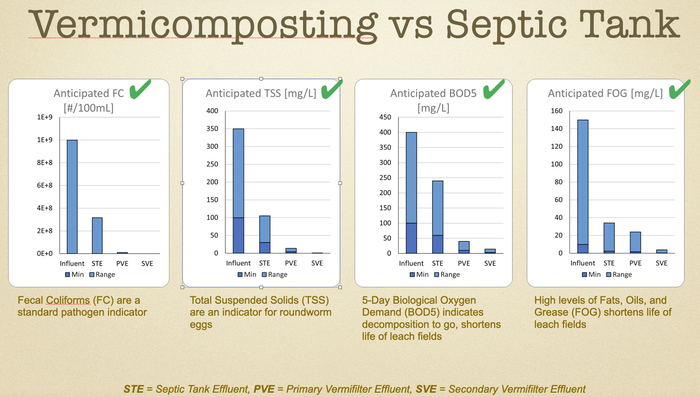
My understanding is that gravel mixed with dirt (either directly or from root dieback in the long run) creates an impermeable layer, hence French Drains put geo-fabric outside the gravel surrounding the pipe for more longevity.  As far as clogging the geo-fabric wrapped around the drainage cell (called a Flo-Log), I'm guessing the risk factors would be similar to what causes leach fields to clog... BODs (biological oxygen demand), FOG (fats, oils and grease), suspended solids, and localized distribution.  Recirculating vermifilters are great at reducing the first 3 risks, and I hope to use dosing to help with the fourth.  I'm guessing that having something like 90% void space of a Flo-Log would be less likely to clog than the 20% void space of aggregate and perforated piping.  Ideal would be to use open ended pipes, but I haven't found a cost effective way to distribute effluent over a large enough area to maximize reuse.

How big are the holes in HDPE perforated piping, and what are the hole positions across the circumference?  I think you'd want holes at the 6 o'clock position to ensure complete drainage and the 12 o'clock position to reduce the risk of sweating, minimizing risk of root intrusion.  I hear PVC becomes structurally weak with more than 3 holes across the circumference, and perhaps the closest you could buy commercially is the version with 3 evenly spaced circumference holes installed upside down (holes at 2, 6, and 10 o'clock), which might be good enough.  I hear geo-fabric will dissuade roots as long as there is no standing water on the other side, but I suspect you could wrap perforated piping as well as you could a drainage cell.  If you could get perforated piping to fully drain, prevent sweating, and not crack in freezing soils, then it may help the effluent spread farther, maximizing reuse, which would be really nice.  

Too many users, undersizing the primary bins, media that breaks down slowly, colder temperatures, and use of toilet paper increase the risk that you'd need to pull off worm castings.  Media that breaks down quickly (e.g. wood chips) create humus faster, increasing the risk of clogging and sending more suspended solids downstream.  If I can get each IBC to at least take several years to fill before switching to the redundant one (to allow sufficient time for roundworm eggs to die off before removal of worm castings and humus), I'd prefer to use pine bark chips that break down very slowly.
 
I wish to win the lottery. I wish for a lovely piece of pie. And I wish for a tiny ad:
The USDA promoted wild native persimmons a century ago. Get the ebook:
https://permies.com/t/126158/ebooks/Native-Persimmon-downloadable-ebook-reprint
reply
    Bookmark Topic Watch Topic
  • New Topic