• Post Reply Bookmark Topic Watch Topic
  • New Topic
permaculture forums growies critters building homesteading energy monies kitchen purity ungarbage community wilderness fiber arts art permaculture artisans regional education skip experiences global resources cider press projects digital market permies.com pie forums private forums all forums
this forum made possible by our volunteer staff, including ...
master stewards:
  • Carla Burke
  • Nancy Reading
  • John F Dean
  • r ransom
  • Jay Angler
  • Timothy Norton
stewards:
  • paul wheaton
  • Pearl Sutton
  • Tereza Okava
master gardeners:
  • Christopher Weeks
  • M Ljin
gardeners:
  • thomas rubino
  • Jeremy VanGelder
  • Megan Palmer

2-Hole Perforated Pipe vs Wrapped Gravel

 
pollinator
Posts: 135
45
fungi composting toilet composting greening the desert homestead
  • Likes 7
  • Mark post as helpful
  • send pies
    Number of slices to send:
    Optional 'thank-you' note:
  • Quote
  • Report post to moderator
I'm doing a flush vermicomposting toilet system that does tertiary level of cleaning on the effluent.  I'd like sub-grade distribution to be along 100ft laterals.  It would be nice to be all passive with no moving parts, as long as it remains viable long term.  We do have a bit of a slope we can work with if that helps.

My best guesses about how to distribute effluent evenly along the laterals, at low cost, for DIY installation, is either 2-hole perforated piping (commercial holes at 4 and 8 o'clock positions or DIY slits) as level as I can get it, or gravel wrapped in non-woven geotextile fabric with a trench at a slight slope, perhaps with a dry well at the end just in case.

Ideally I would love to plant trees and shrubs along the downhill side of the laterals.  If I used perforated piping I'd probably need to create an air gap (e.g. chamber) around it to air prune the roots.  If wrapped gravel is used, I'd hope that roots would prefer not to penetrate the fabric when there is easy water below it and the gravel can fully drain (a principle learned from the drainage cell industry).  I'm thinking of starting with one lateral, and adding more or tweaking the design if needed.  Thoughts?
 
steward
Posts: 18655
Location: USDA Zone 8a
4730
dog hunting food preservation cooking bee greening the desert
  • Likes 4
  • Mark post as helpful
  • send pies
    Number of slices to send:
    Optional 'thank-you' note:
  • Quote
  • Report post to moderator
I would do the perforated pipe set on gravel and topped with a layer of gravel then earth.

gravel wrapped in non-woven geotextile fabric


To me, this sounds like an accident waiting to happen.

I have no thoughts about planting trees and shrubs as I have no experience there.
 
pollinator
Posts: 1792
Location: Victoria BC
325
  • Likes 7
  • Mark post as helpful
  • send pies
    Number of slices to send:
    Optional 'thank-you' note:
  • Quote
  • Report post to moderator
I had a permitted septic system put in recently here, a similar function.

The installer was *extremely* particular about perfectly leveling the pipes, which are bedded in sand. The feed enters from the center, not one end.

Interestingly, the holes in the pipe were drilled on site; smaller holes than commercial perf pipe, at spacing determined by math required to design the system to code.

We've done geotextile/gravel sausages for drainage purposes, and I do not think they would be a good replacement for the perf pipe..

No data on trees/shrubs nearby, interested to see what data you find related to that part.
 
Burton Sparks
pollinator
Posts: 135
45
fungi composting toilet composting greening the desert homestead
  • Likes 6
  • Mark post as helpful
  • send pies
    Number of slices to send:
    Optional 'thank-you' note:
  • Quote
  • Report post to moderator
Thank you Annie Miller and D Nikolls for your input!  It has caused me to rethink.  I had been hesitant to use perforated pipe, wondering how could it possibly spread evenly across hundreds of holes along a 100ft run, but perhaps the point is that it is better than no pipe.  I also realized that maybe I was less concerned about using fabric because of how clean I expect the output to be, and perhaps just saying "tertiary" level of cleaning may not have adequately conveyed why.

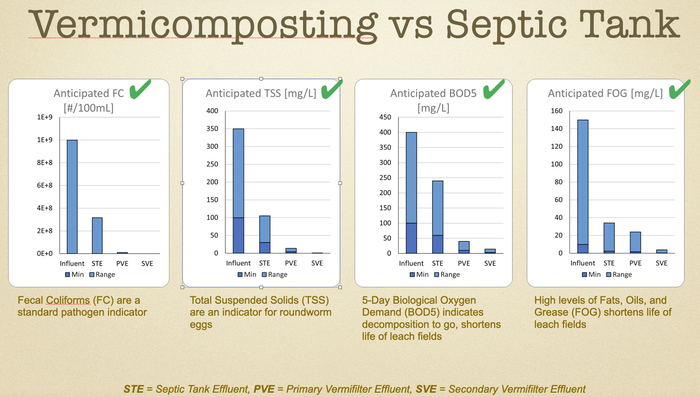
Here's my attempt to try to quantify the difference between a standard septic tank vs vermicomposting/vermifilters.  Keep in mind that wastewater parameters vary widely around the world and performance of a vermifilter depends on various factors.

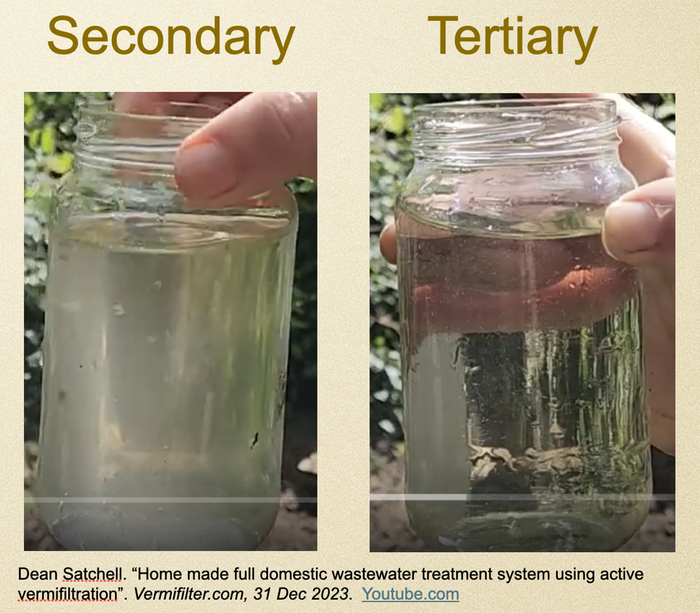
This image is an attempt to show a visual comparison between secondary and tertiary treated wastewater from an operating recirculating vermifilter, pulled from a video here.


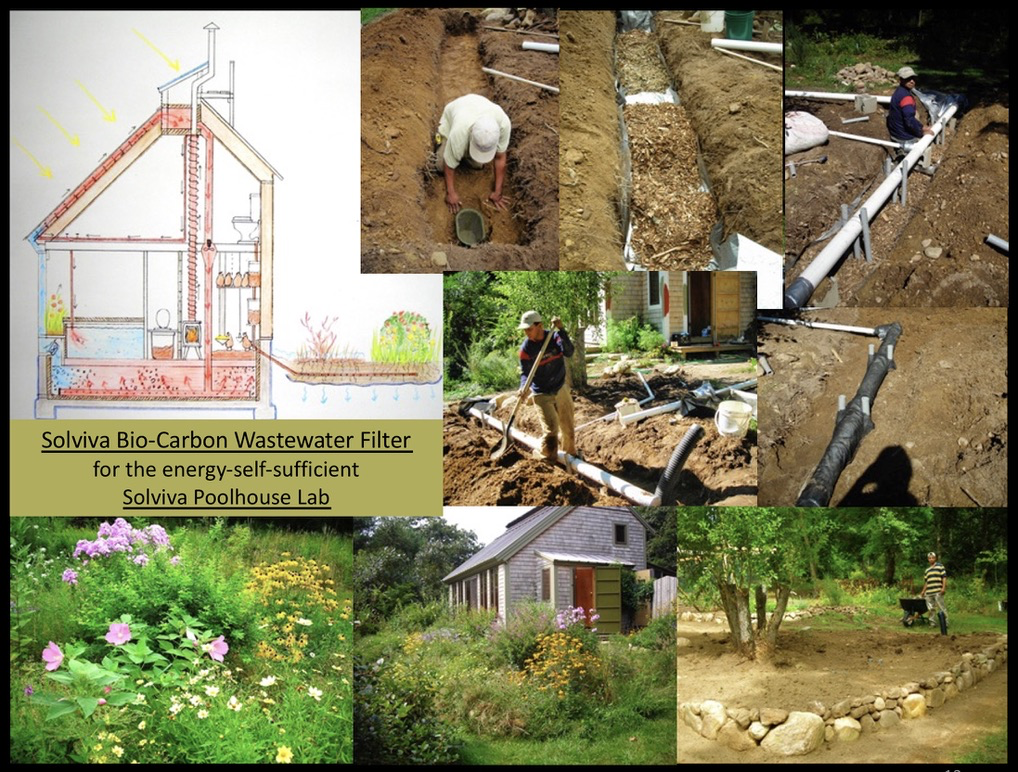
Given that the recirculating aerobic vermifilters are so effective at removing suspended solids and finishing off any composting (BODs) that would form a biological mat, I really don't expect my output to form a mat.  To try to quantify how much the mat from septic tank output might help with evenly spreading the effluent, I read this past week that it can reduce the soil percolation rate by 100x to 1000x.  To compensate and meet the criteria of even distribution along such a long lateral, it may make sense to try something like Anna Edey's Greenfilters.  She lined the bottom and 2-inches up the side of a level trench with plastic, raised the perforated pipe up on cinder blocks, filled around it with mulch, and planted thirsty plants and bushes right next to it.  She claimed it worked for at least 18years (before she moved).  Here's one of the pictures from her website:
 
I agree. Here's the link: http://stoves2.com
reply
    Bookmark Topic Watch Topic
  • New Topic